Recovery Collection: Türkiye: Izmit earthquake 1999
Introduction
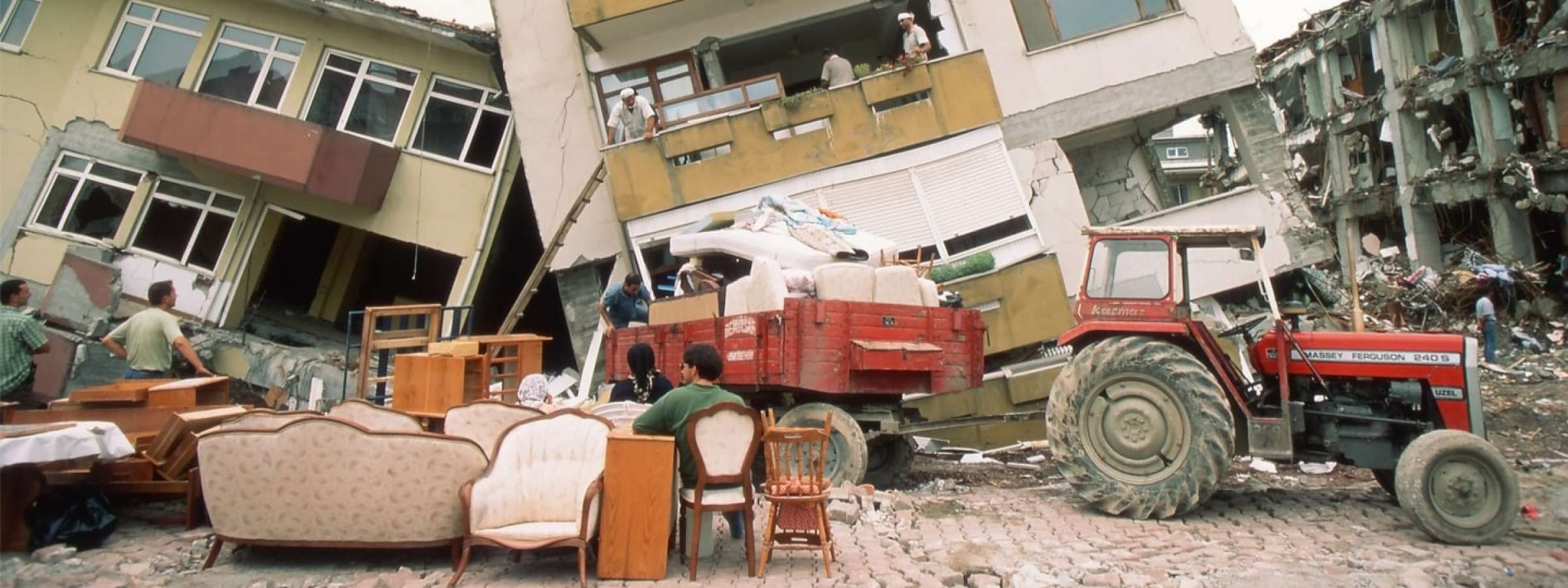
The Izmit Earthquake, also called Kocaeli Earthquake or Golcuk Earthquake, occurred on 17 August 1999. The magnitude 7.4 earthquake, which lasted less than a minute, struck the Anatolian fault system with the epicentre at about 7 miles southeast of Izmit. It was the most damaging earthquake in Türkiye, causing the death of 17,000 people and leaving more than 250,000 people homeless. It was followed by the magnitude 7.2 Duzce Earthquake on 12 November 1999, which also occurred on the North Anatolian Fault and caused at least 845 deaths in Duzce and surrounding areas.
The Izmit earthquake happened in the industrialized and most densely populated urban areas of Istanbul, Sakarya, Golcuk, Darica, and Derince. Reports show that about 120,000 houses were severely damaged due to poor construction. Many bridges and other infrastructure were also damaged. From an economic perspective, the damage was estimated at 23 billion US dollars. In the industrial areas, the earthquake caused a serious fire, which was taken control only after five days. The Izmit Earthquake demonstrated gaps in the capacities of disaster response agencies. A massive international response assisted the wounded and homeless and the overall search and rescue process.
The reconstruction programs included the Turkish government's Earthquake Reconstruction Program and World Bank Comprehensive Framework Program. An important lesson learned following the earthquake was the importance of risk mitigation and preparedness. To achieve this, new building codes were introduced, and related legislation were amended. As rapid and unplanned urbanization was also identified as a risk factor, the "Planned Urbanization and Housing Production Mobilization" strategy was introduced, a compulsory earthquake insurance system implemented, and strengthening of critical public infrastructure, including schools, hospitals, pipes and lifelines, was undertaken. There was an increase in disaster awareness of the public and private sectors and a recognition of the important role of civil society. The gaps in health and medical services were also addressed through psychosocial support programs in response to the needs of disaster survivors experiencing trauma.