PreventionWeb
Navigation loading…

Australian Journal of Emergency Management (AIDR)

AJEM

Mission

A quarterly journal of analysis, considered views, lessons learned and insights into current and future issues from researchers and practitioners at all levels of emergency management.

Show more
Latest additions
Items: 3
Documents and publications
5 November 2020
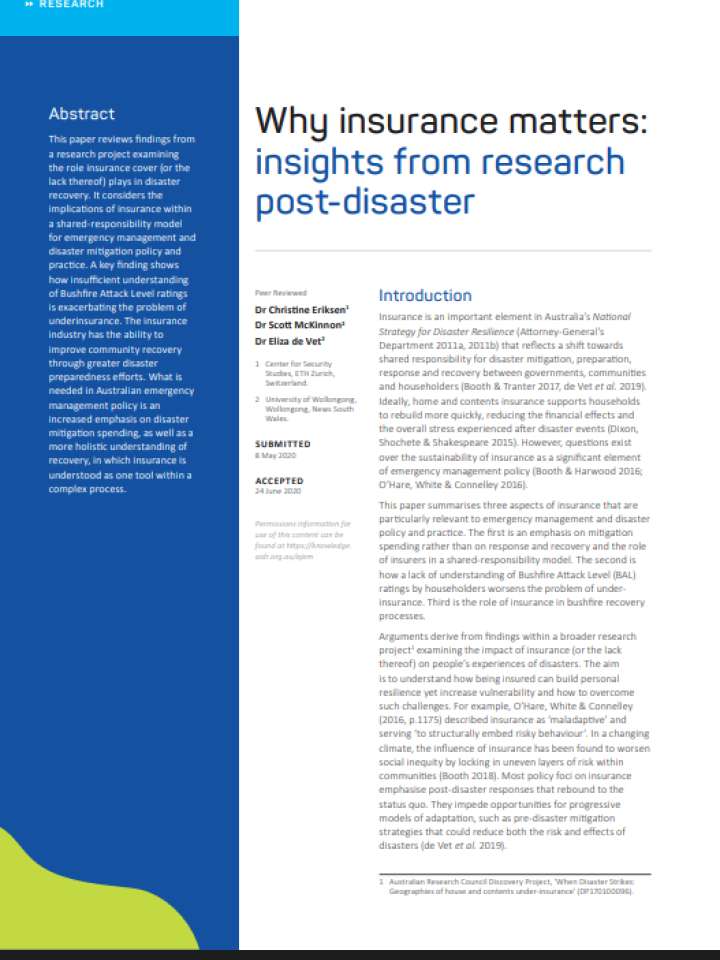
Why insurance matters: Insights from research post-disaster

This paper reviews findings from a research project examining the role insurance cover (or the lack thereof) plays in disaster recovery. It considers the implications of insurance within a shared-responsibility model for emergency management and disaster

Australian Journal of Emergency Management (AIDR)
This paper reviews findings from a research project examining the role insurance cover (or the lack thereof) plays in disaster recovery.
Documents and publications
6 August 2020
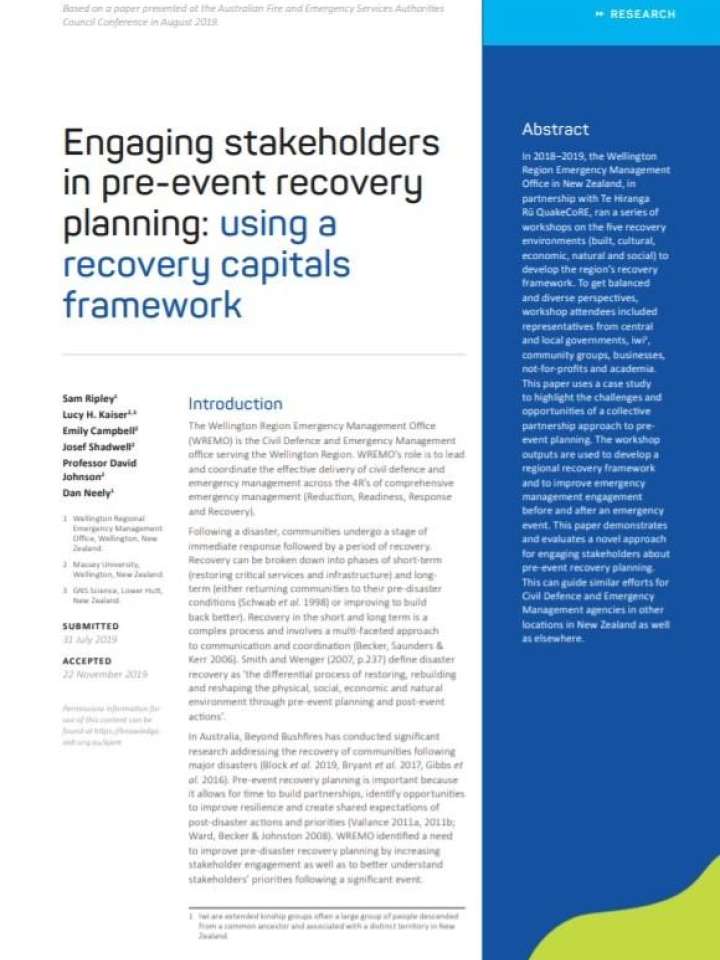
Engaging stakeholders in pre-event recovery planning: Using a recovery capitals framework

In 2018–2019, the Wellington Region Emergency Management Office in New Zealand, in partnership with Te Hiranga Rū QuakeCoRE, ran a series of workshops on the five recovery environments (built, cultural, economic, natural and social) to develop the region’s recovery framework. To get balanced and diverse perspectives, workshop attendees included representatives from central and local governments, iwi1 , community groups, businesses, not-for-profits and academia. This paper uses a case study to highlight the challenges and opportunities of a collective partnership approach to preevent planning. The workshop outputs are used to develop a regional recovery framework and to improve emergency management engagement before and after an emergency event. This paper demonstrates and evaluates a novel approach for engaging stakeholders about pre-event recovery planning. This can guide similar efforts for Civil Defence and Emergency Management agencies in other locations in New Zealand as well as elsewhere.
Australian Journal of Emergency Management (AIDR)
In 2018–2019, the Wellington Region Emergency Management Office in New Zealand, in partnership with Te Hiranga Rū QuakeCoRE, ran a series of workshops on the five recovery environments (built, cultural, economic, natural and social) to develop the region’s recovery framework. To get balanced and diverse perspectives, workshop attendees included representatives from central and local governments, iwi1 , community groups, businesses, not-for-profits and academia. This paper uses a case study to highlight the challenges and opportunities of a collective partnership approach to preevent planning. The workshop outputs are used to develop a regional recovery framework and to improve emergency management engagement before and after an emergency event. This paper demonstrates and evaluates a novel approach for engaging stakeholders about pre-event recovery planning. This can guide similar efforts for Civil Defence and Emergency Management agencies in other locations in New Zealand as well as elsewhere.
Documents and publications
6 August 2020
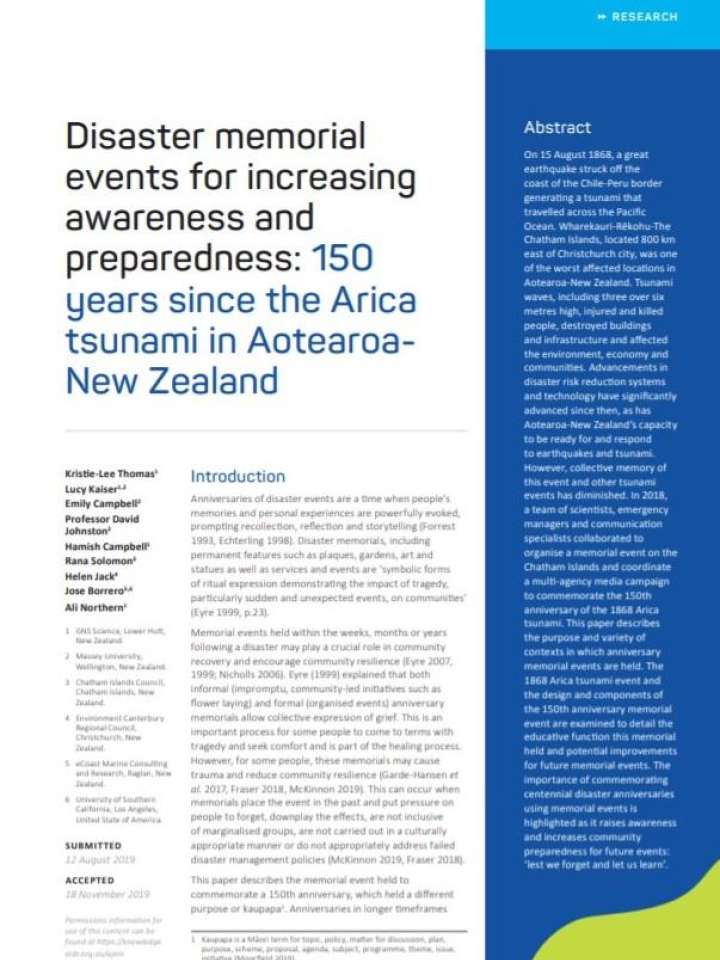
Disaster memorial events for increasing awareness and preparedness: 150 years since the Arica tsunami in Aotearoa-New Zealand

On 15 August 1868, a great earthquake struck off the coast of the Chile-Peru border generating a tsunami that travelled across the Pacific Ocean. Wharekauri-Rēkohu-The Chatham Islands, located 800 km east of Christchurch city, was one of the worst

Australian Journal of Emergency Management (AIDR)
On 15 August 1868, a great earthquake struck off the coast of the Chile-Peru border generating a tsunami that travelled across the Pacific Ocean.

More content for this organization may be available on PreventionWeb or on the site search.

Voluntary Commitments

The organization has no registered commitments.

The Sendai Framework Voluntary Commitments (SFVC) online platform allows stakeholders to inform the public about their work on DRR. The SFVC online platform is a useful toolto know who is doing what and where for the implementation of the Sendai Framework, which could foster potential collaboration among stakeholders. All stakeholders (private sector, civil society organizations, academia, media, local governments, etc.) working on DRR can submit their commitments and report on their progress and deliverables.

Contact information

https://knowledge.aidr.org.au/collections/australian-journal-of-emergency-manag…
+62 21 6542983
Fax:
+62 21 6542983

Is this page useful?

Yes No
Report an issue on this page

Thank you. If you have 2 minutes, we would benefit from additional feedback (link opens in a new window).

The International Recovery Platform (IRP) is a global partnership working to strengthen knowledge, and share experiences and lessons on building back better in recovery, rehabilitation, and reconstruction.

Latest IRP videos and photos: YouTube Flickr Contact IRP

Loading