PreventionWeb
Menu

Elsevier

Netherlands, the
Private Sector

Mission

Elsevier's operations are organized in two divisions: Science & Technology and Health Sciences. These products and services include electronic and print versions of journals, monographs, textbooks and reference works and cover the health, life, physical and social sciences. Elsevier is a Reed Elsevier company.
Show more
Latest additions
Items: 19
Publication
Published on
30 March 2025
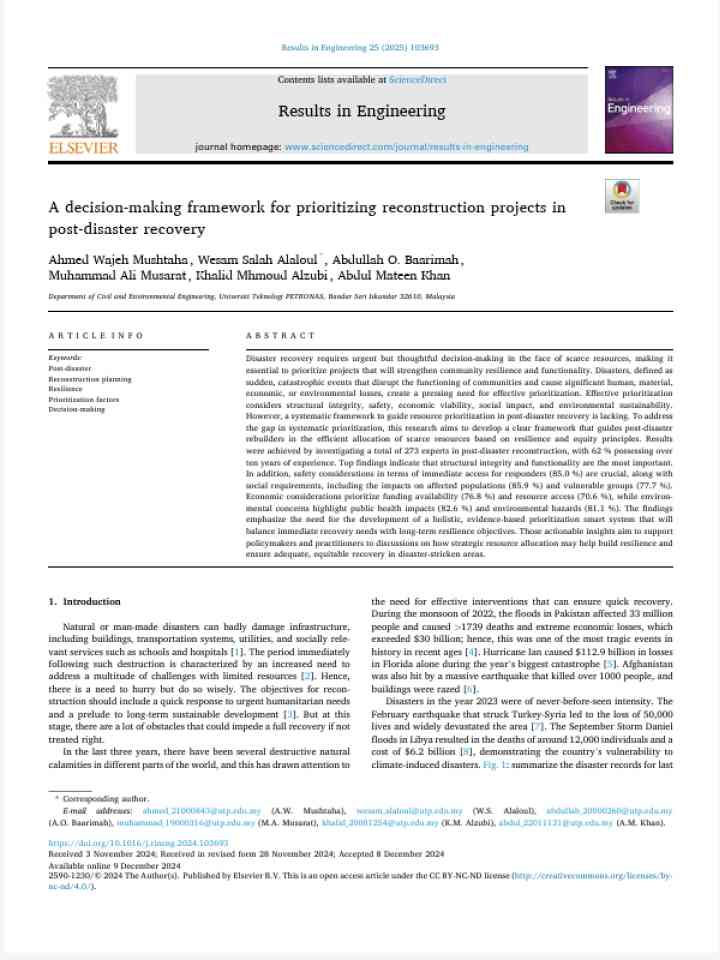
A decision-making framework for prioritizing reconstruction projects in post-disaster recovery
This research aims to develop a clear framework that guides post-disaster rebuilders in the efficient allocation of scarce resources based on resilience and equity principles.
Publication
Published on
28 February 2025
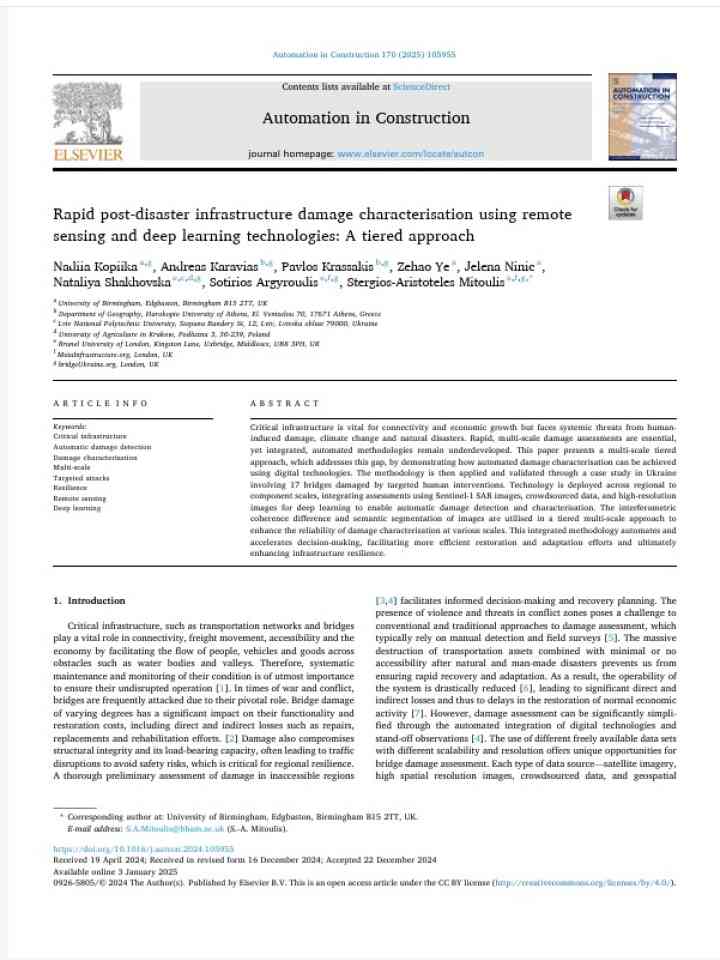
Rapid post-disaster infrastructure damage characterisation using remote sensing and deep learning technologies: A tiered approach
This paper presents a multi-scale tiered approach to post-disaster infrastructure characterisation, demonstrating how automated damage characterisation can be achieved using digital technologies.
Publication
Published on
21 January 2020
Recovery curves for housing reconstruction from the 2011 Great East Japan Earthquake and comparison with other post-disaster recovery processes
The Great East Japan Earthquake and Tsunami catastrophically struck the eastern part of Japan on March 11, 2011.
Publication
Published on
10 January 2020
Transition of post-disaster housing of rural households: A case study of the 2015 Gorkha earthquake in Nepal
The aim of this paper is (1) to explain the transition of the residential status (i.e., type of places or houses in which affected households stay) after the disaster event and (2) to reveal the factors affecting the housing decisions.
Publication
Published on
24 September 2019
Effective combinations of information content and channels for the post-disaster reconstruction of rural housing: A case study of the 2015 Gorkha Nepal Earthquake
This study aimed to statistically examine how the content and channels influence the activities of households in developing country rural communities to recover from disasters.
Publication
Published on
9 May 2019
Command-and-control, emergency powers, and the failure to observe United Nations disaster management principles following the 2009 L'Aquila earthquake
Using the disaster risk reduction paradigm and United Nations principles for post-disaster interventions, this report analyses the actions of the Italian civil protection agency following the April 2009 earthquake in L'Aquila (Abruzzo, Italy), esp
Publication
Published on
29 January 2019
Microinsurance for disaster recovery: business venture or humanitarian intervention? An analysis of potential success and failure factors of microinsurance case studies
This is case studies about the microinsurance for disaster recovery, including business venture or humanitarian intervention, and an analysis of potential success and failure factors.
Publication
Published on
21 December 2018
When the earth doesn’t stop shaking: How experiences over time influenced information needs, communication, and interpretation of aftershock information during the Canterbury Earthquake Sequence, New Zealand
This research aimed to improve understanding of aftershock information needs for agencies and the public, and how people interpreted and responded to such information.

Pagination

  • Previous page ‹ Previous
  • Current page 1
  • Page 2
  • Page 3
  • Next page Next ›

More content for this organization may be available on PreventionWeb or on the site search.

Voluntary Commitments

The organization has no registered commitments.

The Sendai Framework Voluntary Commitments (SFVC) online platform allows stakeholders to inform the public about their work on DRR. The SFVC online platform is a useful toolto know who is doing what and where for the implementation of the Sendai Framework, which could foster potential collaboration among stakeholders. All stakeholders (private sector, civil society organizations, academia, media, local governments, etc.) working on DRR can submit their commitments and report on their progress and deliverables.

Contact information

http://www.elsevier.com/
+31 204853911
Fax:
+31 204852457

Is this page useful?

Yes No
Report an issue on this page

Thank you. If you have 2 minutes, we would benefit from additional feedback (link opens in a new window).

The International Recovery Platform (IRP) is a global partnership working to strengthen knowledge, and share experiences and lessons on building back better in recovery, rehabilitation, and reconstruction.

Latest IRP videos and photos: YouTube Flickr Contact IRP

Loading