Mission
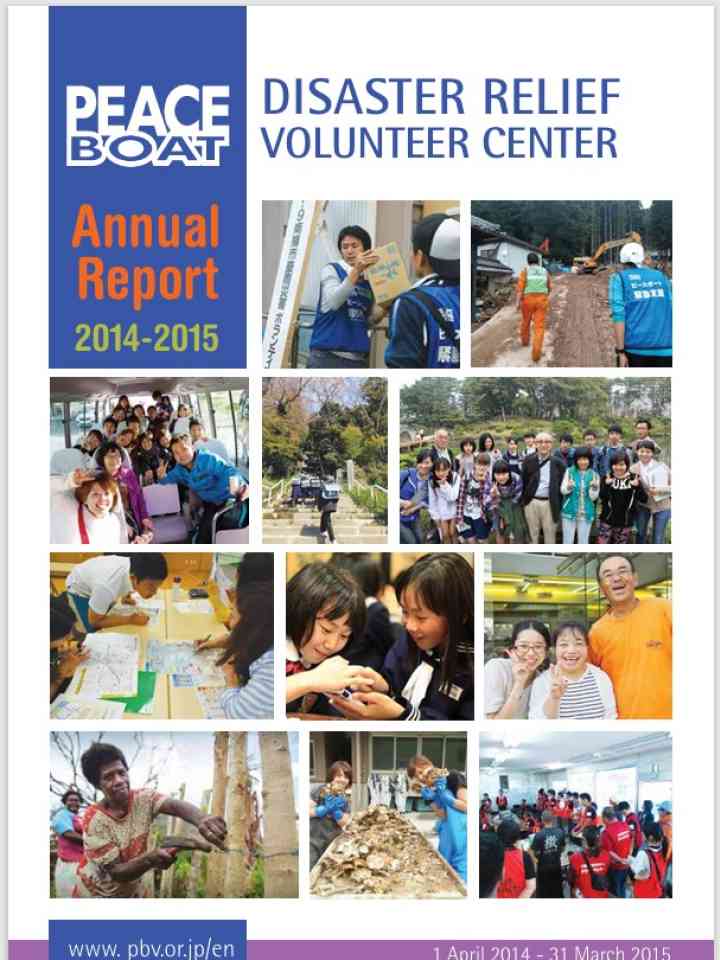
Peace Boat began its disaster relief work following the Kobe earthquake of 1995, and since then has provided disaster relief support in Japan and around the world. Following the Great East Japan Earthquake and Tsunami of 2011, Peace Boat established the Peace Boat Disaster Relief Volunteer Center (PBV) to focus on emergency relief and DRR, specializing in the training and coordination of volunteers.
Peace Boat is a Japan-based international non-governmental and non-profit organization that works to promote peace, human rights, equal and sustainable development, and respect for the environment.
Peace Boat seeks to create awareness and action based on effecting positive social and political change in the world. Peace Boat pursues this through the organization of global educational programmes, responsible travel, cooperative projects and advocacy activities. These activities are carried out on a partnership basis with other civil society organizations and communities in Japan, Northeast Asia, and around the world.
Peace Boat carries out its main activities through a chartered passenger ship that travels the world on peace voyages. The ship creates a neutral, mobile space and enables people to engage across borders in dialogue and mutual cooperation at sea, and in the ports that Peace Boat visits. Activities based in Japan and Northeast Asia are carried out from Peace Boat's seven Peace Centers in Japan.
- 1. Strengthen the capability and capacity of community and volunteer organisations through improving the management and coordination of volunteers
- 2. Strengthen the strategic role of the community and volunteers in all phases of DRR
- 3. Building disaster resilient communities – Communities cannot be resilient in isolation
PEACE BOAT “ACTION POINTS”
- 1. Work towards developing “How to make YOUR community more resilient – a handbook for community members” inspired by the UN “How to make cities more resilient - A handbook for local government leaders”
- 2. Develop and implement a training programme for community members and volunteers that gives them the skills to strategically manage and coordinate their communities and design their own Disaster Risk Reduction Plan (DRRP) and Disaster Response Plan (DRP)
- 3. Bring community and volunteer groups together to facilitate better understanding and cooperation in DRR, through networking, exchange programmes, conferences etc.
- 4. Build a resource pool to enable a quick pre-planned response in time of need
Peace Boat Disaster Relief Center
http://www.peaceboat.jp/relief/ (English)
http://www.pbv.or.jp (Japanese)
Peace Boat
http://www.peaceboat.org/english/ (English
http://www.peaceboat.org/index_j.shtml (Japanese)
Peace Boat is promoting the strategic management and coordination of the volunteer sector through active participation in committees and networks that seek to strengthen the inclusion and participation of the whole community in all phases of DRR.
Through our awareness and training programmes, Peace Boat is encouraging community members to understand the vulnerabilities of the areas they live and how to act upon warnings and safely assist others in their community.
Peace Boat has a systematic training programme in management, leadership skills and DRR for community members and volunteers.
It also holds events and engages the media to increase awareness of the the DRR issues that face the community.
Peace Boat is encouraging community members to understand the vulnerabilities of the structures they live and work in and to take steps to strengthen those structures against the disaster risks.
Peace Boat educates community members on the importance to prepare for disaster and the actions to be taken in case a disaster occurs.
Peace Boat's Disaster Relief Volunteer Center excels at the dispatch and coordination of volunteers in times of disasters. It works closely with those affected and volunteers to ensure a quick, safe and effective response.
Provide a platform for both national and international awareness-raising, with a view to generating solidarity and understanding for the survivors of the nuclear disaster that followed the Great East Japan Earthquake and Tsunami of 2011 and keeping their plight in the public eye. Such a goal will not only benefit the Fukushima survivors, but will also increase national and global awareness of the effects of nuclear disaster, both on people and the environment.
Peace Boat's global voyages visit over 120 ports and is implementing a programme to raise awareness and gain participation of the port cities in the 'Making Cities Resilient campaign'.
Through promoting the 'Mayors for Peace' initiative, Peace Boat has an extensive network to draw on.
Voluntary Commitments
The Sendai Framework Voluntary Commitments (SFVC) online platform allows stakeholders to inform the public about their work on DRR. The SFVC online platform is a useful toolto know who is doing what and where for the implementation of the Sendai Framework, which could foster potential collaboration among stakeholders. All stakeholders (private sector, civil society organizations, academia, media, local governments, etc.) working on DRR can submit their commitments and report on their progress and deliverables.