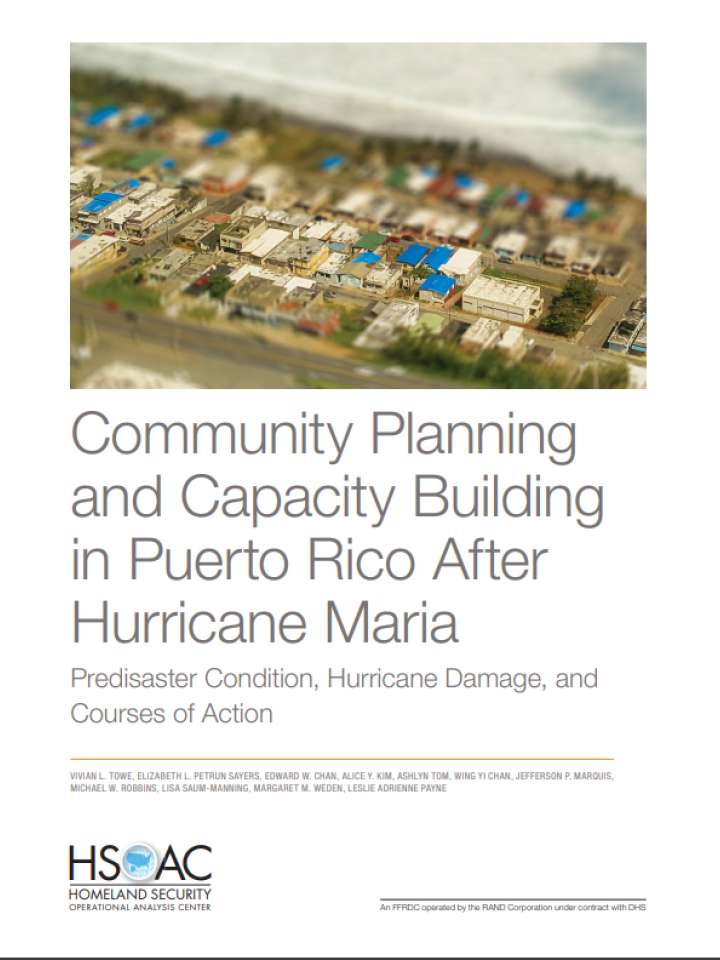
Community planning and capacity building in Puerto Rico after hurricane Maria : Predisaster conditions, hurricane damage, and courses of action
The authors describe the status of Puerto Rico's communities in terms of population characteristics and dynamics, community and individual preparedness, and economic pressures leading up to the landfalls of the hurricanes. They also report on the impact that the hurricanes had on Puerto Rico's communities in terms of damage, community stress, and migration away from the island. These analyses and discussions informed the development of 15 courses of action (COAs) aimed at improving Puerto Rico's capacity for emergency preparedness, coordination, communication, recovery planning, and research and training, to meet the needs of Puerto Rico and its vulnerable communities during a disaster.
Key Findings
Several preexisting social and economic issues subsequently affected timely recovery and response and created conditions where residents were especially vulnerable to the hurricane's impact
- Puerto Rico's residents described a varied level of preparedness among themselves and other community members as Hurricane Maria approached.
- Many preexisting community-level stressors affected Puerto Rico's response and recovery efforts, including foundational issues and sources of chronic stress.
- Among the foundational issues, current and former residents reported (1) poor infrastructure, (2) a fragile economy, (3) poor governance/government corruption, (4) inequality, and (5) lacking a sense of community.
- Chronic stressors—including (1) the lack of an emergency preparedness/response system, (2) misinformation, and (3) outmigration to the continental United States—were related to the aforementioned foundational issues and likely to have also affected preparedness at the individual level.
The pattern of damage from the disaster substantially overlaps the distribution of social vulnerability, as opposed to the path of the hurricane
- The most socioeconomically disadvantaged municipalities sustained the most damage, while the municipalities with the most socioeconomic advantage experienced the least damage.
- Six months after Hurricane Maria's landfall, most residents interviewed in Puerto Rico were still focused on near-term survival.
- Puerto Rico residents saw government as most important in response and recovery efforts, but their comments were more favorably disposed toward nongovernmental organization (NGO) and local community-based activities.
- Most Puerto Ricans relied on faith-based organizations, NGOs, community, family, and individuals (including community leaders) for information on posthurricane news.
- Residents shared an overwhelming amount of distrust for local and federal government agencies.
Recommendations
- Build a disaster-related data analysis and decision support capability to support disaster preparedness and hazard-mitigation activities.
- Focus on community-level capacity building for preparedness and response.
- Enhance Puerto Rico's hazard-mitigation assessment, monitoring, and evaluation enterprise.
- Hire planners to develop and implement disaster resilience plans in collaboration with 50–100 selected communities.
- Establish a Center of Excellence for Disaster Preparedness and Recovery at a university in Puerto Rico.
- Build a Public Information and Communication capability to facilitate the continued engagement of Puerto Rican communities in the recovery process.
- Conduct an assessment and develop a shelter plan that includes a comprehensive and strategic approach to sheltering across Puerto Rico.
- Establish a Municipal Emergency Management Office in municipalities where one does not exist.
- Establish a process by which municipalities severely affected by the hurricanes develop their respective recovery and reconstruction plans in a coordinated way.
- Fund a design competition that fosters innovative solutions for risk reduction.
- Ensure coordination and development across sectors, and work to ensure that major infrastructure projects are implemented in a thoughtful manner.
- Conduct a study to reevaluate the current state of Puerto Rico's grant management processes and workforce.
- Organize a three-day conference in Puerto Rico that convenes chief acquisition officers, contract officers, and other procurement experts involved in rebuilding after the hurricanes.
- Establish a set of 100 scholarships annually, for five years, to train municipal government workers and local NGO staff in grant writing.
- Strengthen local nonprofit and NGO involvement in disaster recovery to maximize their contributions as recovery partners.
Explore further