PreventionWeb
Menu
Publications
Author(s) Gaurav Chachra Qingkai Kong Jim Huang et al.

Detecting damaged buildings using real-time crowdsourced images and transfer learning

Source
Nature Scientific Reports

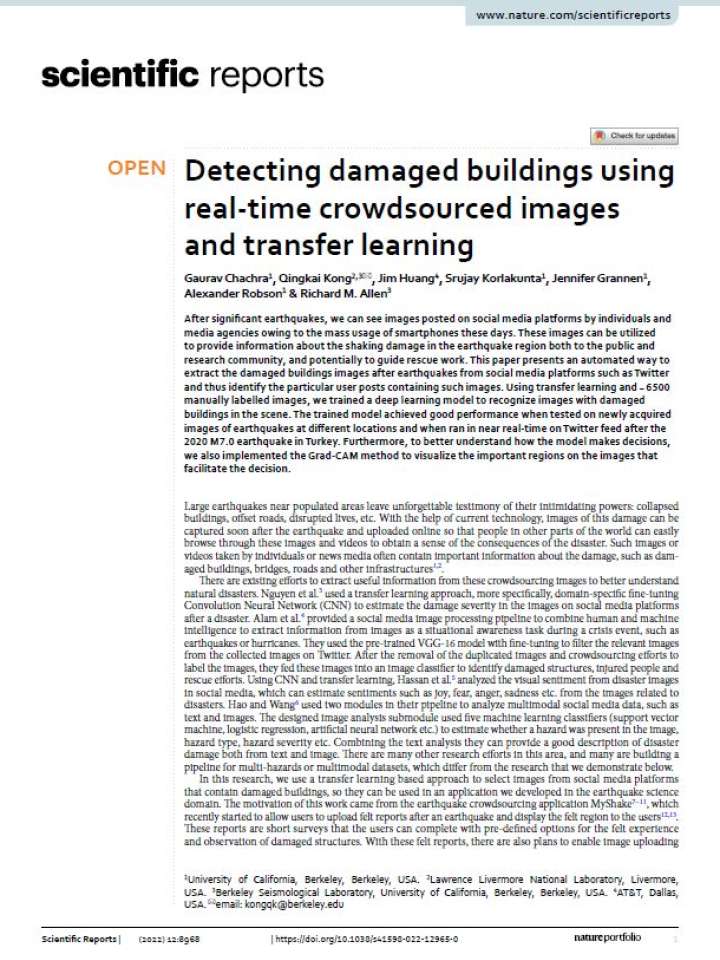
This paper presents an automated way to extract the damaged buildings images after earthquakes from social media platforms such as Twitter and thus identify the particular user posts containing such images. After significant earthquakes, we can see images posted on social media platforms by individuals and media agencies owing to the mass usage of smartphones these days. These images can be utilized to provide information about the shaking damage in the earthquake region both to the public and research community, and potentially to guide rescue work.

Using transfer learning and ~ 6500 manually labelled images, we trained a deep learning model to recognize images with damaged buildings in the scene. The trained model achieved good performance when tested on newly acquired images of earthquakes at different locations and when ran in near real-time on Twitter feed after the 2020 M7.0 earthquake in Turkey. Furthermore, to better understand how the model makes decisions, the authors also implemented the Grad-CAM method to visualize the important regions on the images that facilitate the decision.

Download

Access Detecting damaged buildings using real-time crowdsourced images and transfer learning
Download a backup copy hosted by this site PDF, 4.2 MB English

We keep a copy of many documents to improve long-term access. Use this if the publisher’s site is slow or unavailable. Problems? Contact us.

Last checked: 30 May 2022

Editors' recommendations

  • The use of social media in natural hazard early warning systems
  • Community resilience in the age of social media: a literature review
  • How to use social media to better engage people affected by crises: a brief guide for those using social media in humanitarian organizations
  • Comparative review of social media analysis tools for preparedness

Explore further

Hazards Earthquake
Themes Disaster risk communication Recovery Science-policy-practice interface
Country and region Türkiye
Cover
ISBN/ISSN/DOI
10.1038/s41598-022-12965-0 (DOI)
Number of pages
12 p.
Publication year
2022

Also featured on

PreventionWeb

Is this page useful?

Yes No
Report an issue on this page

Thank you. If you have 2 minutes, we would benefit from additional feedback (link opens in a new window).

The International Recovery Platform (IRP) is a global partnership working to strengthen knowledge, and share experiences and lessons on building back better in recovery, rehabilitation, and reconstruction.

Latest IRP videos and photos: YouTube Flickr Contact IRP

Loading