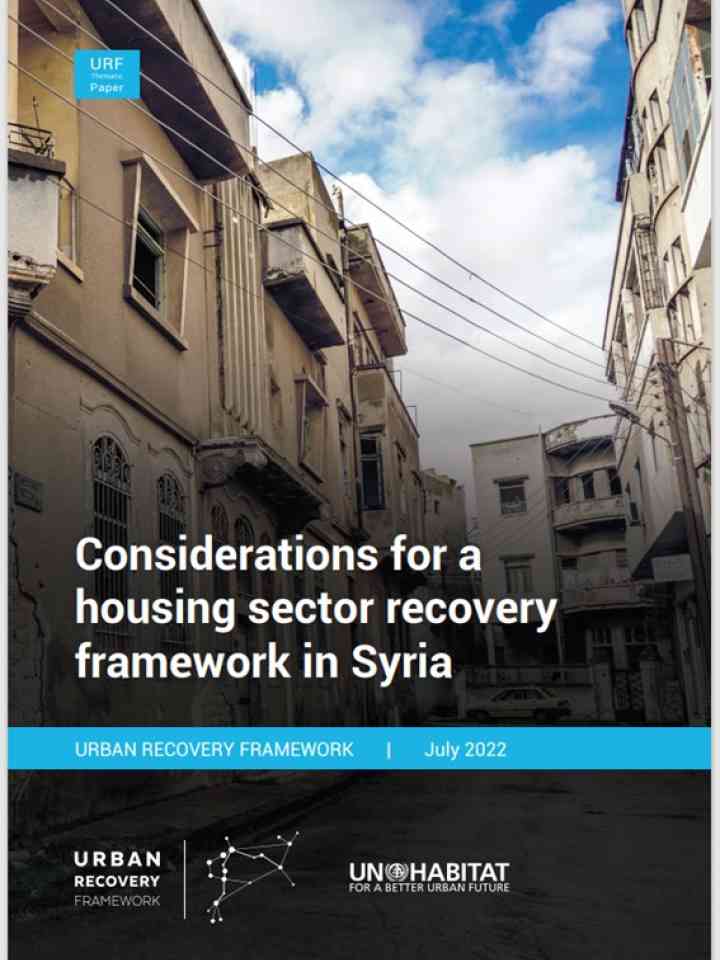
Considerations for a housing sector recovery framework in Syria-Urban recovery Framework
Now in its eleventh year, the crisis in Syria, which has displaced over 13.4 million people, has had a significant impact on the country’s population, economy, infrastructure, services, and social fabric. Housing and infrastructure damage resulting from the conflict has severely affected Syria’s housing stock and economy. An estimated 328,000 dwellings have either been destroyed or severely damaged due to the conflict and are unable to be reoccupied. A further 600,000 – 1 million dwellings were moderately or lightly damaged.
The paper is part of a series of policy papers developed as part of the Urban Recovery Framework (URF), which explores conditions and recovery options for Syria. It contributes with analysis of the housing sector and presents options to pursue housing sector recovery through area-based approaches that focus on accountable local public service delivery. As such, it seeks to explore one of the seven URF pillars.
UN Habitat and other UN agencies and partners are currently providing support to the restoration of housing and basic services to urban areas in Syria, within the URF and wider Shelter and Early Recovery efforts. Efforts to date have involved the preparation of urban recovery plans that include programming to assist in the rehabilitation of housing, related to the potential or actual return of internally displaced persons (IDPs) and refugees to locations impacted by the conflict.
While a National Housing Strategy has been under development by the Government of Syria since 2020, and while there is a gradually widening scope for integrated housing recovery interventions within the humanitarian architecture, significant gaps remain, both in terms of scale and scope, for the development of an effective housing sector recovery framework in Syria.
Explore further