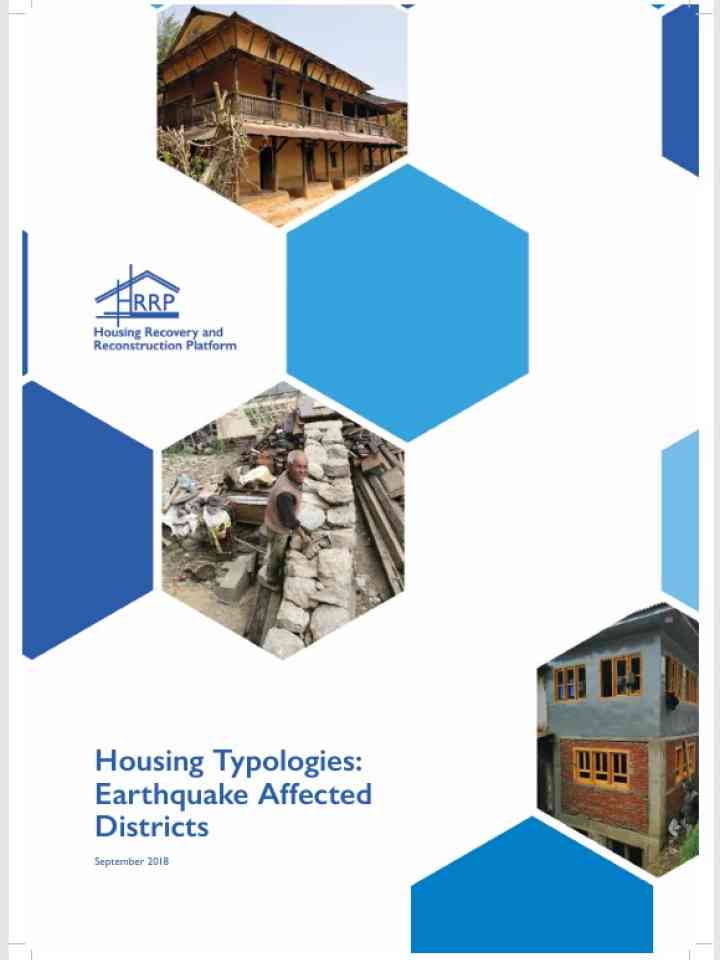
Housing Typologies: Earthquake Affected Districts
This document provides examples of the wide range of housing types being constructed across the 32 districts affected by the April 2015 Gorkha earthquake.
There are 13 main typologies that the examples collected from the districts can be grouped under:
- Stone and Cement Mortar Masonry (SCM)
- Stone and Mud Mortar Masonry (SMM)
- Brick and Cement Mortar Masonry (BCM)
- Brick and Mud Mortar Masonry (BMM)
- Reinforced Cement Concrete Framed Building (RCC)
- Hybrid Structures
- Timber Frame Structures
- Hollow Concrete Block and Cement Mortar Masonry (HCB)
- Dry Stone Masonry (DSM)
- Adobe Structures
- ]Bamboo Structures
- Compressed Stabilised Earth Block (CSEB) Masonry
- Light Steel Frame Structures
The beginning of each of the sections in the document includes a map showing, by district, the percentage of buildings of that typology damaged by the earthquake. This data has been sourced from the Central Bureau of Statistics (CBS) damage assessment, which was carried out to determine eligibility for the government's housing reconstruction or retrofit grants.
Each section also includes a table of 'pros' and 'cons'. These are not intended to provide a value judgement of any particular typology in relation to others, but simply to provide an indication of the positive and negative aspects of the different typologies that households may face during their reconstruction.
Explore further