PreventionWeb
Menu
Author(s) Dewi Rezalini Anwar Gehan Selim

Integrating child-friendly green spaces into post-disaster recovery: Psychological, physical, and educational sustainability impact on children’s well-being

Source
Sustainability (MDPI)

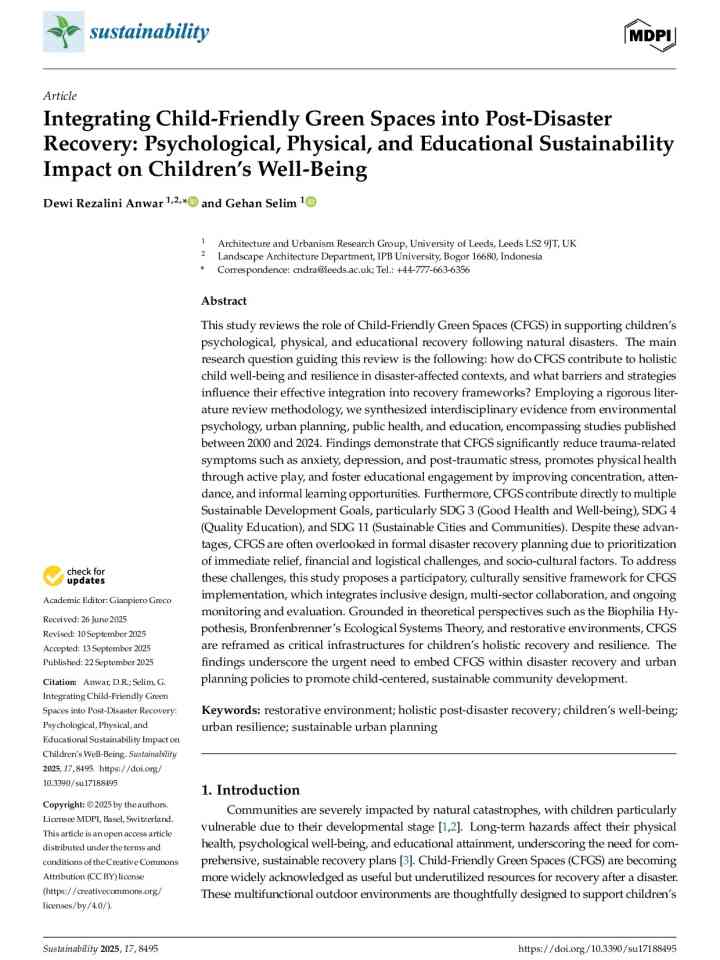
This study investigates the role of Child-Friendly Green Spaces (CFGS) in supporting children's psychological, physical, and educational recovery in the wake of disasters. Moreover, the study analyses the barriers and strategies that influence their efficacy of CFGS integration. The methodology employed is that of a comprehensive literature review, synthesising interdisciplinary evidence from environmental psychology, urban planning, public health, and education, for studies published between 2000 and 2024.

The results show that CFGS significantly reduce trauma-related symptoms such as anxiety, depression, and post-traumatic stress, promotes physical health through active play, and foster educational engagement by improving concentration, attendance, and informal learning opportunities. Despite these advantages, the study finds that CFGS are often overlooked in formal disaster recovery planning. Instead, the prioritization is of immediate relief, financial and logistical challenges, and socio-cultural factors. To address these challenges, this study proposes a participatory, culturally sensitive framework for CFGS implementation, which integrates inclusive design, multi-sector collaboration, and ongoing monitoring and evaluation.

Download

Access Integrating child-friendly green spaces into post-disaster recovery: Psychological, physical, and educational sustainability impact on children’s well-being
Download a backup copy hosted by this site PDF, 2.5 MB English

We keep a copy of many documents to improve long-term access. Use this if the publisher’s site is slow or unavailable. Problems? Contact us.

Last checked: 26 September 2025

Editors' recommendations

  • Investigating the green space accessibility for assembly areas of the urban road in case of disaster: Kastamonu case study
  • Guidelines for climate-resilient, gender-responsive, and socially inclusive public open spaces in Bangladesh
  • Fundamentals for thermal comfort and safety: designing climate-ready playgrounds
  • Inclusive DRR for hyper-marginalised children and youth

Explore further

Themes Children and Youth Health and health facilities Recovery
Integrating child-friendly green spaces into post-disaster recovery: Psychological, physical, and educational sustainability impact on children’s well-being thumbnail
ISBN/ISSN/DOI
10.3390/su17188495 (DOI)
Number of pages
17 p.
Publication year
2025

Also featured on

PreventionWeb

Is this page useful?

Yes No
Report an issue on this page

Thank you. If you have 2 minutes, we would benefit from additional feedback (link opens in a new window).

The International Recovery Platform (IRP) is a global partnership working to strengthen knowledge, and share experiences and lessons on building back better in recovery, rehabilitation, and reconstruction.

Latest IRP videos and photos: YouTube Flickr Contact IRP

Loading