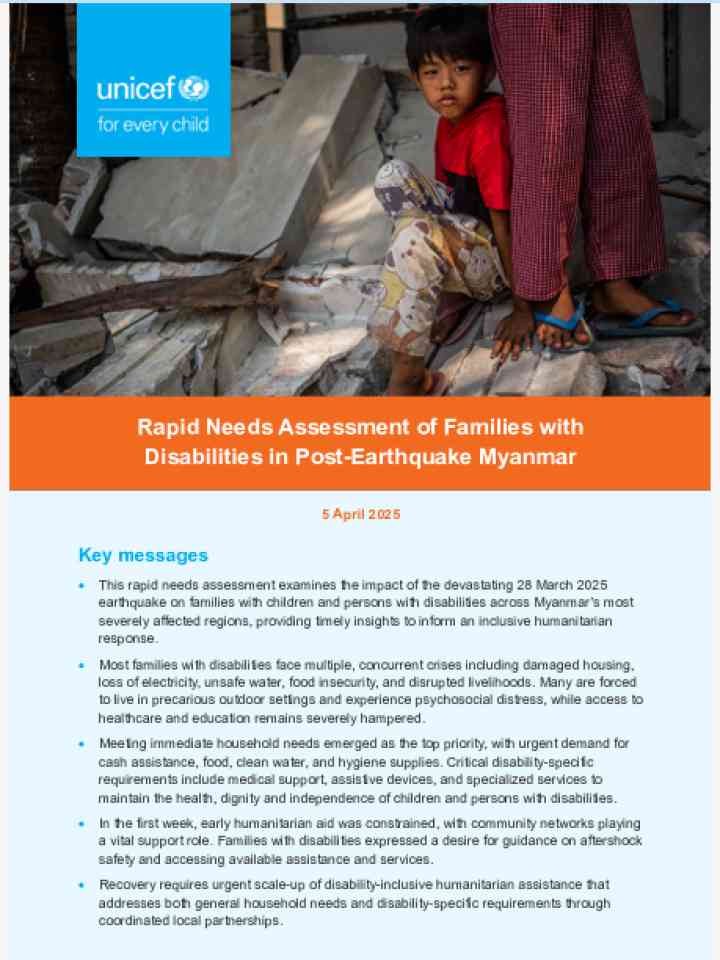
Rapid needs assessment of families with disabilities in post-earthquake myanmar
This report presents key findings from a rapid needs assessment focused on families with disabilities in regions severely affected by the recent earthquakes in Myanmar.
On Friday 28 March 2025, two powerful earthquakes—the first of magnitude 7.7 at 12:50pm local time, followed twelve minutes later by another measuring 6.4—caused widespread devastation. Both earthquakes occurred at a shallow depth of 10 km, centred approximately 16 km northnorth-west of Sagaing city and 19 km north-west of Mandalay, Myanmar’s second-largest city. Strong tremors were felt as far as neighbouring Thailand. According to Myanmar’s Department of Meteorology and Hydrology (DMH), the country experienced 73 aftershocks ranging from magnitudes 2.8 to 7.5 in the following week.
As of 4 April 2025, national reports indicate over 3,000 fatalities, nearly 5,000 injuries, and more than 370 people still missing, with diminishing hopes of finding further survivors. Extensive damage has disrupted critical infrastructure including housing, public buildings, religious sites, schools, roads, bridges, water and electricity networks, and communication towers. The UN Office for the Coordination of Humanitarian Affairs (OCHA) estimates that the earthquakes have impacted approximately 17 million people across 57 townships, with more than 9 million experiencing severe consequences.
Recognising the heightened vulnerability of persons with disabilities during disasters, this rapid needs assessment explicitly targeted households with family members previously screened and registered as having a disability by UNICEF in collaboration with local disability networks across earthquakeaffected townships.
Explore further