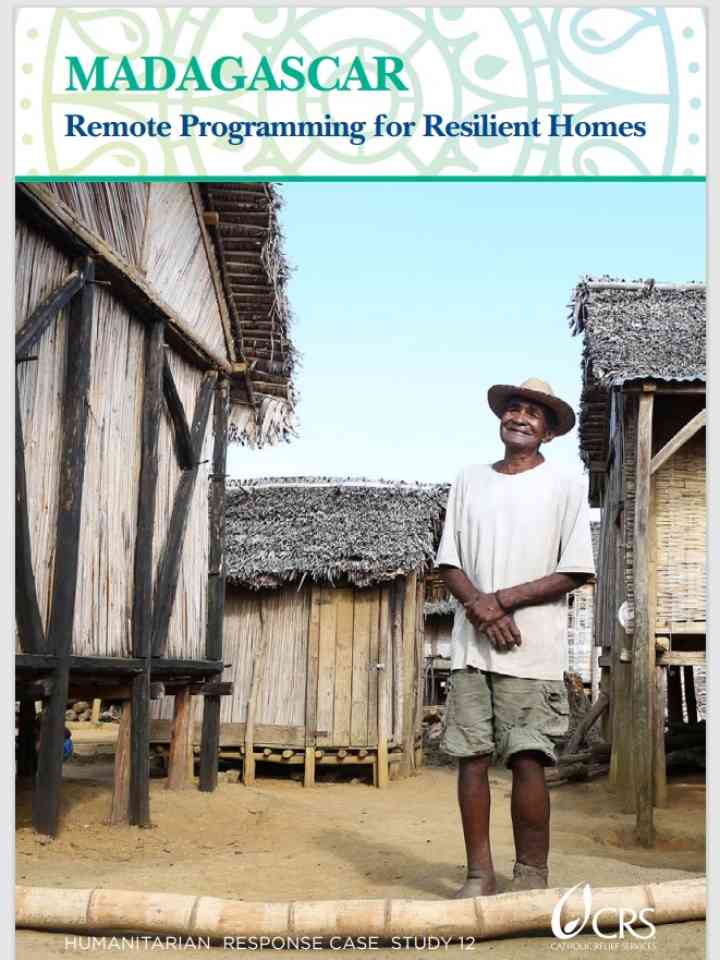
Madagascar Remote Programming for Resilient Homes
On February 2012, Madagascar was hit by two cyclones: The intense Tropical Cyclone Giovanna hit the east coast of the island, and the moderate Tropical Storm Irina hit in the north and southeastern coast. The official death toll from the BNGRC (National Bureau of Disaster and Risk Management), dated March 16, indicates 111 people dead, 299 injured, three missing, 332,204 affected, and 55,060 displaced.
The two cyclones caused significant damage in the areas of housing, agriculture, livelihoods, health and education. Families left their usual place of residence and sought refuge in welfare centers or accommodation with their extended families or neighbors. Less than 15 percent of families were able to rehabilitate their homes one month after the passage of the cyclone. Households headed by women or the elderly or disabled were not able to rehabilitate their homes within the next six months. Local materials necessary for the rehabilitation of homes were hard to come by, expensive and beyond the financial capacity of vulnerable families.
The purpose of the shelter project was to build houses with a strong DRR integration for community-led recovery. All the homes were built with local materials, mainly derived of a local Malagasy plant named "Ravinala" or Travelers Palm. The target program participants were the most vulnerable who had lost their houses after the two storms: the disabled, elderly and pregnant women. The budget covered the construction of 598 houses to be completed with the Food for Work method to pay the artisans.
The success of a project depends on two conditions: the involvement and ownership of the program participants, and an effective quality monitoring and evaluation (M&E) system. This project combined these two conditions. More precisely, the effective participation of program participants and local authorities in M&E can be done at a lower cost and provides a sense of ownership to the participants, which in turn improves sustainability.
Explore further