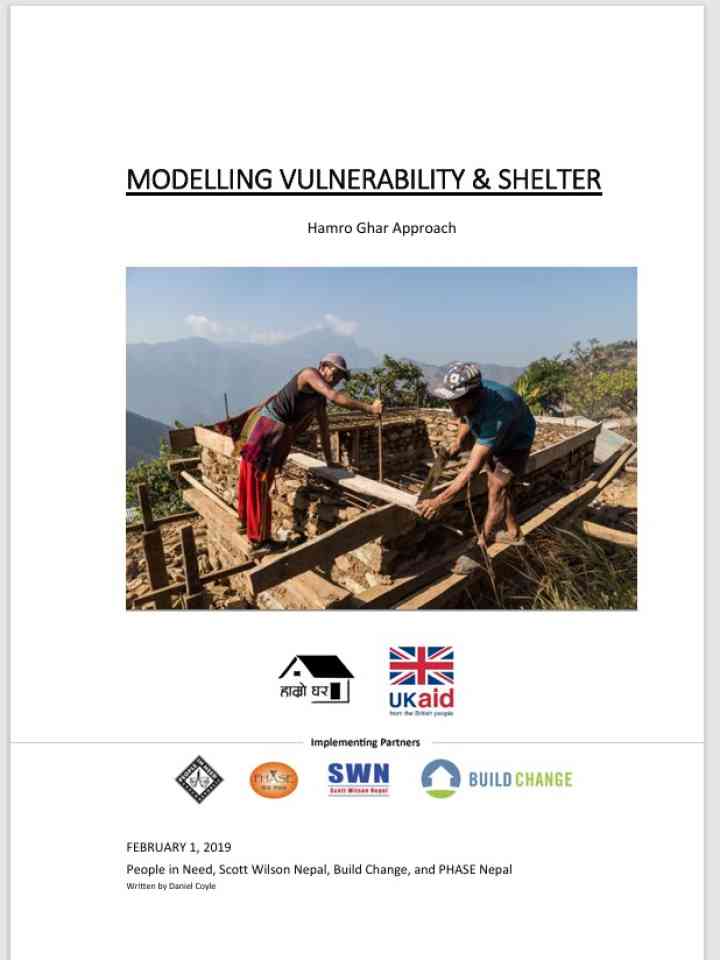
Modelling Vulnerability & Shelter - Hamro Ghar Approach
Just over three years since the Gorkha 2015 Earthquake, the reconstruction of damaged or destroyed homes remains at the centre of earthquake victims' experience and the wider perceptions of the successes and failure of reconstruction. Nepal's context poses many challenges with respect to the design of any large-scale earthquake reconstruction programming. Of particular concern, are the long-term impacts that the earthquake will inevitably leave on those who were and remain the most vulnerable. The work presented here represents the thoughts and approaches of the Hamro Ghar consortium and our attempts to better understand the challenges experienced by vulnerable households. This work hopefully contributes towards the creation of different models and ways of approaching post-earthquake vulnerability based on household socio-economics and sectors, in this case shelter.
This document will present a model for approaching this subject that seeks to create a clear visual picture of the economic reality that households experience in the process of reconstruction. At its heart, the Hamro Ghar model is largely based on the premise that shelter reconstruction essentially poses a very clear economic challenge to affected households. While it was immediately understood on a macroeconomic level that available assistance was not going to be able to address the needs posed by the context, we believed there was also a failure to engage in a household or community level economic approach. In analysing the context and approaching the design of Hamro Ghar, we intentionally examined the household level economic contexts of vulnerable households and communities as opposed to a more technical approach that emphasized maximizing resilience outcomes. Central to our thinking was the question households themselves were repeatedly forced to ask and answer in the years following the earthquake. Namely, what inputs do households need, in terms of either capital or other contributions, to reconstruct their homes and how can these be acquired? Hamro Ghar's vulnerability model is a demonstration of one such approach and how it can be used to profile households' capacities, model communities' vulnerabilities, create design parameters for programming, and select specific interventions that target specific input deficits.
This work is primarily intended as a programming document for practitioners to use and build off of in Nepal and other contexts and should not be understood as a research paper or review of other works and approaches regarding post-earthquake shelter vulnerability. The document will begin with a presentation of Hamro Ghar's analytical model and classification system for different types of post-earthquake shelter vulnerability. After which, the approach to targeting and "indicators of success" and how they were implemented under the program will also be explained. Finally, this document will conclude with a summary of the observations and lessons we feel are captured by our analysis, model, and experience in field.
Explore further