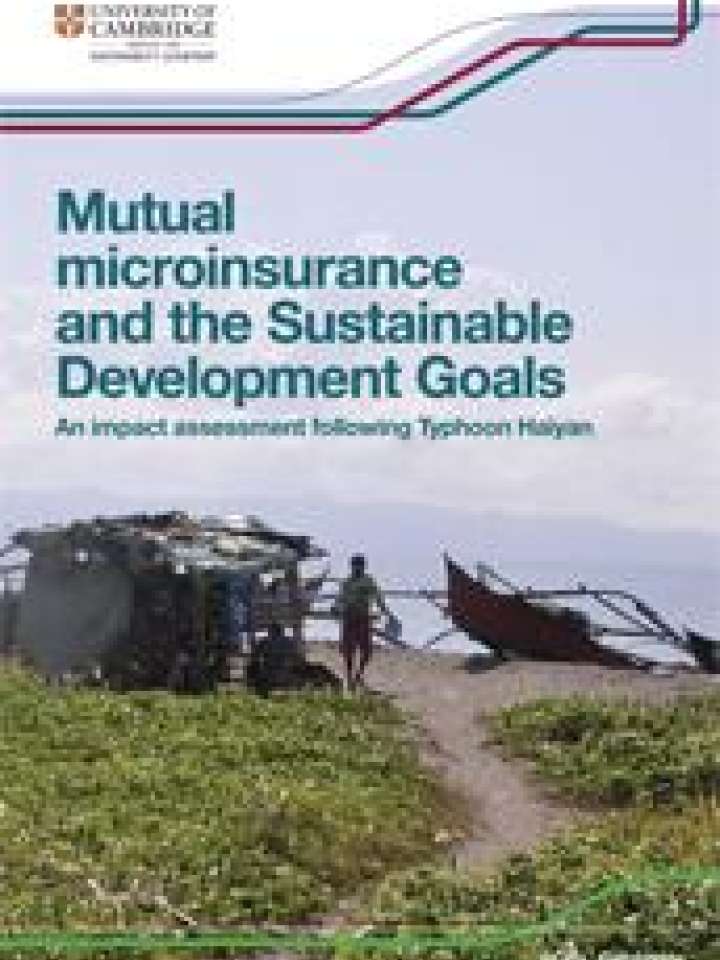
Mutual microinsurance and the Sustainable Development Goals: An impact assessment following Typhoon Haiyan
The Cabridge Institute for Sustainability Leadership (CISL) has collected data from households in the Philippines affected by the devastating 2013 Typhoon Haiyan to assess whether those with mutual microinsurance life cover policies were able to recover more effectively than those without.
The research finds that mutual microinsurance, enabled by adequate regulation, can contribute to the SDGs by increasing the protection and resilience of low-income communities. Key findings include:
- For the first time, operational insurance functions and outcomes have been assigned to the delivery of SDG targets and aligned with possible insurance-related metrics and indicators. The authors document that mutual microinsurance has the potential to contribute to targets within ten of the SDGs by building financially literate, insurable, resilient and empowered communities.
- The success of the business model of the largest microinsurer in the Philippines, the Center for Agriculture and Rural Development Mutual Benefit Association (CARD MBA), is based on three key elements: the interdependence of microfinance and microinsurance, highly developed community networks and the supportive Philippine regulatory environment.
- Following a disaster, mutual microinsurance is likely to be most effective in combination with other financial mechanisms, such as access to credit and emergency aid.
- The impact of mutual microinsurance on recovery after Typhoon Haiyan illustrates the benefits of robust community networks at times of extreme crisis. Established community structures helped with the efficient validation and payment of claims, despite very difficult circumstances, and the distribution of disaster aid packages to members.
This report builds on a study, published by CISL in 2015; Insurance regulation for sustainable development: Protecting human rights against climate risks and natural hazards, which analysed the role of insurance regulation in protecting the basis human rights of life, livelihood and shelter against natural hazards and climate risk.