PreventionWeb
Navigation loading…

Navigation failed to load. If you are on the UNDRR office network, your browser may be blocking access to external resources. Learn how to allow access.

Menu
Case StudyPublications
Author(s) Surendra Sherchan Reuben Samuel Kedar Marahatta Nazneen Anwar Mark Humphrey Van Ommeren Roderico Ofrin

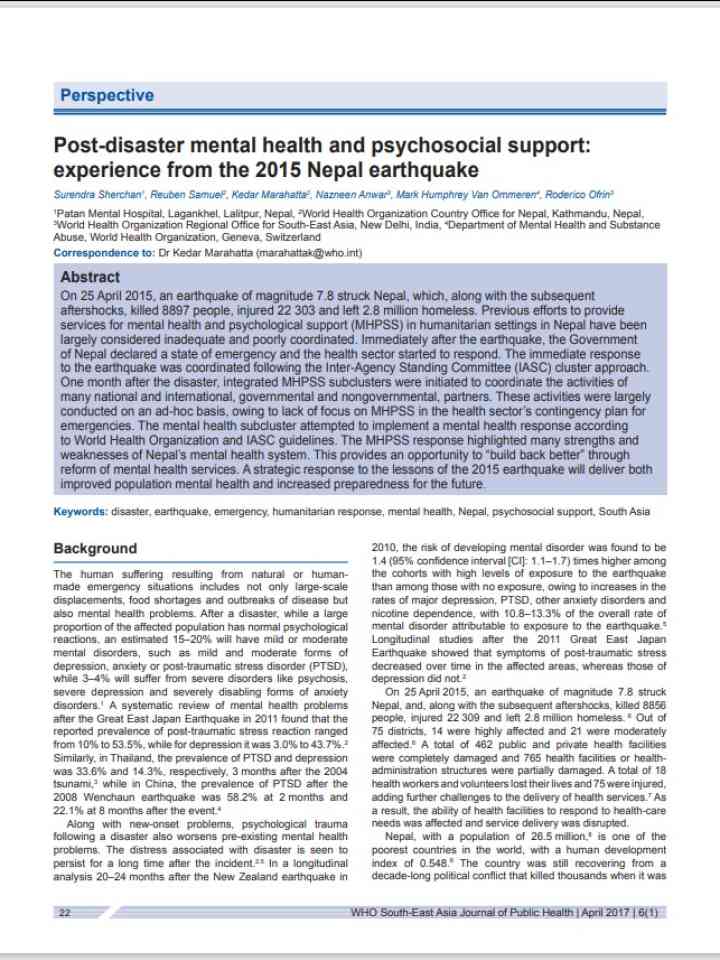
Post-disaster mental health and psychosocial support: experience from the 2015 Nepal earthquake

Source
World Health Organization (WHO)

On 25 April 2015, an earthquake of magnitude 7.8 struck Nepal, which, along with the subsequent aftershocks, killed 8897 people, injured 22 303 and left 2.8 million homeless.

Previous efforts to provide services for mental health and psychological support (MHPSS) in humanitarian settings in Nepal have been largely considered inadequate and poorly coordinated. Immediately after the earthquake, the Government of Nepal declared a state of emergency and the health sector started to respond. The immediate response to the earthquake was coordinated following the Inter-Agency Standing Committee (IASC) cluster approach. One month after the disaster, integrated MHPSS subclusters were initiated to coordinate the activities of many national and international, governmental and nongovernmental, partners.

These activities were largely conducted on an ad-hoc basis, owing to lack of focus on MHPSS in the health sector's contingency plan for emergencies. The mental health subcluster attempted to implement a mental health response according to World Health Organization and IASC guidelines. The MHPSS response highlighted many strengths and weaknesses of Nepal's mental health system. This provides an opportunity to "build back better" through reform of mental health services. A strategic response to the lessons of the 2015 earthquake will deliver both improved population mental health and increased preparedness for the future.

Download

Post-disaster mental health and psychosocial support: experience from the 2015 Nepal earthquak PDF, 0.2 MB English

Last checked: 3 September 2024

Editors' recommendations

  • National disaster mental health and wellbeing framework - Supporting Australians’ mental health through disaster
  • Coastal exposure and residents’ mental health in the afected areas by the 2011 Great East Japan Earthquake and Tsunami
  • National Disaster Mental Health and Wellbeing Framework: Our Stories: Beyond the Disaster 2021

Explore further

Hazards Earthquake
Themes Health and health facilities Recovery
Country and region Nepal
Post-disaster mental health and psychosocial support: experience from the 2015 Nepal earthquak
Publication year
2017

Is this page useful?

Yes No
Report an issue on this page

Thank you. If you have 2 minutes, we would benefit from additional feedback (link opens in a new window).

The International Recovery Platform (IRP) is a global partnership working to strengthen knowledge, and share experiences and lessons on building back better in recovery, rehabilitation, and reconstruction.

Latest IRP videos and photos: YouTube Flickr Contact IRP

Loading