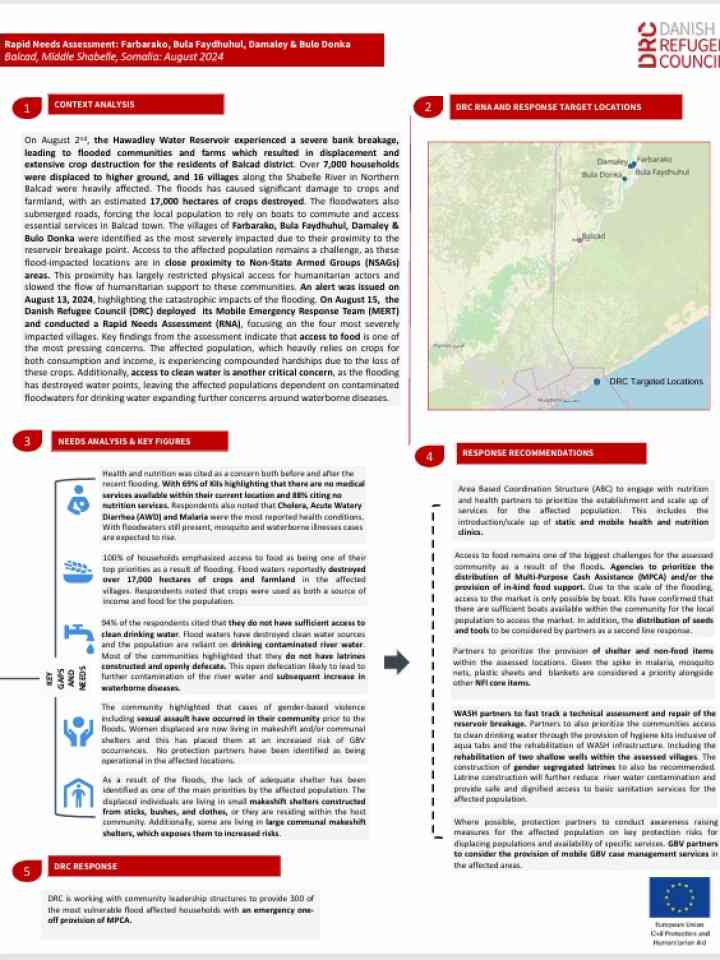
Rapid Needs Assessment: Farbarako, Bula Faydhuhul, Damaley & Bulo Donka Balcad, Middle Shabelle, Somalia: August 2024
On the 2nd of August, the Hawadley Water Reservoir experienced a severe bank breakage, leading to flooded communities and farms which resulted in displacement and extensive crop destruction for the residents of Balcad district. Over 7,000 households were displaced to higher ground, and 16 villages along the Shabelle River in Northern Balcad were heavily affected. The floods have caused significant damage to crops and farmland, with an estimated 17,000 hectares of crops destroyed. The floodwaters also submerged roads, forcing the local population to rely on boats to commute and access essential services in Balcad town. The villages of Farbarako, Bula Faydhuhul, Damaley and Bulo Donka were identified as the most severely impacted due to their proximity to the reservoir breakage point.
Access to the affected population remains a challenge, as these flood-impacted locations are near Non-State Armed Groups (NSAGs) areas. This proximity has largely restricted physical access for humanitarian actors and slowed the flow of humanitarian support to these communities. An alert was issued on August 13, highlighting the catastrophic impacts of the flooding.
On August 15, the Danish Refugee Council (DRC) deployed its Mobile Emergency Response Team (MERT) and conducted a Rapid Needs Assessment (RNA), focusing on the four most severely impacted villages. Key findings from the assessment indicate that access to food is one of the most pressing concerns. The affected population, which heavily relies on crops for both consumption and income, is experiencing compounded hardships due to the loss of these crops. Additionally, access to clean water is another critical concern, as the flooding has destroyed water points, leaving the affected populations dependent on contaminated floodwaters for drinking water expanding further concerns around waterborne diseases.
Explore further