PreventionWeb
Navigation loading…

Habitat for Humanity International

HFHI
United States of America
Non Governmental Organizations

Mission

A nonprofit, ecumenical Christian housing ministry, Habitat for Humanity seeks to eliminate poverty housing and homelessness from the world and to make decent shelter a matter of conscience and action. International and community-level Habitat for Humanity offices service specific areas in partnership with and on behalf of Habitat for Humanity International. Affiliate offices coordinate all aspects of Habitat home building in its local area—fundraising; building site selection; partner family selection and support; house construction; and mortgage servicing.
Show more
Latest additions
Items: 6
Documents and publications
13 May 2019
Fiji shelter handbook: Inclusive and accessible shelter planning for Fijian communities

The Fiji Shelter Handbook focuses on shelter coordination and response in Fiji. The handbook holistically supports the shelter sector’s preparedness for and response to disasters such as cyclones, floods, droughts, earthquakes and tsunamis. This support

Habitat for Humanity International
Global Shelter Cluster
The Fiji Shelter Handbook focuses on shelter coordination and response in Fiji. The handbook holistically supports the shelter sector’s preparedness for and response to disasters such as cyclones, floods, droughts, earthquakes and tsunamis.
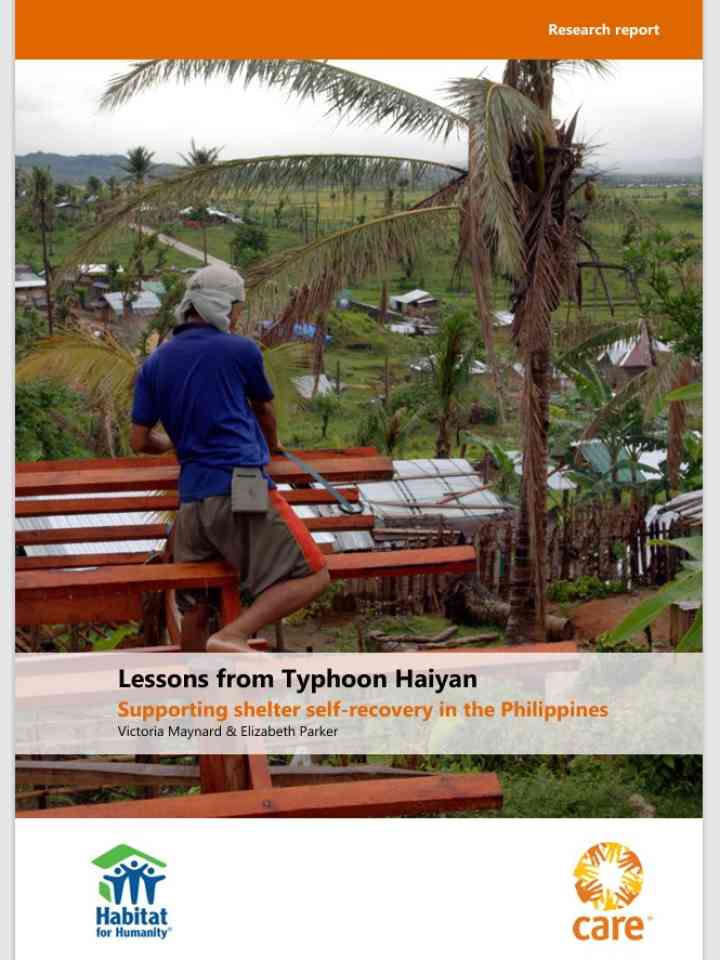
Lessons From Typhoon Haiyan: Supporting Shelter Self-Recovery in The Philippines
Documents and publications
Publications
30 May 2018
Lessons From Typhoon Haiyan: Supporting Shelter Self-Recovery in The Philippines

This research aimed to synthesise learning from several SSSR (Support for Shelter Self-Recovery) programmes in order to improve policy and practice in future humanitarian responses.

CARE International
Habitat for Humanity International
This research aimed to synthesise learning from several SSSR (Support for Shelter Self-Recovery) programmes in order to improve policy and practice in future humanitarian responses.
Documents and publications
24 October 2016
What did we learn? The shelter response and housing recovery in the first two years after the 2010 Haiti earthquake

This report is a synthesis of the experiences, observations, and recommendations of a large group of experienced post-disaster shelter and recovery experts gathered from interviews, surveys, and direct discussions, and information derived from a desk

World Bank, the
International Federation of Red Cross and Red Crescent Societies (IFRC)
United Nations Human Settlements Programme (UN-HABITAT)
Global Facility for Disaster Reduction and Recovery, the (GFDRR)
Habitat for Humanity International
This report is a synthesis of the experiences, observations, and recommendations of a large group of experienced post-disaster shelter and recovery experts gathered from interviews, surveys, and direct discussions, and information derive
HFHJ News Letter
Documents and publications
Publications
30 March 2014
3 Years Since the Great East Japan Earthquake

This artcle summarizes the emergency relief operation and the rebuilding project held by Habitat for Humanity Japan (Habitat Japan) after the Great East Japan Earthquake.

Habitat for Humanity International
This artcle summarizes the emergency relief operation and the rebuilding project held by Habitat for Humanity Japan (Habitat Japan) after the Great East Japan Earthquake.
Documents and publications
25 February 2013
Disaster response shelter catalogue

This catalogue is an overview of Habitat for Humanity's work, including its work in disaster risk reduction. It aims to provide an inspiring record of Habitat's disaster response and mitigation efforts and captures many of the valuable lessons learned.

Habitat for Humanity International
This catalogue is an overview of Habitat for Humanity's work, including its work in disaster risk reduction. It aims to provide an inspiring record of Habitat's disaster response and mitigation efforts and captures many of the valuable lessons learned.
Meetings and conferences
Washington, DC
6 October 2011
In person
Rebuilding a city: the dos and don’ts in post-disaster urban recovery
Population growth, urbanization and climate change expose increasing numbers of people to natural hazards in urban areas. From New Orleans in 2005 to Port-au-Prince, Haiti in 2010, recent urban disasters in developing and developed countries have drawn
Population growth, urbanization and climate change expose increasing numbers of people to natural hazards in urban areas.

More content for this organization may be available on PreventionWeb or on the site search.

Voluntary Commitments

The organization has no registered commitments.

The Sendai Framework Voluntary Commitments (SFVC) online platform allows stakeholders to inform the public about their work on DRR. The SFVC online platform is a useful toolto know who is doing what and where for the implementation of the Sendai Framework, which could foster potential collaboration among stakeholders. All stakeholders (private sector, civil society organizations, academia, media, local governments, etc.) working on DRR can submit their commitments and report on their progress and deliverables.

Contact information

http://www.habitat.org
+91 112 419 8432
Fax:
+91 112 419 8612

Is this page useful?

Yes No
Report an issue on this page

Thank you. If you have 2 minutes, we would benefit from additional feedback (link opens in a new window).

The International Recovery Platform (IRP) is a global partnership working to strengthen knowledge, and share experiences and lessons on building back better in recovery, rehabilitation, and reconstruction.

Latest IRP videos and photos: YouTube Flickr Contact IRP

Loading