PreventionWeb
Menu
Author(s) Liv Haselbach Mubarak Adesina Nayana Muppavarapu et al.

Spatially estimating flooding depths from damage reports

Source
Natural Hazards (Springer)

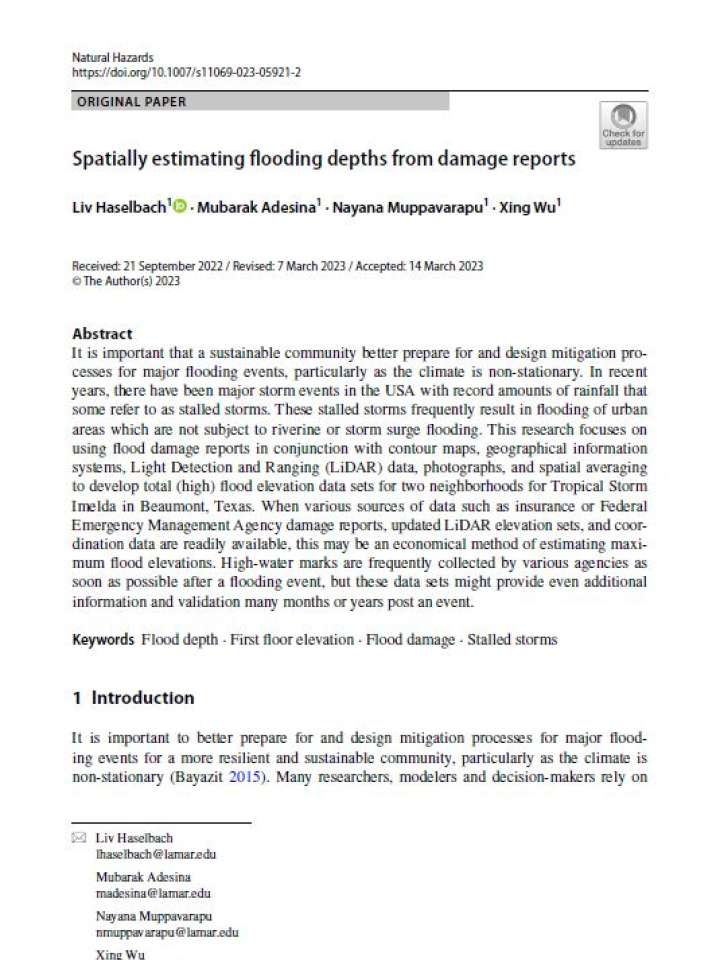
This research focuses on using flood damage reports in conjunction with contour maps, geographical information systems, Light Detection and Ranging (LiDAR) data, photographs, and spatial averaging to develop total (high) flood elevation data sets. It is important that a sustainable community better prepare for and design mitigation processes for major flooding events, particularly as the climate is non-stationary. In recent years, there have been major storm events in the USA with record amounts of rainfall that some refer to as stalled storms. These stalled storms frequently result in flooding of urban areas which are not subject to riverine or storm surge flooding.

When various sources of data such as insurance or Federal Emergency Management Agency damage reports, updated LiDAR elevation sets, and coordination data are readily available, this may be an economical method of estimating maximum flood elevations. High-water marks are frequently collected by various agencies as soon as possible after a flooding event, but these data sets might provide even additional information and validation many months or years post an event.

Download

Access Spatially estimating flooding depths from damage reports
Download a backup copy hosted by this site PDF, 2.1 MB English

We keep a copy of many documents to improve long-term access. Use this if the publisher’s site is slow or unavailable. Problems? Contact us.

Last checked: 5 April 2023

Editors' recommendations

  • Hurricane Harvey and equitable recovery: Mapping social vulnerability and intensity of wind and flooding from Hurricane Harvey in Texas
  • USA: Texas: Flood risk and mitigation
  • Hurricane Harvey: Texas at risk
  • How much water can be captured from flood flows to store in depleted aquifers for mitigating floods and droughts? A case study from Texas, US

Explore further

Hazards Flood
Themes Recovery
Country and region United States of America
Cover
ISBN/ISSN/DOI
10.1007/s11069-023-05921-2 (DOI)
Number of pages
13 p.
Publication year
2023

Also featured on

PreventionWeb

Is this page useful?

Yes No
Report an issue on this page

Thank you. If you have 2 minutes, we would benefit from additional feedback (link opens in a new window).

The International Recovery Platform (IRP) is a global partnership working to strengthen knowledge, and share experiences and lessons on building back better in recovery, rehabilitation, and reconstruction.

Latest IRP videos and photos: YouTube Flickr Contact IRP

Loading