PreventionWeb
Navigation loading…

Navigation failed to load. If you are on the UNDRR office network, your browser may be blocking access to external resources. Learn how to allow access.

Menu
Last updated 11 Aug 2025

Recovery Collection: Typhoon Haiyan (Yolanda) 2013
Image
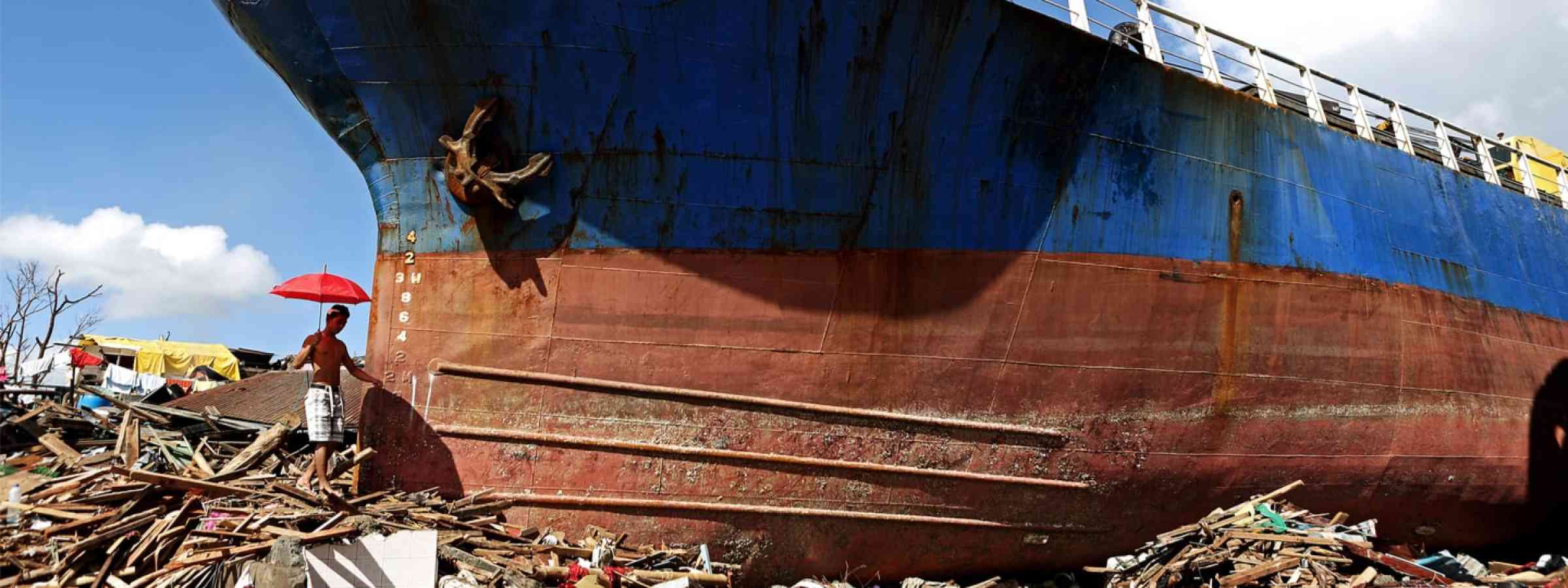
A beached boat and debris.
ymphotos/Shutterstock

Introduction

Typhoon Haiyan, locally known as Super Typhoon Yolanda, was one of the most powerful tropical cyclones on record and made landfall at the Eastern part of the Philippines on 17 November 2013. The most affected islands were Leyte and Samar. The typhoon killed over 6,000 people and affected in around 590 municipalities approximately 16 million people, including 4 million who were displaced. The typhoon also caused widespread damage to housing, livelihoods and infrastructure across nine of the poorest provinces of the country. Almost 1.1 million houses were damaged or destroyed.

The National Disaster Risk Reduction and Management Council (NDRRMC) of the Government of Philippines evacuated over 125,00 people to over 109 evacuation centres before the arrival of typhoon. Initially, the Government developed a document “Reconstruction Assistance on Yolanda”, in which the overall damages and losses from the typhoon were estimated at US$12.9 billion and the needs for recovery and reconstruction were estimated at US$8.2 billion. Subsequently, the Government developed a “Comprehensive Rehabilitation and Recovery Plan”, for the implementation of which the following five clusters were established: Food and water distribution, peace and order, shelter and reconstruction, social services as well as livelihood, employment and commerce.

The World Bank proposed as lessons learned from the typhoon to reform the NDRRMC, to create a disaster rehabilitation and recovery framework as well as effective coordination mechanisms, to develop implementation modalities and strategies for faster rehabilitation and recovery interventions, an effective emergency procurement manual as well as standards for disaster rehabilitation and recovery communications and to explore further channels of funding for disaster rehabilitation and recovery.
Hazards
Cyclone, Hurricane and Typhoon
Country and region
Philippines

Knowledge base

Items: 60
Documents and publications
18 January 2019
The impact of Typhoon Haiyan on health staff: a qualitative study in two hospitals in eastern Visayas, the Philippines

This study aimed to understand the impact of Typhoon Haiyan on health staff at a personal and work level when the storm hit the Philippines in 2013. The three main aspects reported as influencing staff were accessibility, safety and emotional aspects.

Frontiers in Public Health
Update
24 November 2018
Philippines: Catholic Church shares post-‘Yolanda’ recovery gains

A religious leader in the Philippines has said that during the post-Typhoon Yolanda recovery, more than 30,000 families have benefited from the Catholic Church's PHP 3.2 billion rehabilitation and reconstruction program. The program is one success amid several innovative accomplishments that have helped the Church implement its recovery projects.

Philippines News Agency
Documents and publications
Case Study
20 June 2018
A typology framework for trade-offs in development and disaster risk reduction: a case study of Typhoon Haiyan recovery in Tacloban, Philippines

This paper presents, explores, and tests a conceptual framework for analysing the trade-offs that underpin this relationship as evidenced through policy goals, initiatives, and decision-making processes.

Multidisciplinary Digital Publishing Institute
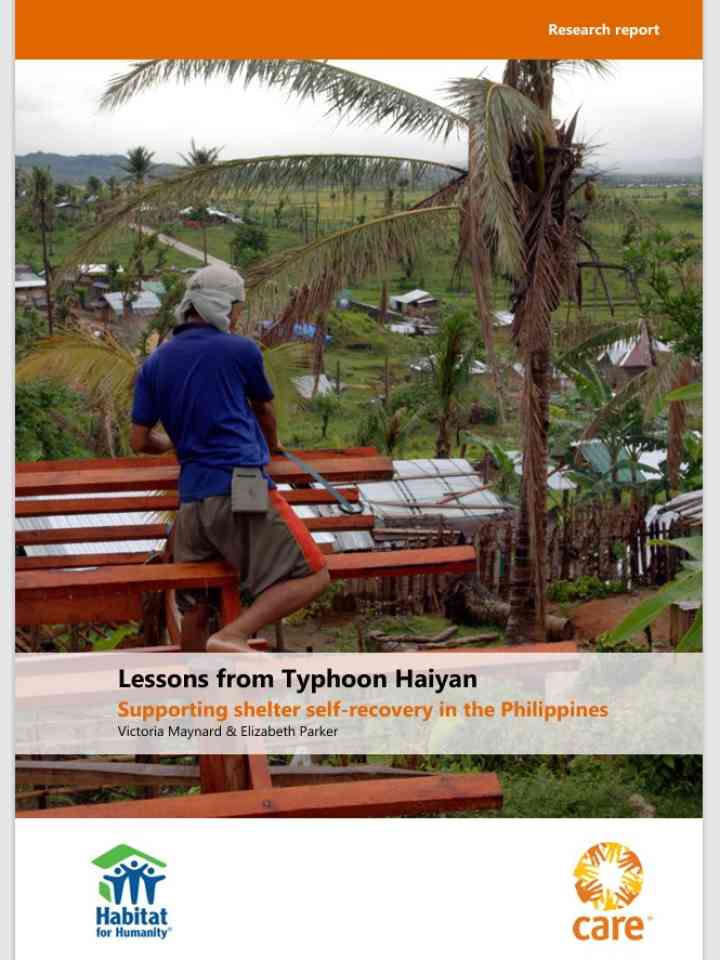
Lessons From Typhoon Haiyan: Supporting Shelter Self-Recovery in The Philippines
Documents and publications
Publications
30 May 2018
Lessons From Typhoon Haiyan: Supporting Shelter Self-Recovery in The Philippines

This research aimed to synthesise learning from several SSSR (Support for Shelter Self-Recovery) programmes in order to improve policy and practice in future humanitarian responses.

CARE International
Habitat for Humanity International
Documents and publications
13 November 2017
Self-recovery from disasters: an interdisciplinary perspective

This working paper presents the findings from a pilot research project that investigated how disaster-affected households in low- and middle-income countries rebuild their homes in situations where little or no support is available from humanitarian agencies. The project was an interdisciplinary collaboration involving social scientists, geoscientists, structural engineers and humanitarian practitioners.

ODI Global
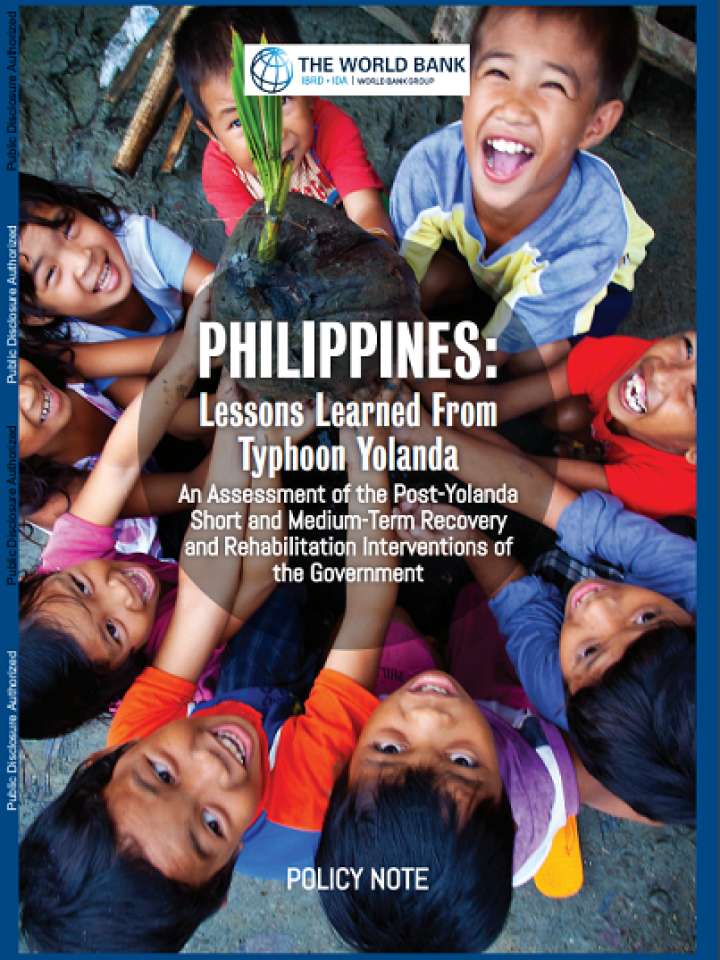
Philippines Lessons Learned from Typhoon Yolanda
Documents and publications
Reports and analysis
11 October 2017
Philippines: Lessons learned from Typhoon Yolanda: an assessment of the Post-Yolanda short and medium-term recovery and rehabilitation interventions of the government

This document is an assessment of specific aspects of the Philippines' short and medium-term recovery from the Typhoon Yolanda.

World Bank, the
Documents and publications
16 December 2016
Building resilience from within: Enhancing humanitarian civil-military coordination in post-Haiyan Philippines

This report outlines and examines the changes made to Humanitarian Assistance and Disaster Relief (HADR) in the Philippines based on lessons from Super Typhoon Haiyan.

S. Rajaratnam School of International Studies
Documents and publications
24 October 2016
Typhoon Haiyan: Lessons for urban disaster response and recovery

This briefing examines the challenges the city government faced, first in the immediate humanitarian response and later during the recovery and rehabilitation phases. Drawing on these experiences, it makes recommendations for local and national government and humanitarian agencies to improve their capacity for a more coordinated, efficient and sustainable response to future disasters.

International Institute for Environment and Development (IIED)
Documents and publications
15 September 2016
Resilience and disaster trends in the Philippines: Opportunities for national and local capacity building

This paper explores the policy and institutional mechanisms for disaster risk reduction management and research which have been conducted in the Philippines related to disaster preparedness, management and resilience. It draws on direct observations of and conversations with disaster management professionals, in addition to a review of the extant literature on resilience and disaster preparedness.

Public Library of Science
Tacloban after Haiyan: Working Together Towards Recovery
Documents and publications
Publications
1 September 2016
Tacloban after Haiyan: Working Together Towards Recovery

This paper describes the experience, challenges, successes and lessons of the Tacloban city government as the city transitioned from the humanitarian response to the recovery and development phases following the disaster.

International Institute for Environment and Development (IIED)

Pagination

Showing results 11–20 on this page

  • Previous
  • 1
  • 2
  • 3
  • Next

Is this page useful?

Yes No
Report an issue on this page

Thank you. If you have 2 minutes, we would benefit from additional feedback (link opens in a new window).

The International Recovery Platform (IRP) is a global partnership working to strengthen knowledge, and share experiences and lessons on building back better in recovery, rehabilitation, and reconstruction.

Latest IRP videos and photos: YouTube Flickr Contact IRP

Loading