PreventionWeb
Navigation loading…

Navigation failed to load. If you are on the UNDRR office network, your browser may be blocking access to external resources. Learn how to allow access.

Menu
Last updated 11 Aug 2025

Recovery Collection: Typhoon Haiyan (Yolanda) 2013
Image
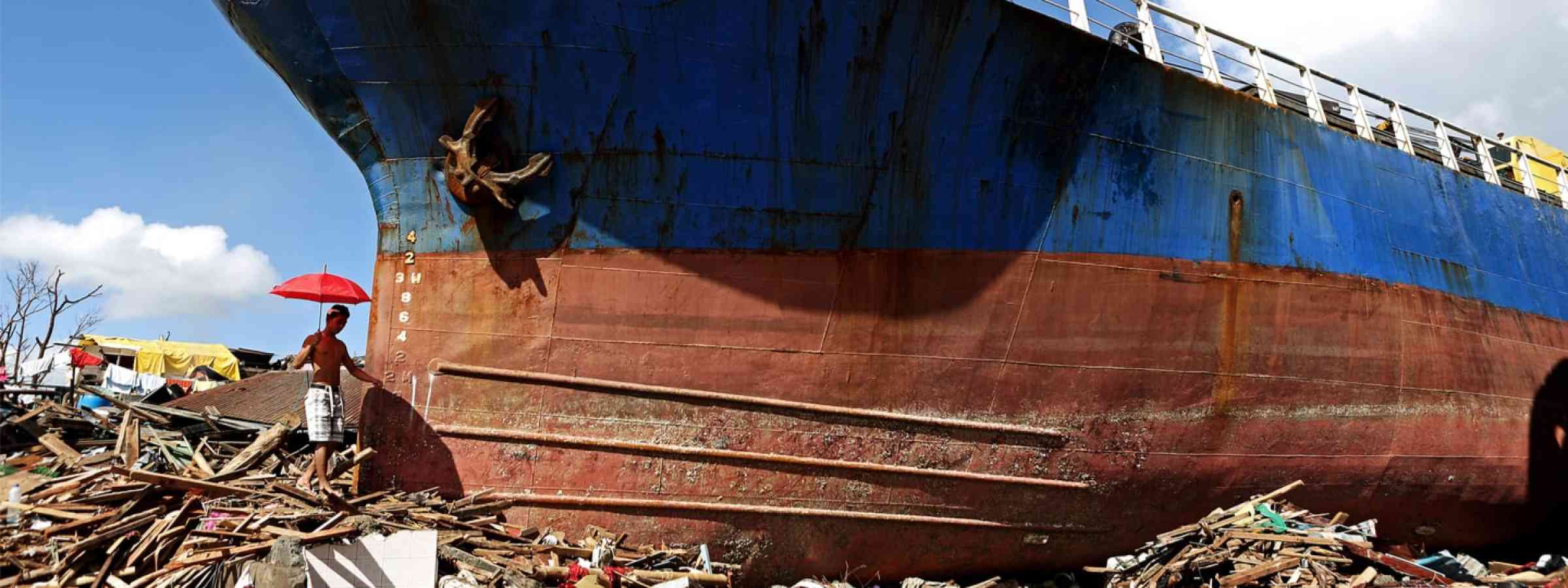
A beached boat and debris.
ymphotos/Shutterstock

Introduction

Typhoon Haiyan, locally known as Super Typhoon Yolanda, was one of the most powerful tropical cyclones on record and made landfall at the Eastern part of the Philippines on 17 November 2013. The most affected islands were Leyte and Samar. The typhoon killed over 6,000 people and affected in around 590 municipalities approximately 16 million people, including 4 million who were displaced. The typhoon also caused widespread damage to housing, livelihoods and infrastructure across nine of the poorest provinces of the country. Almost 1.1 million houses were damaged or destroyed.

The National Disaster Risk Reduction and Management Council (NDRRMC) of the Government of Philippines evacuated over 125,00 people to over 109 evacuation centres before the arrival of typhoon. Initially, the Government developed a document “Reconstruction Assistance on Yolanda”, in which the overall damages and losses from the typhoon were estimated at US$12.9 billion and the needs for recovery and reconstruction were estimated at US$8.2 billion. Subsequently, the Government developed a “Comprehensive Rehabilitation and Recovery Plan”, for the implementation of which the following five clusters were established: Food and water distribution, peace and order, shelter and reconstruction, social services as well as livelihood, employment and commerce.

The World Bank proposed as lessons learned from the typhoon to reform the NDRRMC, to create a disaster rehabilitation and recovery framework as well as effective coordination mechanisms, to develop implementation modalities and strategies for faster rehabilitation and recovery interventions, an effective emergency procurement manual as well as standards for disaster rehabilitation and recovery communications and to explore further channels of funding for disaster rehabilitation and recovery.
Hazards
Cyclone, Hurricane and Typhoon
Country and region
Philippines

Knowledge base

Items: 60
TYPHOON HAIYAN (YOLANDA) SHELTER RESPONSE OUTCOME ASSESSMENT
Documents and publications
Publications
9 June 2016
Philippines Shelter Recovery Outcome Assessment May 2016

Planned and implemented with the Global Shelter Cluster and operational shelter in the Philippines, this report examines some of the characteristics influencing shelter recovery after Typhoon Haiyan.

Global Shelter Cluster
Documents and publications
9 May 2016
Disaster-resilient microfinance - Learning from communities affected by Typhoon Haiyan

This reports analyzes the economic recovery of 4,000 households in the Philippines that were badly affected by typhoon Haiyan (Yolanda) in the Philippines and recommends improvements to the role of microfinance in enhancing the financial resilience of such communities.

Asian Development Bank (ADB)
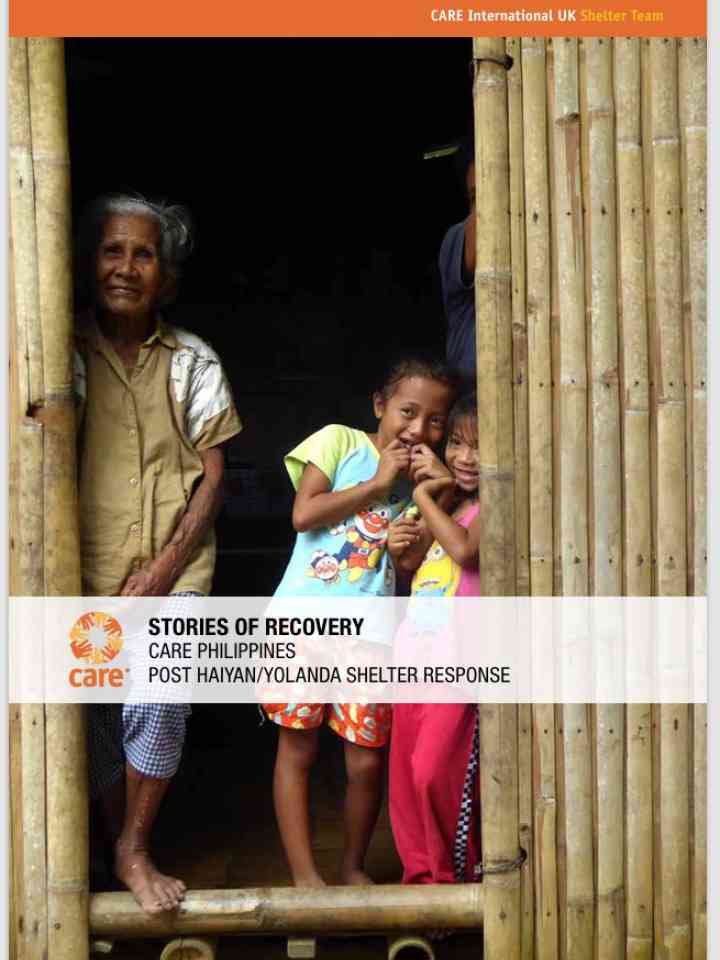
Stories of recovery: CARE Philippines post Haiyan/Yolanda shelter response
Documents and publications
Publications
30 April 2016
Stories of recovery: CARE Philippines post Haiyan/Yolanda shelter response

This report evaluates the shelter response which used a self-recovery approach, providing almost 16,000 families with cash, materials and tools and also analyses the relationship between shelter and livelihood programmes.

CARE International
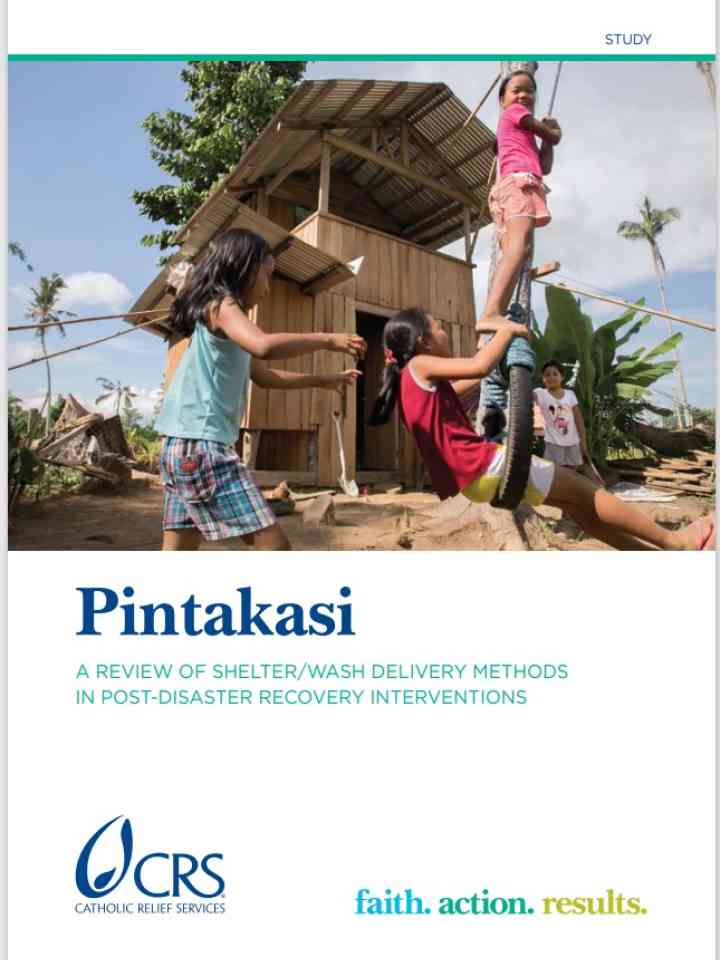
 Pintakasi: A Review of Shelter/WASH Delivery Methods in Post‑Disaster Recovery Interventions
Documents and publications
Publications
1 April 2016
Pintakasi: A Review of Shelter/WASH Delivery Methods in Post‑Disaster Recovery Interventions

This study hopes to contribute valuable lessons learned and share best practices from the program to the shelter/WASH recovery communities of practice within the humanitarian sector as a whole.

Catholic Relief Services
Documents and publications
1 February 2016
Typhoon Haiyan: portraits of resilience

Two years after the typhoon ravaged coastal and farmland communities, the people who survived the storm -the farmers and fishers- are well on the road to recovery. This book is a tribute to their resilience and FAO's work together to build back better their agricultural livelihoods after suffering such devastating losses.

Food and Agriculture Organization of the United Nations (FAO)
Update
12 January 2016
Philippines: Recovering from Yolanda, one step at a time

Much—perhaps too much—has been made of Filipino resiliency. While government programs are important for redrawing the conditions under which they labor, their success hinge precisely on people’s ability to respond to and recuperate from their misfortune.

Philippines - government
Update
2 December 2015
Caritas: Yolanda survivors declare support to climate change and community-managed disaster risk reduction

Caritas Palo Director Fr. Al Cris Badana emphasized the importance of the involvement of the communities in addressing climate change and disaster risks knowing the impact of super typhoon Yolanda that wrought havoc to the people in areas affected.

Philippine Information Agency
Post-Disaster Recovery and Resilience in Typhoon Yolanda Affected Areas
Documents and publications
Publications
22 November 2015
Post-Disaster Recovery and Resilience in Typhoon Yolanda Affected Areas - Immediate Response Initiatives from UNDP

This artcle is immideate response report of affected area after the typhoeen Yolanda(Haiyan), made landfall in the eastern Visayas region of the Philippines.

United Nations Development Programme (UNDP)
Documents and publications
12 November 2015
Is the response over? The transition from response to recovery in the health sector post-Typhoon Haiyan

This paper analyzes the period of overlap between response and recovery phases in the Philippines occurred three to seven months post-Typhoon Haiyan from February 2014 to July 2014. It highlights the need to define a period of transition from response to recovery of the health sector as it may have important implications on the health system functioning as a whole.

World Health Organization (WHO)
Documents and publications
Case Study
10 November 2015
Social protection and disaster risk management in the Philippines: the case of typhoon Yolanda (Haiyan)

This paper evaluates how the Philippines utilize social protection systems and programs to help households better manage disaster risk.

World Bank, the

Pagination

Showing results 21–30 on this page

  • Previous
  • 1
  • 2
  • 3
  • 4
  • Next

Is this page useful?

Yes No
Report an issue on this page

Thank you. If you have 2 minutes, we would benefit from additional feedback (link opens in a new window).

The International Recovery Platform (IRP) is a global partnership working to strengthen knowledge, and share experiences and lessons on building back better in recovery, rehabilitation, and reconstruction.

Latest IRP videos and photos: YouTube Flickr Contact IRP

Loading