PreventionWeb
Menu

Fuji Technology Press

Japan
Private Sector

Mission

Fuji Technology Press was established as an English language publisher in Tokyo in 1963. It remains a publisher of journals of scientific essays, publishing four journals in the English language and one in Japanese.

Their mission is to publish to the entire world cutting-edge research findings from Japan and the rest of Asia, as well as from Europe and the US.
Show more
Latest additions
Items: 9
Publication
Published on
5 March 2024
Innovation for Resilient Coastal Structures to Reduce Tsunami Disaster
The Great East Japan Earthquake Tsunami on March 11, 2011, caused unprecedented damage mainly in northeast Japan. This paper introduces the characteristics of the tsunami and resultant damage.
Publication
Published on
5 March 2024
Effects of Post-Disaster Aid Measures to Firms: Evidence from Tohoku University Earthquake Recovery Firm Survey 2012–2015
The paper finds that group subsidy and debt reduction had important roles in the recovery of business activities and demonstrates the importance of a panel survey in understanding and guiding policies for the resilience of the regional economy.
Publication
Published on
1 June 2022
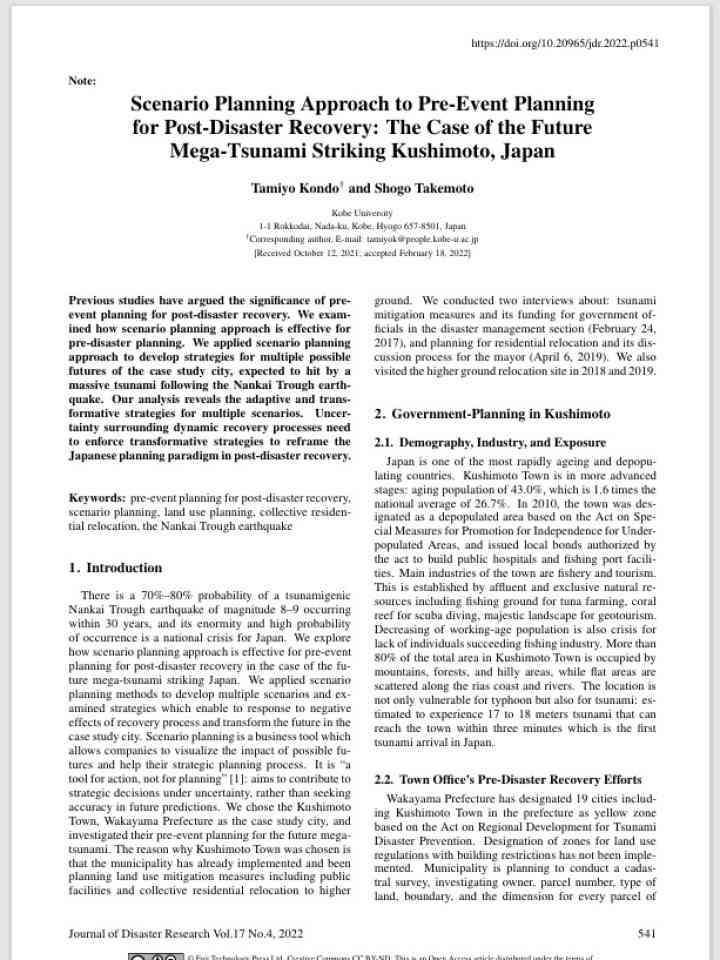
Scenario Planning Approach to Pre-Event Planning for Post-Disaster Recovery: The Case of the Future Mega-Tsunami Striking Kushimoto, Japan
This document examines how scenario planning approach is effective for pre-disaster planning, through a case study of Kushimoto Japan.
Publication
Published on
1 December 2020
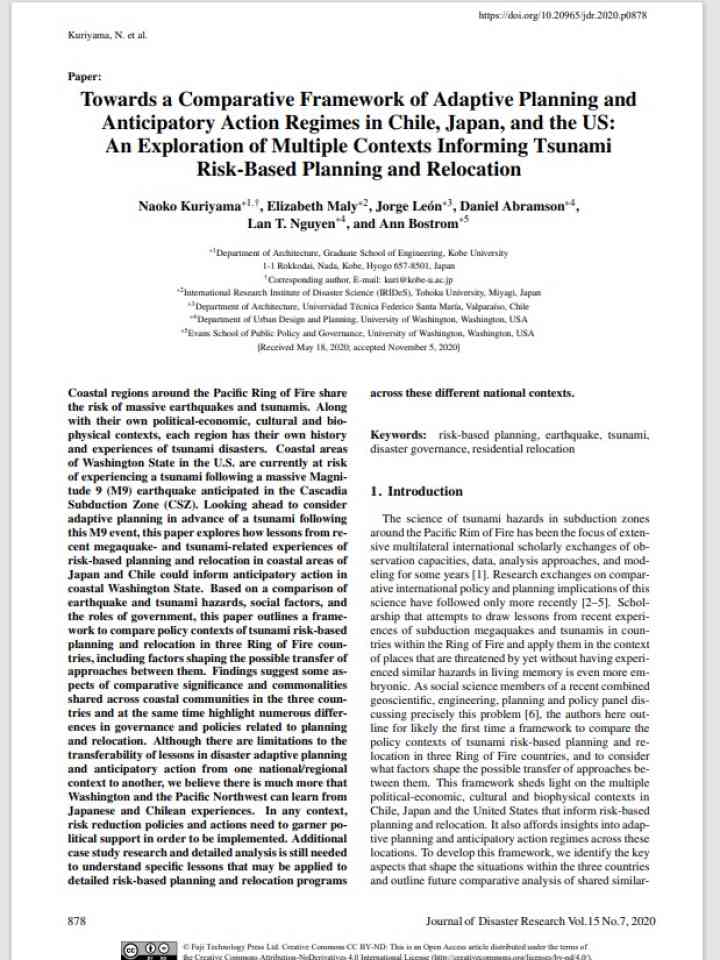
Towards a Comparative Framework of Adaptive Planning and Anticipatory Action Regimes in Chile, Japan, and the US: An Exploration of Multiple Contexts Informing Tsunami Risk-Based Planning and Relocation
Tthis paper explores how lessons from recent megaquake- and tsunami-related experiences of risk-based planning and relocation in coastal areas of Japan and Chile could inform anticipatory action in coastal Washington State.
Publication
Published on
1 November 2019
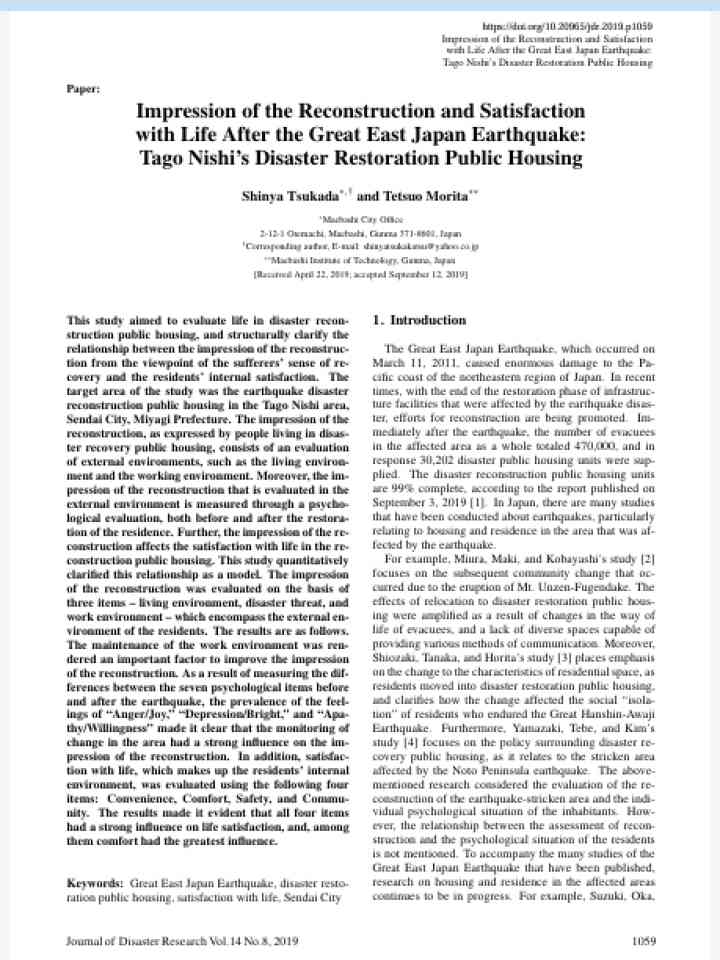
Impression of the Reconstruction and Satisfaction with Life After the Great East Japan Earthquake: Tago Nishi’s Disaster Restoration Public Housing
This study examined life in disaster reconstruction public housing and clarified how residents’ impressions of reconstruction relate to their sense of recovery and internal satisfaction.
Publication
Published on
5 March 2018
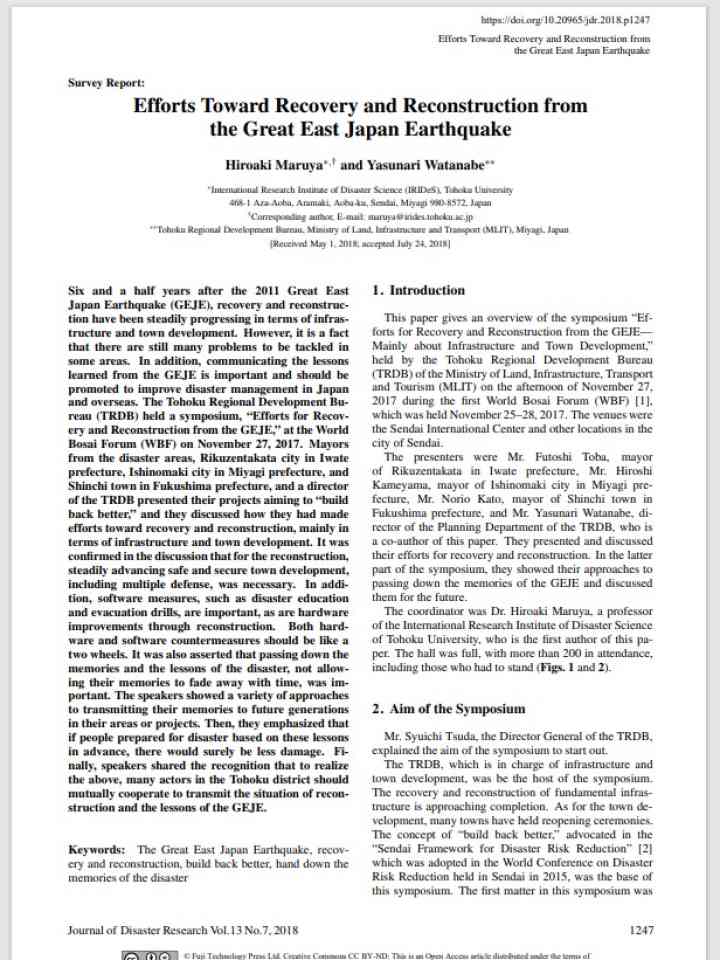
Efforts toward recovery and reconstruction from the Great East Japan Earthquake
Six and a half years after the Great East Japan Earthquake, recovery and reconstruction have been steadily progressing in terms of infrastructure and town development. However, there are still many problems to be tackled in some areas.
Publication
Published on
5 March 2016
Targeting vulnerable people with a social safety net: Lessons from the CFW program for the 2011 Great East Japan Earthquake and Tsunami disaster
The Emergency Job Creation (EJC) program in which unemployed people are hired for recovery works funded by the government was introduced after the 2011 earthquake and tsunami disaster. This paper evaluates how the EJC program targeted those most in need.
Publication
Published on
1 February 2012
How to optimize the urban recovery after earthquake disaster – Preparedness for recovery from the next Tokyo earthquake
The author suggested Tokyo Metropolitan Government to prepare the pre-disaster recovery and reconstruction from the next Tokyo Earthquake. It is important to prepare the reconstruction plan making and reconstruction procedure of projects.

Pagination

  • Previous page ‹ Previous
  • Current page 1
  • Page 2
  • Next page Next ›

More content for this organization may be available on PreventionWeb or on the site search.

Voluntary Commitments

The organization has no registered commitments.

The Sendai Framework Voluntary Commitments (SFVC) online platform allows stakeholders to inform the public about their work on DRR. The SFVC online platform is a useful toolto know who is doing what and where for the implementation of the Sendai Framework, which could foster potential collaboration among stakeholders. All stakeholders (private sector, civil society organizations, academia, media, local governments, etc.) working on DRR can submit their commitments and report on their progress and deliverables.

Contact information

http://www.fujipress.jp/index.html
[email protected]

Is this page useful?

Yes No
Report an issue on this page

Thank you. If you have 2 minutes, we would benefit from additional feedback (link opens in a new window).

The International Recovery Platform (IRP) is a global partnership working to strengthen knowledge, and share experiences and lessons on building back better in recovery, rehabilitation, and reconstruction.

Latest IRP videos and photos: YouTube Flickr Contact IRP

Loading