PreventionWeb
Menu

International Journal of Disaster Risk Science

IJDRS
China
Academic & Scientific

Mission

The International Journal of Disaster Risk Science is supported by the National Disaster Reduction Center, Ministry of Civil Affairs of China. The journal is published quarterly by Beijing Normal University. Its editorial Office is at the Academy of Disaster Reduction and Emergency Management of the Ministry of Civil Affairs and Ministry of Education at Beijing Normal University. Its operation is jointly managed by the State Key Laboratory of Earth Surface Processes and Resource Ecology, the Key Laboratory of Environmental Change and Natural Disaster of the Ministry of Education, and the International Human Dimensions Program on Global Environmental Change – Integrated Risk Governance or IHDP-IRG Project Office. Publishing and distribution services are provided by the Beijing Normal University Publishing Group.
Show more
Latest additions
Items: 13
Publication
Published on
17 June 2025
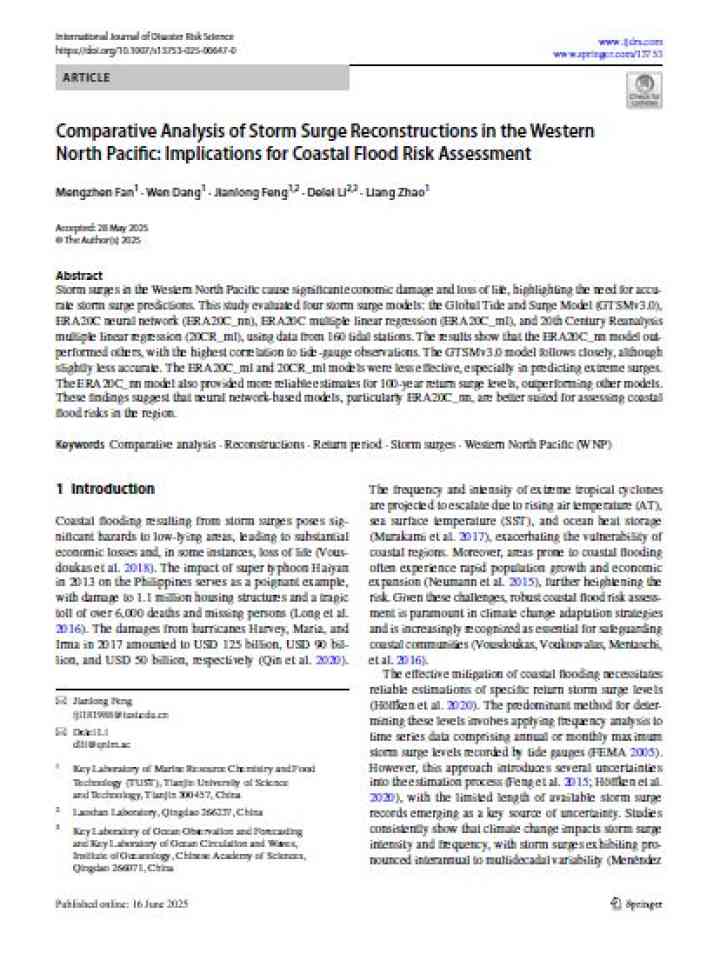
Comparative analysis of storm surge reconstructions in the Western North Pacific implications for coastal flood risk assessment
This study evaluated four storm surge models: the Global Tide and Surge Model (GTSMv3.0), ERA20C neural network (ERA20C_nn), ERA20C multiple linear regression (ERA20C_ml), and 20th Century Reanalysis multiple linear regression (20CR_ml).
Publication
Published on
25 May 2023
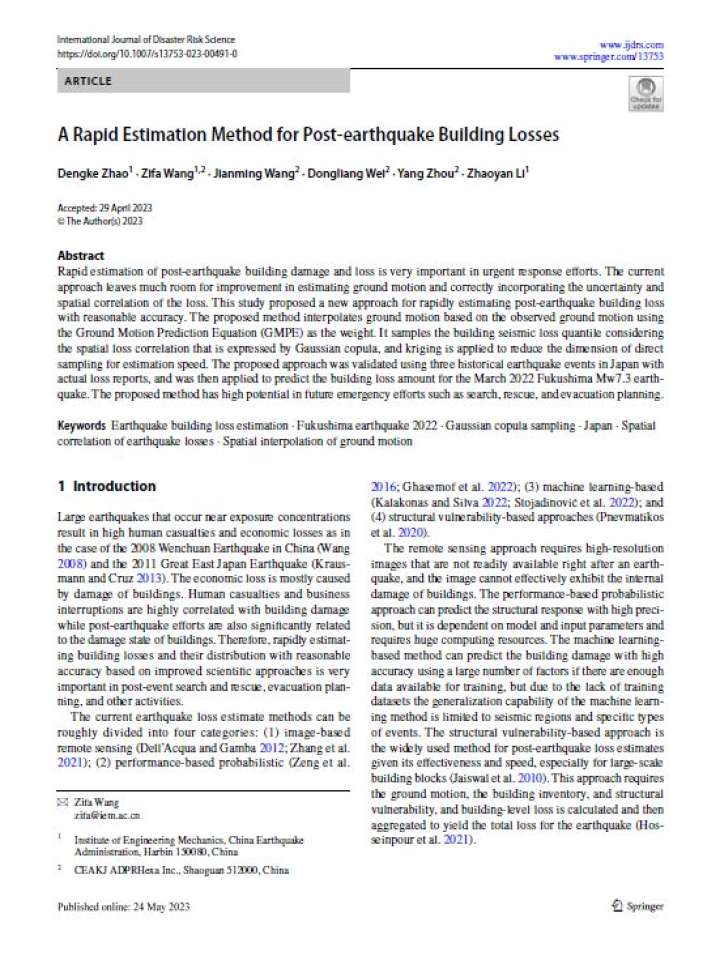
A rapid estimation method for post-earthquake building losses
This study proposed a new approach for rapidly estimating post-earthquake building loss with reasonable accuracy. Rapid estimation of post-earthquake building damage and loss is very important in urgent response efforts.
Publication
Published on
26 September 2022
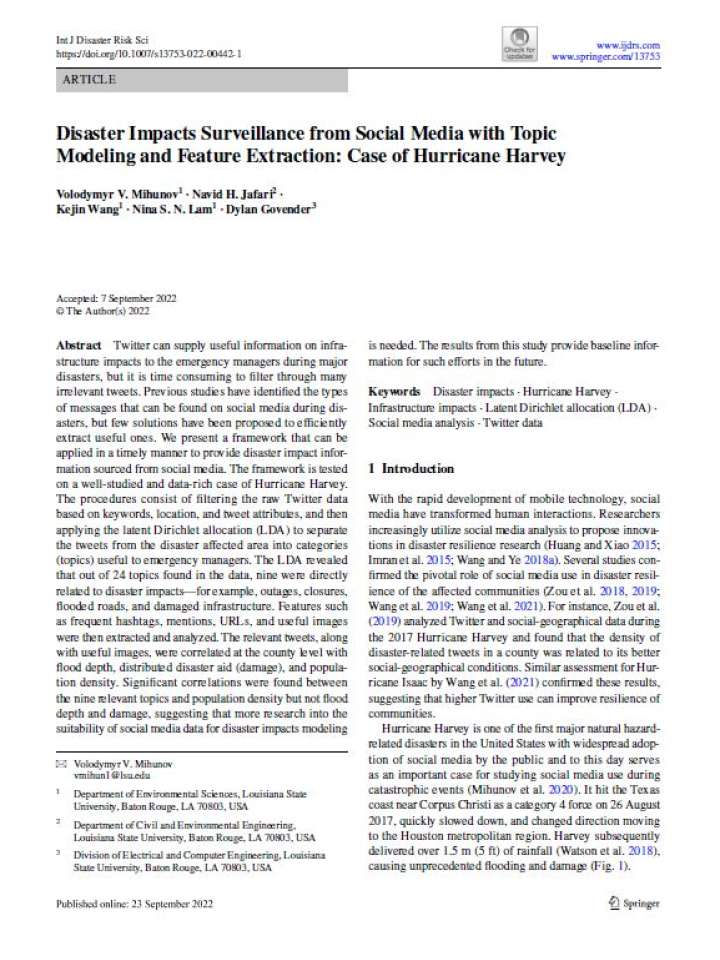
Disaster impacts surveillance from social media with topic modeling and feature extraction: case of Hurricane Harvey
This study analyzed the content of Twitter data collected during Hurricane Harvey to identify the data of the highest relevance for assessing the impacts on infrastructure through automatically grouping the tweets by topics of discussion.
Publication
Published on
22 June 2022
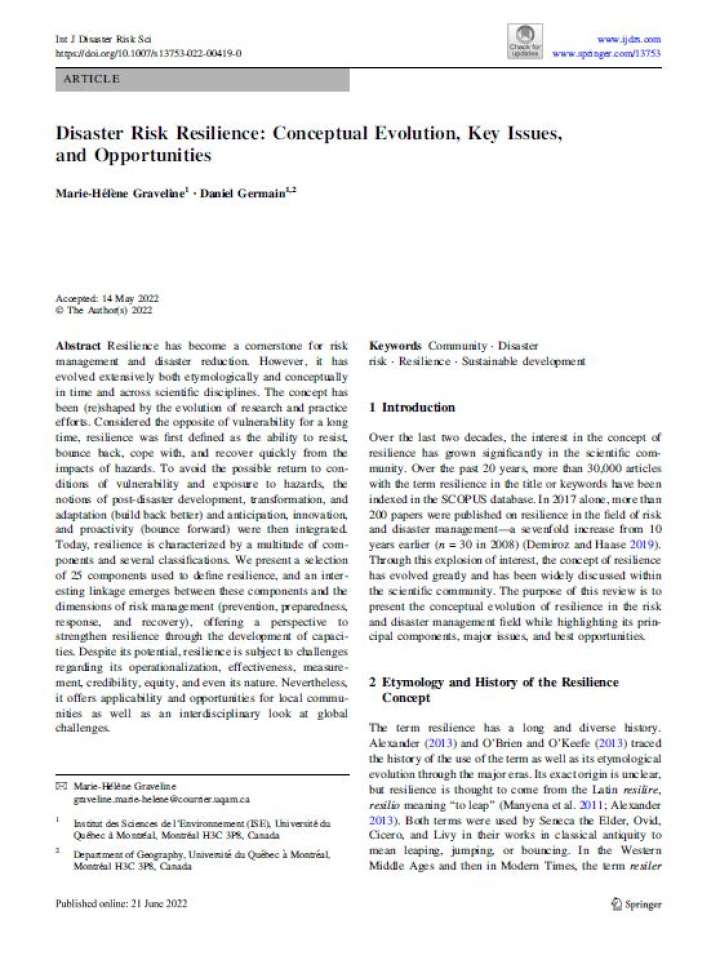
Disaster risk resilience: conceptual evolution, key issues, and opportunities
This paper presents a selection of 25 components used to define resilience, and an interesting linkage emerges between these components and the dimensions of risk management.
Publication
Published on
19 October 2021
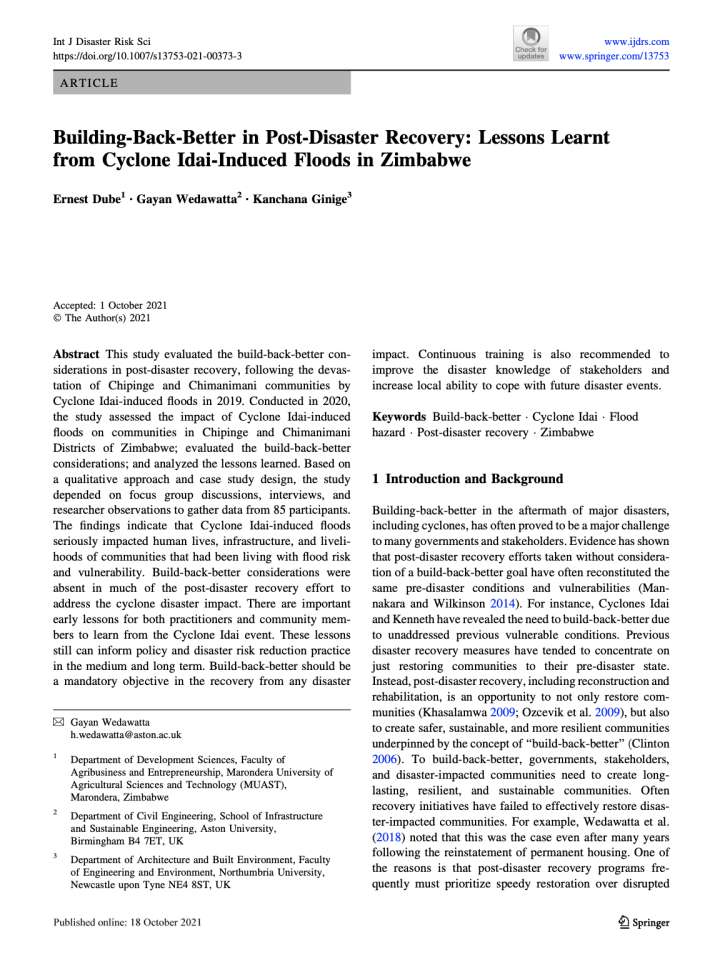
Building-back-better in post-disaster recovery: Lessons learnt from cyclone Idai-induced floods in Zimbabwe
This study evaluates the build-back-better considerations in post-disaster recovery, following the devastation by Cyclone Idai-induced floods in 2019. Conducted in 2020, the study assesses the impact of Cyclone Idai-induced floods.
Publication
Published on
16 October 2020
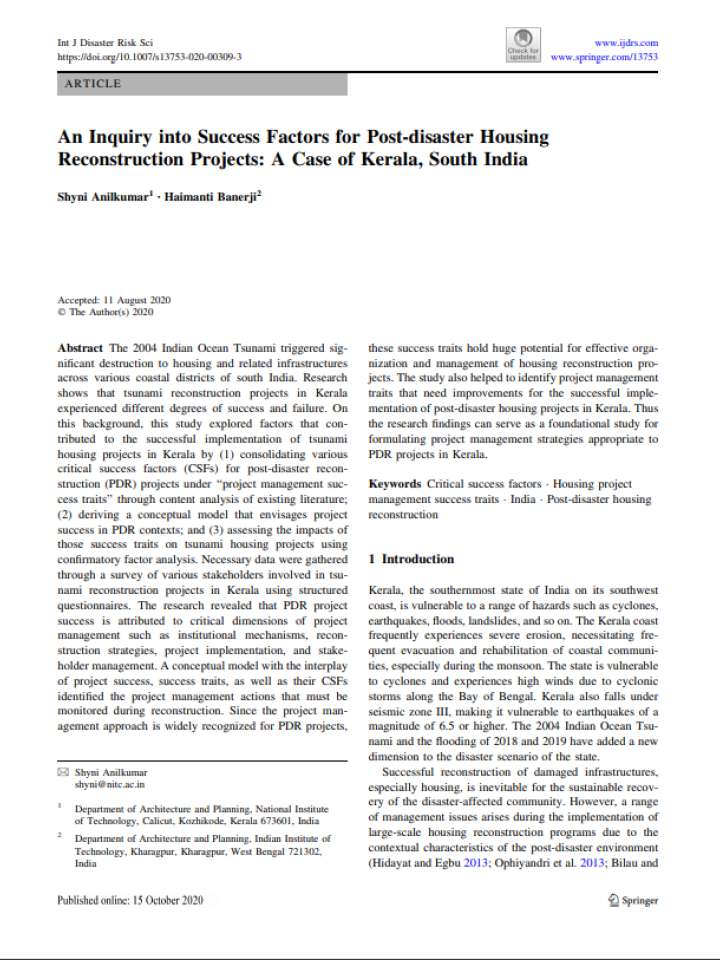
An inquiry into success factors for post-disaster housing reconstruction projects: A Case of Kerala, South India
This study explored factors that contributed to the successful implementation of tsunami housing projects in Kerala, India.
Publication
Published on
18 September 2020
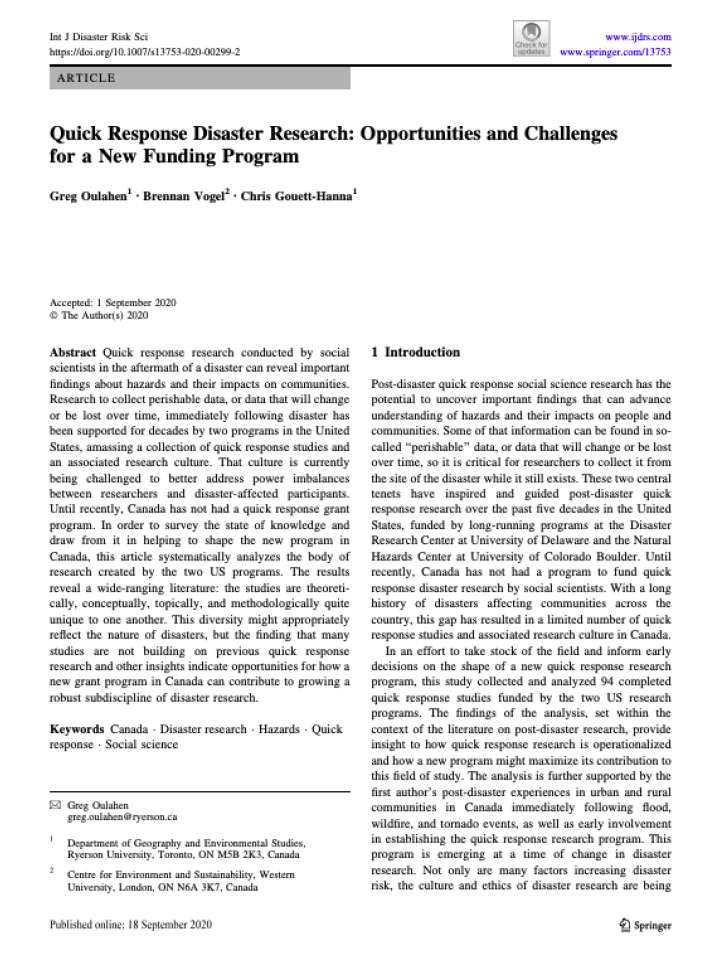
Quick response disaster research: opportunities and challenges for a new funding program
Quick response research conducted by social scientists in the aftermath of a disaster can reveal important findings about hazards and their impacts on communities.
Publication
Published on
28 May 2020
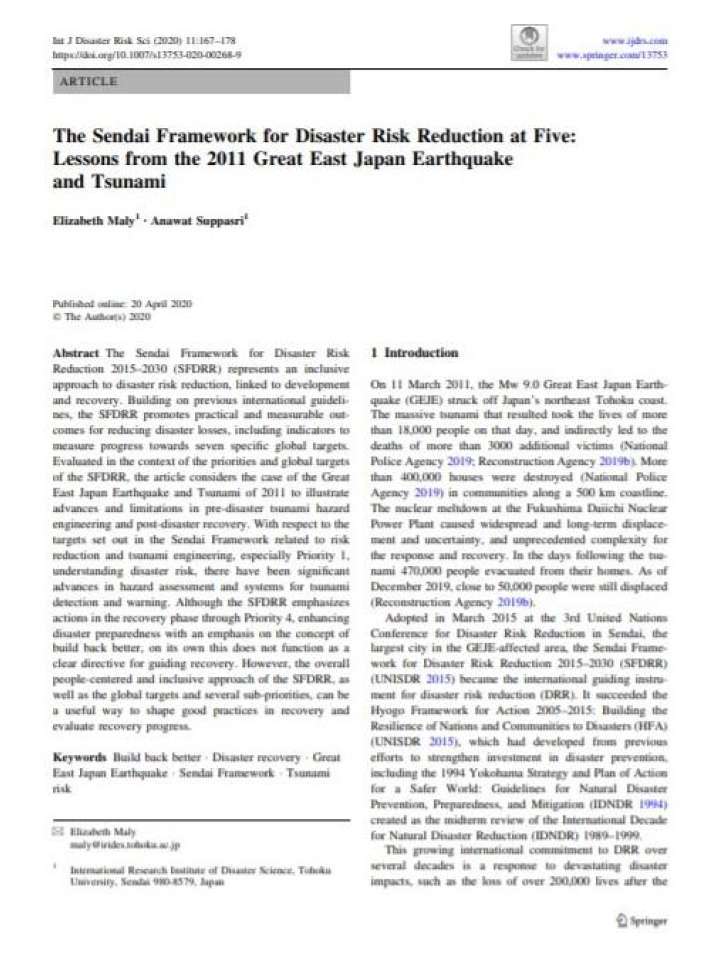
The Sendai Framework for Disaster Risk Reduction at five: Lessons from the 2011 Great East Japan earthquake and tsunami
Evaluated in the context of the priorities and global targets of the SFDRR, the article considers the case of the Great East Japan Earthquake and Tsunami of 2011 to illustrate advances and limitations.

Pagination

  • Previous page ‹ Previous
  • Current page 1
  • Page 2
  • Next page Next ›

More content for this organization may be available on PreventionWeb or on the site search.

Voluntary Commitments

The organization has no registered commitments.

The Sendai Framework Voluntary Commitments (SFVC) online platform allows stakeholders to inform the public about their work on DRR. The SFVC online platform is a useful toolto know who is doing what and where for the implementation of the Sendai Framework, which could foster potential collaboration among stakeholders. All stakeholders (private sector, civil society organizations, academia, media, local governments, etc.) working on DRR can submit their commitments and report on their progress and deliverables.

Contact information

http://www.ijdrs.com/
+41 223621934

Is this page useful?

Yes No
Report an issue on this page

Thank you. If you have 2 minutes, we would benefit from additional feedback (link opens in a new window).

The International Recovery Platform (IRP) is a global partnership working to strengthen knowledge, and share experiences and lessons on building back better in recovery, rehabilitation, and reconstruction.

Latest IRP videos and photos: YouTube Flickr Contact IRP

Loading