PreventionWeb
Menu

Stockholm Environment Institute

SEI
Sweden
Academic & Scientific

Mission

SEI’s mission is to support decision-making and induce change towards sustainable development around the world by providing integrative knowledge that bridges science and policy in the field of environment and development.

Among several centres worldwide, the SEI Asia Centre hosts the Climate Change, Disasters and Development Cluster, which works to support research, capacity development and policy engagement for linkages between development and disaster, DRR and policy-making. More details can be found here: https://www.sei.org/centres/asia/research-areas/climate-change-disasters-and-development/

Disaster Reduction Goal
Our goal is to improve understanding of how disaster risks are created and how they accumulate, recognising that disaster risk, climate change and development are closely related to each other. We are seeking to better integrate disaster risk reduction with equitable, sustainable and resilient development by transforming the relationship between development and DRR.
DRR activities
Policies and Programmes in DRR

SEI hosts the Integrated Research on Disaster Risk (IRDR) International Centre of Excellence on Transforming Development and Disaster Risk (ICoE-TDDR), which acts as a focal point for SEI’s DRR-related work.

We aim to support international and regional efforts by understanding the underlying causes of risk and finding entry points for transformation in DRR and resilience decision-making.

Other recent programmes include:
The Global Resilience Partnership (GRP) Disability and Disasters: Empowering People and Building Resilience to Risk (2015-2017) project is researching the challenges that people with disabilities (PWDs) face in disaster response in order to identify platforms for inclusion and empowerment, and solutions for mainstreaming disability-inclusive DRR (DiDRR) into development planning.

Longer-term (5-10 years) recovery following major disasters in the Asia Pacific Region: Lessons for resilient development, is a project undertake a critical analysis of the longer-term recovery process in five selected disaster case studies, to generate insights that will improve our understanding of the types of transformations required in at-risk societies in order to become more resilient.

Membership in Key Networks

SEI hosts the Integrated Research on Disaster Risk (IRDR) International Centre of Excellence on Transforming Development and Disaster Risk (ICoE-TDDR).

SEI is also a member of key networks including:
- UNDRR Asian Science, Technology and Academia Advisory Group (ASTAAG)
- Global Alliance of Disaster Research Institutes (GADRI)
- Gender and Disaster Network (GDN)
- Ecosystems for Adaptation and Disaster Risk Reduction (PEDRR)
- Asia Pacific Adaptation Network (APAN)

Disaster Reduction Focal Point(s)

Michael Boyland

[email protected]

Websites

https://wetransform.dev

https://www.sei.org/projects-and-tools/projects/sei-initiative-on-transforming-development-and-disaster-risk/

https://www.sei.org/centres/asia/research-areas/climate-change-disasters-and-development/
Show more
Latest additions
Items: 6
Publication
Published on
20 June 2024
A study on examining flood resilience in Asia and developing assessment indicators of South Korea
The study analysed existing flood control projects across Asia, focusing on their contributions to regional flood resilience. The researchers examined flood resilience indicators used and evaluated their strengths and limitations.
Publication
Published on
7 May 2020
Adapting to extremes: key insights for bridging climate change adaptation and disaster risk reduction in the european green deal
This policy brief presents key insights from PLACARD for bridging CCA and DRR. We highlight three areas for action to improve cooperation, and provide recommendations for the European Green Deal. While these perspectives have originated in a European setting, they provide valuable insights across regional and national contexts to support efforts to build more resilient future societies as we adapt to extremes in a warming world.
Meetings and conferences
Online
29 April 2020
Webinar: How to make the COVID-19 recovery sustainable, just and resilient
Join a discussion on 29th April 2020, 15:00–16:15 CEST to hear perspectives from decision-makers, industry professionals and scientists on how to ensure a sustainable, just and resilient recovery from the disruption wrought by the coronavirus dise
Publication
Published on
27 January 2010
Learning from recovery after hurricane Mitch: experience from Nicaragua
This document reviews how Nicaragua has recovered from Hurricane Mitch over the past ten years. The focus is on how relevant the assumptions and claims that were made in the initial recovery planning have been in light of subsequent development.
Publication
Published on
19 January 2010
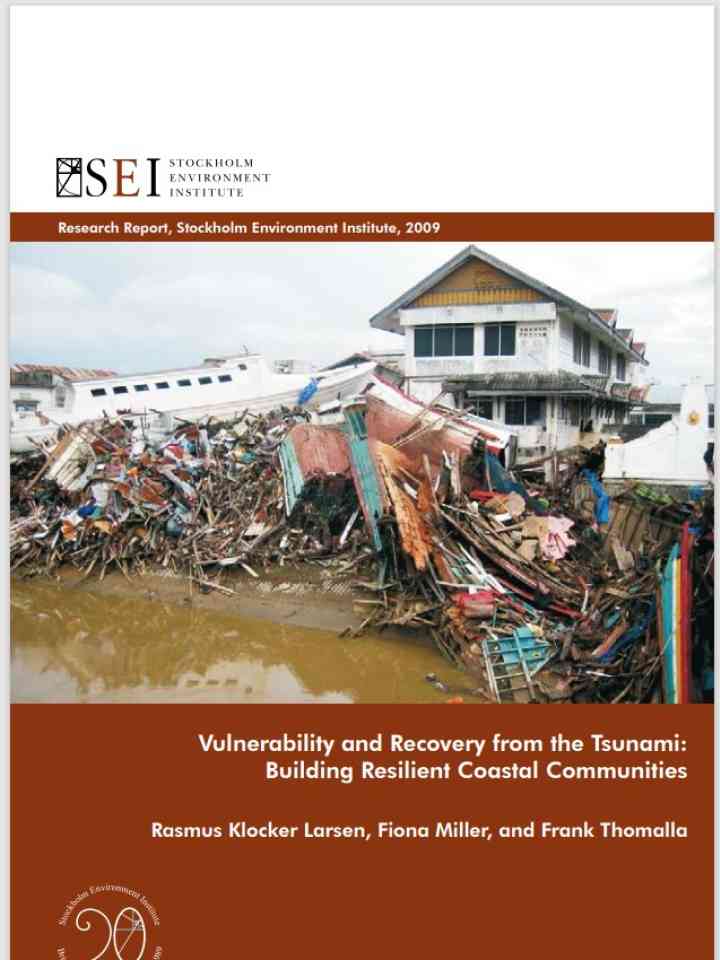
Vulnerability and recovery from the tsunami: building resilient coastal communities: a synthesis of factors contributing to tsunami-related vulnerability in Sri Lanka and Indonesia
This report provides a meta-analysis to synthesise insights from the tsunami recovery literature on the key factors contributing to vulnerability to the 2004 Indian Ocean Tsunami and to emerging vulnerabilities related to post-disaster recovery.
Publication
Published on
13 March 2009
Vulnerability in the context of post 2004 Indian Ocean Tsunami recovery: Lessons for building more resilient coastal communities
This report provides the insight of relief and recovery efforts after the 2004 Indian Ocean Tsunami in South East Asia are burdened by extreme competitiveness and lack of collective action.

More content for this organization may be available on PreventionWeb or on the site search.

Voluntary Commitments

The organization has no registered commitments.

The Sendai Framework Voluntary Commitments (SFVC) online platform allows stakeholders to inform the public about their work on DRR. The SFVC online platform is a useful toolto know who is doing what and where for the implementation of the Sendai Framework, which could foster potential collaboration among stakeholders. All stakeholders (private sector, civil society organizations, academia, media, local governments, etc.) working on DRR can submit their commitments and report on their progress and deliverables.

Contact information

https://www.sei.org
[email protected]
+46 8 30 80 44

Is this page useful?

Yes No
Report an issue on this page

Thank you. If you have 2 minutes, we would benefit from additional feedback (link opens in a new window).

The International Recovery Platform (IRP) is a global partnership working to strengthen knowledge, and share experiences and lessons on building back better in recovery, rehabilitation, and reconstruction.

Latest IRP videos and photos: YouTube Flickr Contact IRP

Loading