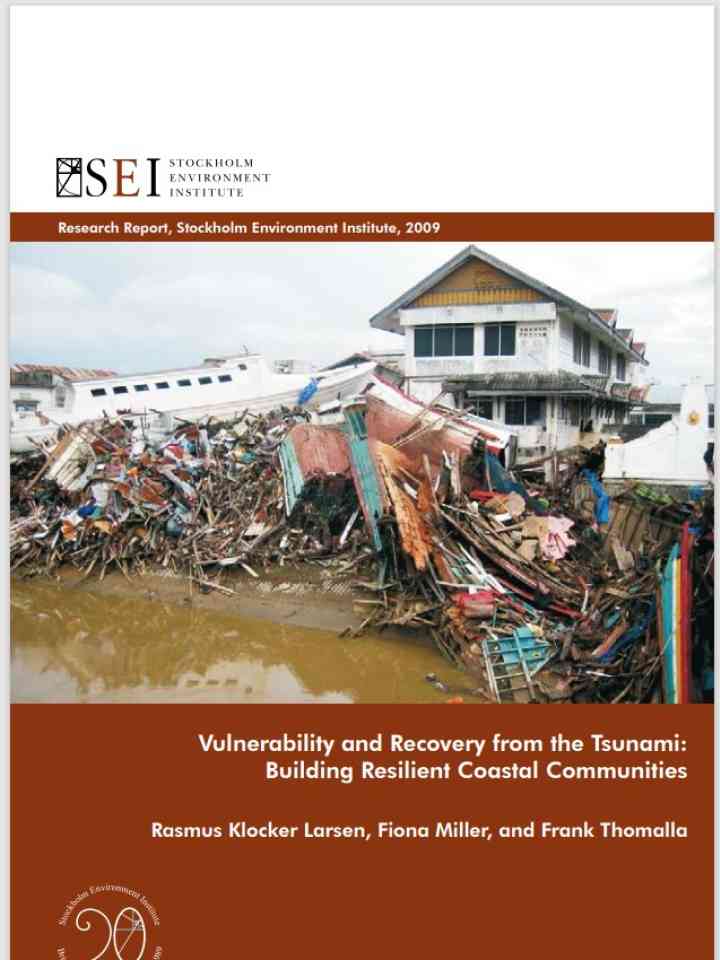
Vulnerability and recovery from the tsunami: building resilient coastal communities: a synthesis of factors contributing to tsunami-related vulnerability in Sri Lanka and Indonesia
In this study we conducted a meta-analysis to synthesise insights from 382 documents from the tsunami recovery literature on the key factors contributing to vulnerability to the 2004 Indian Ocean Tsunami and to emerging vulnerabilities related to post-disaster recovery in Sri Lanka and Indonesia. Acknowledging the diversity of vulnerability concepts, vulnerability was interpreted in a simple form as referring to a person or social group's (a vulnerability unit) experience of a kind of stress (risk/outcome) if they are exposed to a certain type of stress, or hazard (causal factor).
Vulnerability is a concept that is often used yet rarely systematically explained or rigorously investigated in practice and just 40 documents were found to contain actual substantiated vulnerability insights with a focus on vulnerable groups. A total of 137 substantiated vulnerability insights were identified and the most vulnerable groups identified were displaced people, women, children, families, farmers and victims from other emergencies. 75 % of all risks identified were emerging during the recovery process, and half of these relate to aid delivery.
In an investigation of the underlying causes of newly emerging vulnerabilities we present how a situation is manifest where, in summary, 1) a lack of long-term planning and undifferentiated aid neglects the diversity of the displaced people and leads to their deepening dependency; 2) aid delivery in coastal communities adds to pre-existing resource conflicts and community tensions, with benefit distribution and coastal zone policies in particular being highly contested; and 3) the underlying causes of women's abuse are not addressed despite a high awareness of the issues, leading to the perpetuation of a culture of gender inequality and marginalisation.
Using a social learning approach, we conclude by arguing that the underlying causes of newly emerging vulnerabilities persist due to a lack of mechanisms for collective action in the wider recovery community and their limited capacity to learn to build resilience. Whilst post disaster aid delivery is an important aspect of disaster risk reduction it could also play a crucial role in supporting the longer term sustainable recovery and development of coastal communities. However, due to its competitive, rather than cooperative, nature it currently often contributes to rather than reduces vulnerability against future shocks.
Explore further