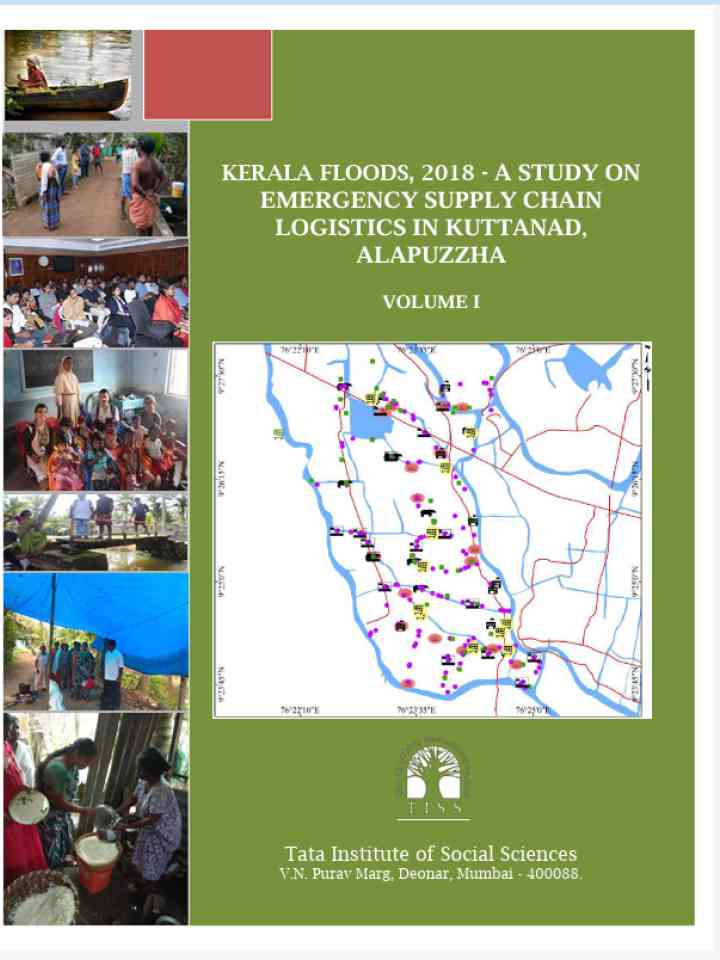
Kerala Floods, 2018 - A Study on Emergency Supply Chain Logistics In Kuttanad, Alapuzzha
The report documents a field-based study conducted after the 2018 Kerala floods to examine emergency supply chain logistics in Kuttanad Taluk, Alappuzha district, one of the most flood-prone wetland regions in the state. Undertaken by the Tata Institute of Social Sciences (TISS) at the request of the Government of Kerala and Kerala State Disaster Management Authority (KSDMA), the study aimed to understand how food and essential supplies reached affected communities during the disaster, particularly before large-scale evacuation to relief camps.
The study involved extensive field mapping across multiple panchayats, covering gruel centres, animal camps, culverts and bridges, ration shops, anganwadis, and SupplyCo/Maveli stores. Using GIS tools and smartphone-based geo-referencing, the research documented the functioning of public distribution systems, Integrated Child Development Services, and cooperative institutions such as SupplyCo, Horti Corp, and MILMA. Special attention is given to the role of gruel centres as decentralized, non-residential community kitchens that ensured food security through local leadership, volunteerism, and collective resource pooling during prolonged flooding.
The report is accompanied by Volume II (Book of Maps), prepared by the Tata Institute of Social Sciences (TISS). It complements Volume I by providing spatial documentation of emergency response infrastructure across Kuttanad Taluk, one of the regions most severely affected by the 2018 floods. The volume compiles detailed GIS-based maps generated from field data collected using smartphone-based geo-referencing and processed through ArcGIS. The maps cover multiple panchayats and depict the locations of gruel centres, animal camps, culverts and bridges, and Public Distribution System (PDS) outlets. By visually integrating these features, the report enables a clearer understanding of the spatial distribution of relief facilities and supply-chain nodes during the flood emergency.
Explore further