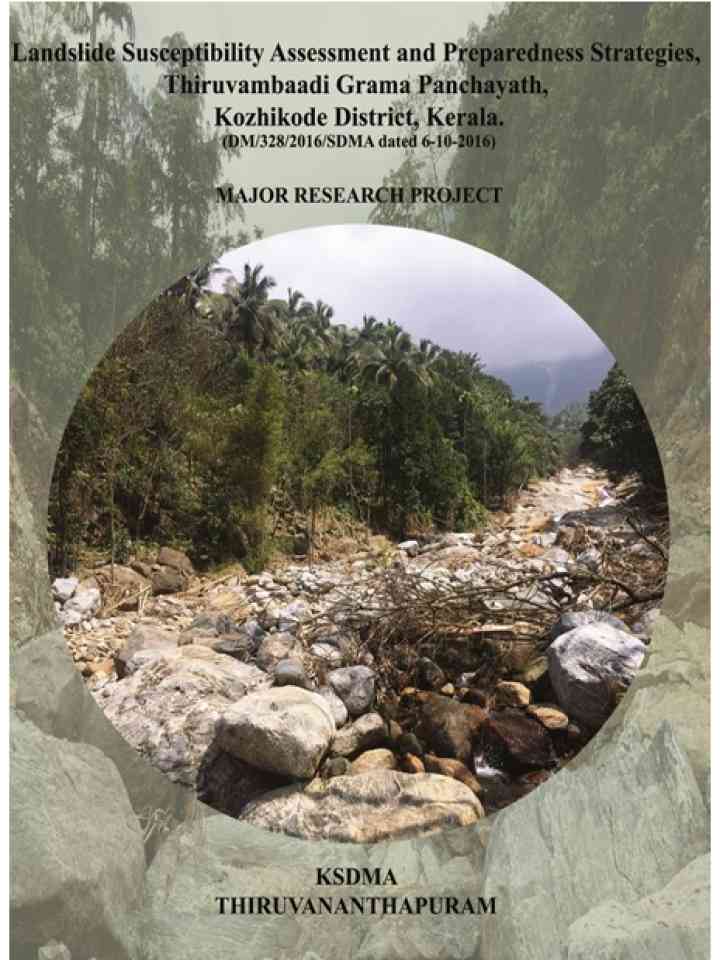
Landslide Susceptibility Assessment and Preparedness Strategies, Thiruvambaadi Grama Panchayath, Kozhikode District, Kerala
The report documents a major research project undertaken to assess landslide susceptibility and preparedness strategies in Thiruvambadi Grama Panchayath, Kozhikode district, Kerala. Situated in the Western Ghats region, the area is highly prone to slope failures due to steep terrain, intense monsoon rainfall, geological conditions, and increasing human interventions. The study was conducted in response to recurrent landslides, including severe events during the 2012 and 2018 monsoons, which caused loss of life, damage to settlements, infrastructure, and agricultural land.
Using a combination of field investigations, geological and geotechnical studies, remote sensing, and GIS techniques, the study analyzes multiple causative factors such as slope, relative relief, curvature, drainage density and frequency, land use, road proximity, and soil properties. A quantitative landslide susceptibility zonation model was applied to classify the area into five zones: stable, moderately stable, moderately unstable, highly unstable, and critical. The assessment was carried out at district, grama panchayath, and ward levels, enabling detailed identification of high-risk locations and patterns of slope failure.
The report provides landslide susceptibility maps and site-specific analyses for selected failure locations, along with recommendations for mitigation and preparedness. It emphasizes the need for land-use regulation, drainage correction, reforestation, and restriction of unsafe development in high- and critical-risk zones. Overall, the study supports local governments and disaster management authorities in planning preventive measures, improving monsoon preparedness, and reducing landslide risk through evidence-based decision-making.
Explore further