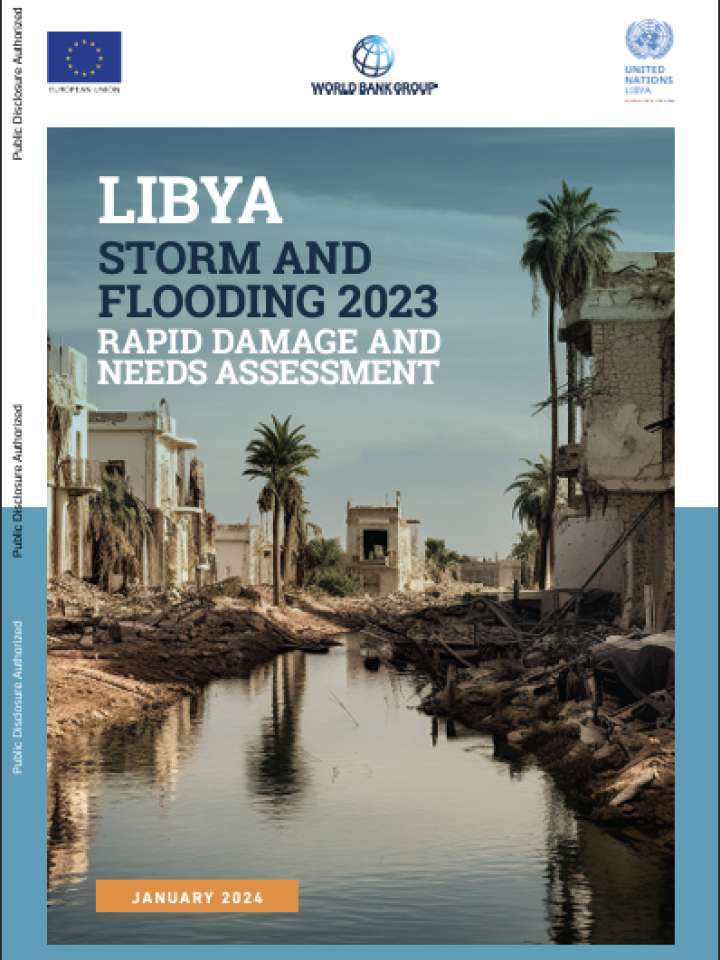
Libya storm and flooding 2023: Rapid damage and needs assessment
The objective of the Rapid Damage and Needs Assessment (RDNA) is to estimate the impact of the storm and floods on physical assets and service delivery in the most affected areas and take stock of the ensuing recovery needs. The RDNA covers 20 municipalities and provides in in-depth analysis of the five most affected cities (Derna, Soussa, Al-Bayda, Al-Marj, and Shahhat). The RDNA employs an assessment methodology developed by the WB, EU, and UN that has been successfully applied in numerous disaster-affected countries around the World.
The disaster impacted approximately 1.5 million people – 22 per cent of Libya’s population – living in the coastal and inland cities that were hardest hit. In addition, reconstruction and recovery needs following the catastrophic flooding in eastern Libya last September are estimated at $1.8 billion. In addition to outlining the recovery and reconstruction needs, the RDNA analyses the cost of physical damages caused by the flooding and the economic losses in its aftermath. Damages and losses are estimated at $1.03 and $.62 billion, respectively. The $1.65 billion total of damages and losses account for 3.6 per cent of Libya’s GDP in 2022.
The publication proposes that improvements should be made in the are of ecosystem-based restoration and adaptation in vulnerable landscapes and watersheds. This encompasses three area of interventions: (i) restoring damaged forests (urban and rural), rangelands, wetlands, and protected areas, including infrastructure; (ii) climate-smart coastal zone restoration (mainly Derna), including measures to address sea-level rise; and (iii) nature-based solutions for flood management and water retention to supplement “grey” infrastructure, and non-structural measures proposed by other sectors.
The report also refers to projected implications of climate change:
- Temperatures are expected to rise up to 5°C by 2050, with significant impacts on the occurrence of heatwaves, and increased evaporation rates.
- Overall, changing climate is expected to reduce the rainfall by around six percent by mid-century in the affected regions.
- Sea levels are rising faster in Libya at 6.8 mm a year compared to 2.5 mm a year globally.
- Droughts are likely to increase, with more consecutive das experiencing < 1mm rainfall.
- The occurrence of extreme precipitation evens, that cause pluvial and fluvial flooding are projected to increase.