PreventionWeb
Menu
Publications
Author(s) Sophie L. Buijs Inga J. Sauer Chahan M. Kropf Samuel Juhel Zélie Stalhandske Marleen C. De Ruiter

Recovery under consecutive disasters: how recovery dynamics shape societal resilience

Source
Institute for Environmental Studies
Potsdam Institute for Climate Impact Research
ETH Zurich
Swiss Federal Office of Meteorology and Climatology (MeteoSwiss)

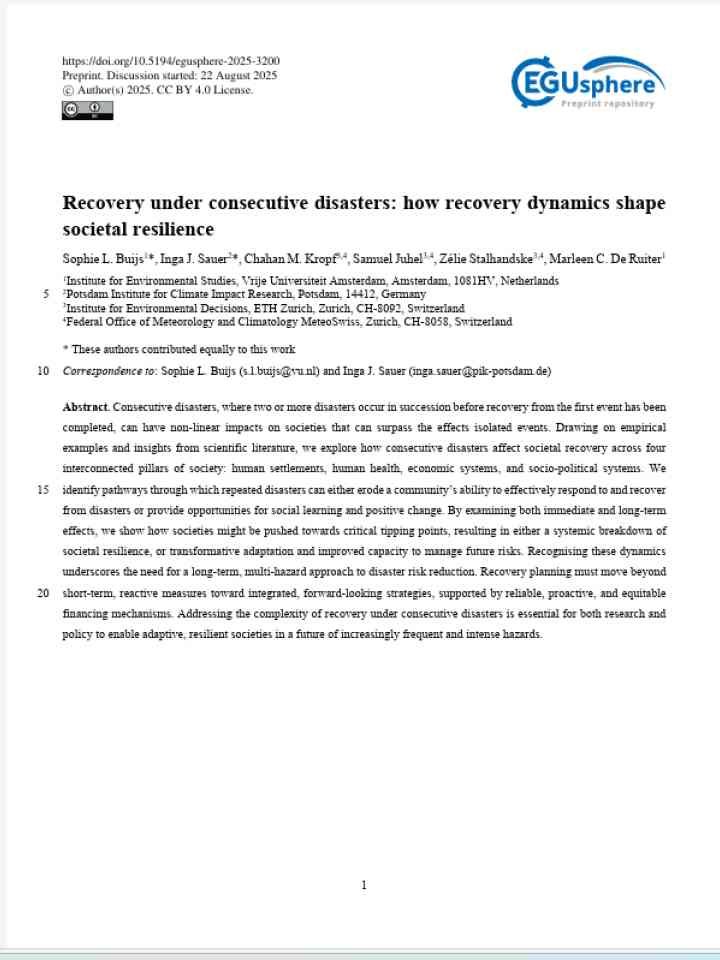
The paper explores the concept of consecutive disasters, defined as multiple disasters occurring before recovery from a prior event is complete. It argues that such events can produce non-linear and compounding impacts that exceed the sum of individual disasters. The authors examine how recovery processes influence societal resilience across four interconnected pillars: human settlements, human health, economic systems, and socio-political systems.

The study shows that incomplete or delayed recovery can increase vulnerability, create feedback loops, and push societies toward negative tipping points. For example, displacement, weakened institutions, economic disruption, and political instability may intensify risks during subsequent disasters. The paper also discusses maladaptation and “asynergies,” where rebuilding efforts focused on one hazard may unintentionally increase vulnerability to others.

At the same time, the authors emphasize that consecutive disasters can create opportunities for learning, institutional reform, and improved preparedness. They advocate for a long-term, multi-hazard disaster risk reduction approach, proactive and equitable recovery financing, and integrated planning across sectors. The paper concludes that recovery should be treated as a central and dynamic component of disaster risk management.

Download

Recovery under consecutive disasters: how recovery dynamics shape societal resilience PDF, 3.1 MB English

Last checked: 25 February 2026

Editors' recommendations

  • Critical assessment of lifeline system performance: Understanding societal needs in disaster recovery
  • ‘Natural’ disasters are due to societal failures – so, here’s a six-point pandemic recovery plan
  • Preventing natural hazards from becoming societal disasters

Explore further

Themes Governance Recovery Social impacts and social resilience
Cover_Institute for Environmental Studies, Vrije Universiteit Amsterdam (Netherlands)
ISBN/ISSN/DOI
https://doi.org/10.5194/egusphere-2025-3200
Number of pages
42 p.
Publication year
2025

Is this page useful?

Yes No
Report an issue on this page

Thank you. If you have 2 minutes, we would benefit from additional feedback (link opens in a new window).

The International Recovery Platform (IRP) is a global partnership working to strengthen knowledge, and share experiences and lessons on building back better in recovery, rehabilitation, and reconstruction.

Latest IRP videos and photos: YouTube Flickr Contact IRP

Loading