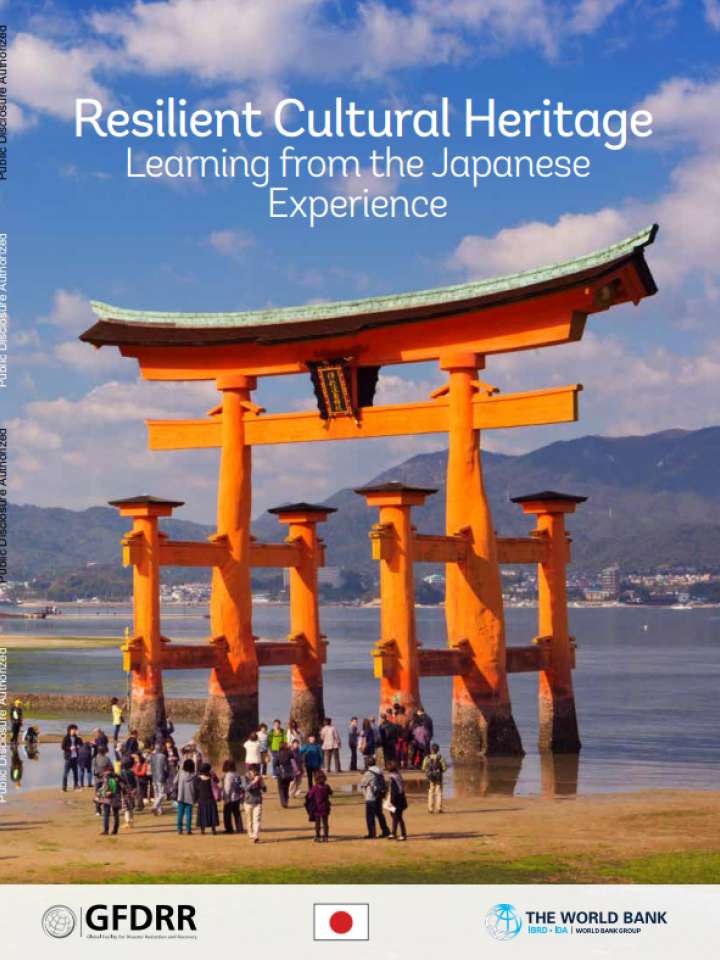
Resilient cultural heritage : Learning from the Japanese experience (English)
This document focuses on best practices and lessons learned from Japan regarding resilient culturage heritage (CH) that might be of assistance in other contexts.
However, while Japan takes the protection of its CH very seriously, exposed as it is to a vast range of hazards, the country also faces several challenges and obstacles in operationalizing DRM for CH. For example, an issue faced throughout Japan is a situation, such as in the Kyoto’s Sannei-zaka area, where local residents no longer live in the traditional homes in the neighborhood because they are often too expensive to restore or upgrade for use in contemporary contexts. In some cases, permissions may be hard to obtain for their adaptive use, resulting in many empty properties that look impressive from the street but are in fact uninhabited (or inhabited only for limited periods). This is both a cause and a consequence of the erosion of the local community. Similar challenges are found in old towns in European countries, such as Italy or the United Kingdom.
Some specific lessons highlighted in the example of Japan include:
- Documenting and categorizing CH is a critical first step to understanding risks to CH and protecting it.
- Investing in interagency cooperation before disasters improves performance throughout the DRM process.
- Involving the local community in CH sites—for risk identification, reduction, preparedness and response, and recovery—provides these sites with better protection.
- Integrating CH into existing risk identification processes and conducting targeted multi-hazard risk assessments for CH assets and sites make action easier and more likely.
- Risk-informed monitoring and maintenance of historic sites allows better prioritization of conservation efforts, while culturally informed DRM measures help better protect sites’ intrinsic values.
- Adopting a mix of “hard” and “soft” measures for risk reduction, preparedness, and response for CH sites can provide a useful protection against natural hazards.
- Traditional knowledge may provide clues to better protect traditional—and even new—structures.
- Rapid resilient recovery efforts may make the difference for preventing unnecessary losses.
- The DRM of CH sites may be improved through coordination with the tourism sector.
- The replication of initiatives and good practices should be promoted country wide.
Please have a look at pp. 82-3 for more details on recommendations.