PreventionWeb
Menu
Author(s) Kim A. Johnston Maureen Taylor Barbara Ryan

Engaging communities to prepare for natural hazards: a conceptual model

Source
Natural Hazards (Springer)

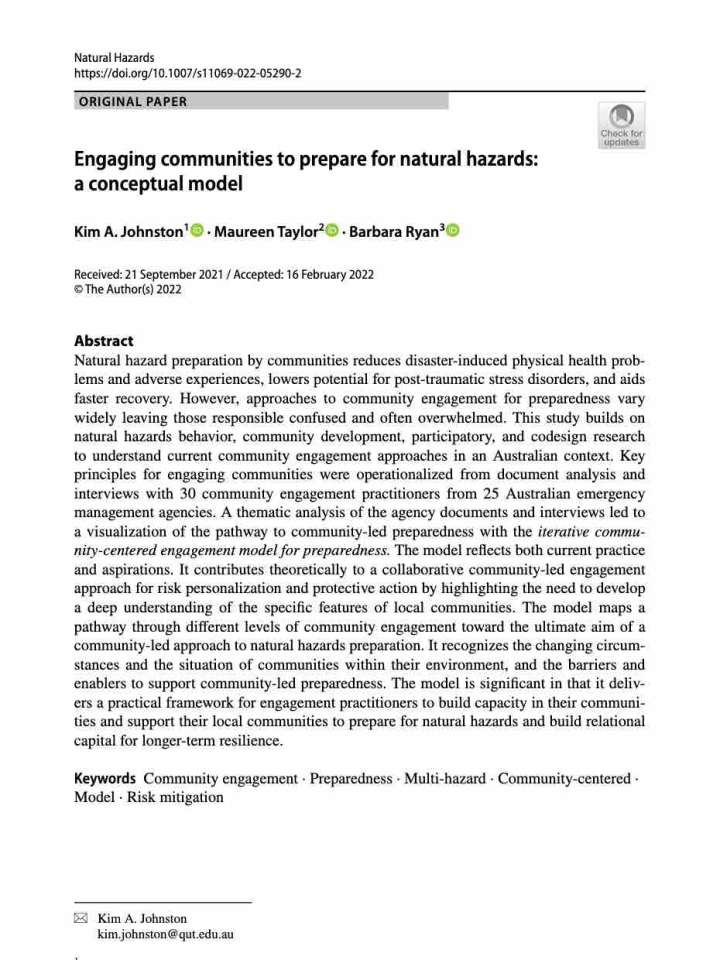
This study builds on natural hazards behavior, community development, participatory, and codesign research to understand current community engagement approaches in an Australian context. Key principles for engaging communities were operationalized from document analysis and interviews with 30 community engagement practitioners from 25 Australian emergency management agencies. A thematic analysis of the agency documents and interviews led to a visualization of the pathway to community-led preparedness with the iterative community-centered engagement model for preparedness.

The model maps a pathway through different levels of community engagement toward the ultimate aim of a community-led approach to natural hazards preparation. It recognizes the changing circumstances and the situation of communities within their environment, and the barriers and enablers to support community-led preparedness. Natural hazard preparation by communities reduces disaster-induced physical health problems and adverse experiences, lowers potential for post-traumatic stress disorders, and aids faster recovery. However, approaches to community engagement for preparedness vary widely leaving those responsible confused and often overwhelmed.

Download

Access Engaging communities to prepare for natural hazards: a conceptual model
Download a backup copy hosted by this site PDF, 0.8 MB

We keep a copy of many documents to improve long-term access. Use this if the publisher’s site is slow or unavailable. Problems? Contact us.

Last checked: 8 March 2022

Editors' recommendations

  • Virtual reality experiment shows most people living in high-risk fire zones are “woefully unprepared”
  • Development of a national set of community service announcements for flood risk
  • Pacific Prepared - Disaster preparedness can be fun
  • How scientists and communities can build partnerships to deal with floods: learning from Indonesia

Explore further

Themes Community-based DRR Preparedness Recovery
Country and region Australia
Cover of the publication
ISBN/ISSN/DOI
0.1007/s11069-022-05290-2 (DOI)
Number of pages
21 p.
Publication year
2022

Also featured on

PreventionWeb

Is this page useful?

Yes No
Report an issue on this page

Thank you. If you have 2 minutes, we would benefit from additional feedback (link opens in a new window).

The International Recovery Platform (IRP) is a global partnership working to strengthen knowledge, and share experiences and lessons on building back better in recovery, rehabilitation, and reconstruction.

Latest IRP videos and photos: YouTube Flickr Contact IRP

Loading