PreventionWeb
Menu
Author(s) Geekiyanage, Devindi; Keraminiyage, Kaushal; Fernando, Terrence et al.

Factors influencing acceptance or rejection regarding being the host community for post-disaster resettlements in developing countries

Source
International Journal of Disaster Risk Reduction (Elsevier)

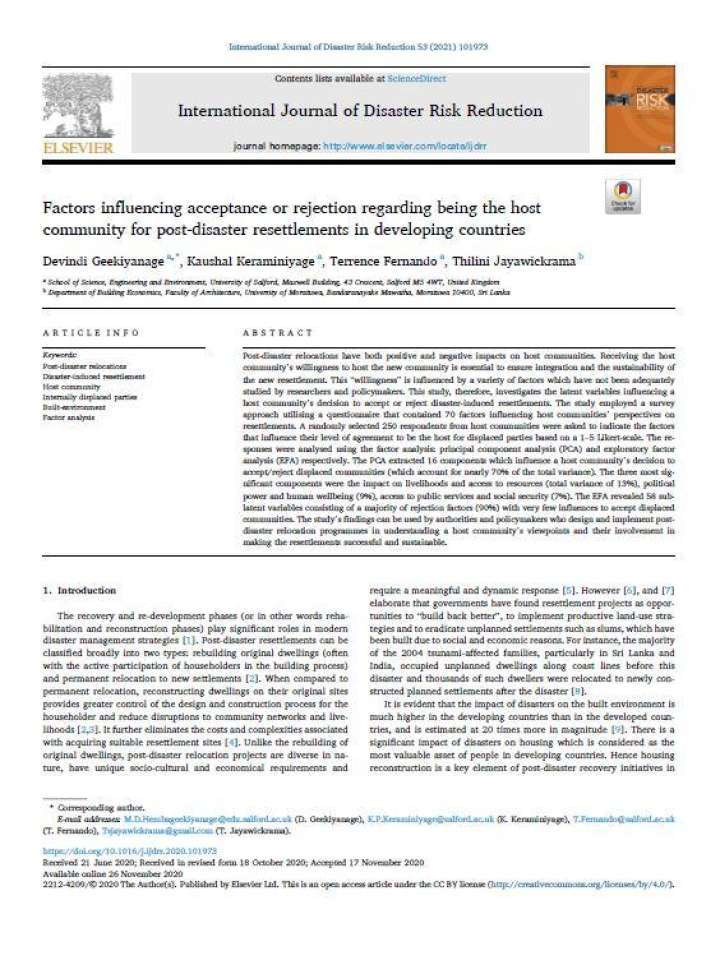
This study investigates the latent variables influencing a host community's decision to accept or reject disaster-induced resettlements. The study employed a survey approach utilising a questionnaire that contained 70 factors influencing host communities' perspectives on resettlements. The responses were analysed using the factor analysis: principal component analysis (PCA) and exploratory factor analysis (EFA) respectively.

The PCA extracted 16 components which influence a host community's decision to accept/reject displaced communities (which account for nearly 70% of the total variance). The three most significant components were the impact on livelihoods and access to resources (total variance of 13%), political power and human wellbeing (9%), access to public services and social security (7%).

The study's findings can be used by authorities and policymakers who design and implement post-disaster relocation programmes in understanding a host community's viewpoints and their involvement in making the resettlements successful and sustainable.

Download

Access Factors influencing acceptance or rejection regarding being the host community for post-disaster resettlements in developing countries English

Last checked: 16 July 2021

Editors' recommendations

  • The influence of land tenure and dwelling occupancy on disaster risk reduction. The case of eight informal settlements in six Latin American and Caribbean countries
  • Building back better (safer): A discussion on constrains to self-recovery and how affected families and communities can be better supported to achieve safer shelter and settlements after disasters
  • Cyclone Idai in Zimbabwe: An analysis of policy implications for post-disaster institutional development to strengthen disaster risk management
  • Resolving post-disaster displacement: insights from the Philippines after Typhoon Haiyan (Yolanda)
  • Post-disaster reconstruction and change: communities' perspective

Explore further

Themes Recovery Human mobility
ISBN/ISSN/DOI
10.1016/j.ijdrr.2020.101973 (DOI)
Number of pages
12 p.
Publication year
2021

Also featured on

PreventionWeb

Is this page useful?

Yes No
Report an issue on this page

Thank you. If you have 2 minutes, we would benefit from additional feedback (link opens in a new window).

The International Recovery Platform (IRP) is a global partnership working to strengthen knowledge, and share experiences and lessons on building back better in recovery, rehabilitation, and reconstruction.

Latest IRP videos and photos: YouTube Flickr Contact IRP

Loading