PreventionWeb
Menu

International Journal of Disaster Risk Reduction (Elsevier)

IJDRR

Mission

The International Journal of Disaster Risk Reduction (IJDRR) is the journal for researchers, policymakers and practitioners across diverse disciplines: earth sciences and their implications; environmental sciences; engineering; urban studies; geography; and the social sciences. IJDRR publishes fundamental and applied research, critical reviews, policy papers and case studies with a particular focus on multi-disciplinary research that aims to reduce the impact of natural, technological, social and intentional disasters. IJDRR stimulates exchange of ideas and knowledge transfer on disaster research, mitigation, adaptation, prevention and risk reduction at all geographical scales: local, national and international.
Show more
Latest additions
Items: 46
Publication
Published on
26 January 2026
Recurrent risk and the disaster loop: A forensic approach to urban flooding
This publication examines how recurrent flooding in Guadalajara, Mexico, is not the result of isolated hydrometeorological events but the outcome of long-standing socio-spatial, institutional, and historical processes shaped by inequality.
Publication
Published on
18 December 2025
Follow-up of the post-seismic reconstruction in Le Teil from the November 11th 2019 seismic event to now: Insights and zoom over building rehabilitation
This work focuses on field monitoring of certain resilience parameters, such as the time for reconstruction and repairs from the effects of the 2019 earthquake that strongly affected the municipality of Le Teil, Rhone Valley, France.
Publication
Published on
12 December 2025
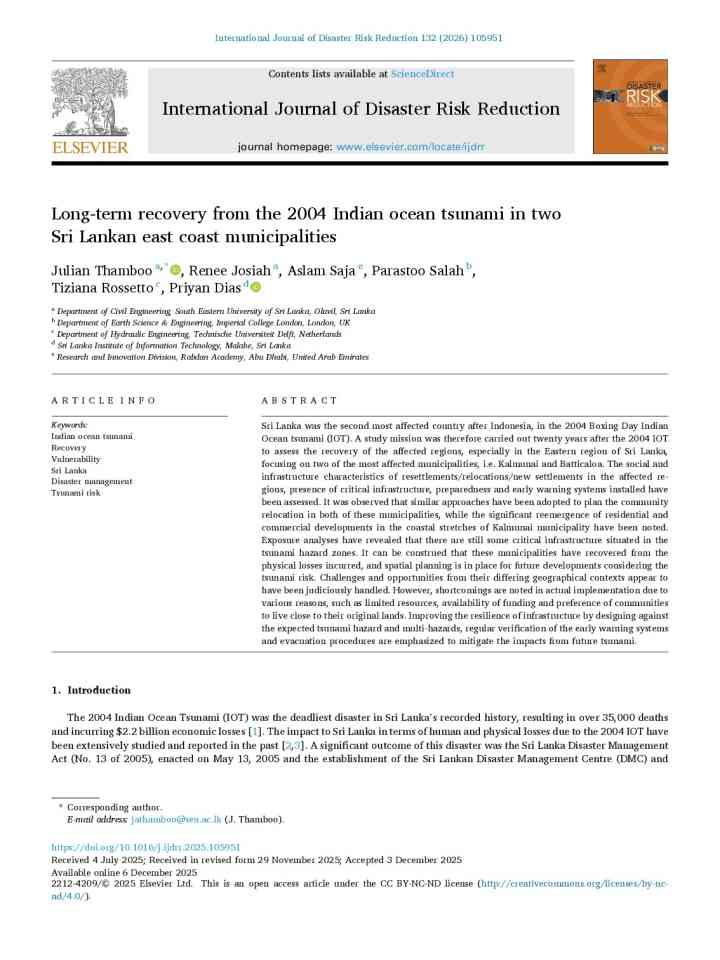
Long-term recovery from the 2004 Indian ocean tsunami in two Sri Lankan east coast municipalities
This paper talks about a study mission that was carried out twenty years after the 2004 Indian Ocean tsunami (IOT) to assess the recovery of the affected regions, especially in the Eastern region of Sri Lanka.
Publication
Published on
30 November 2025
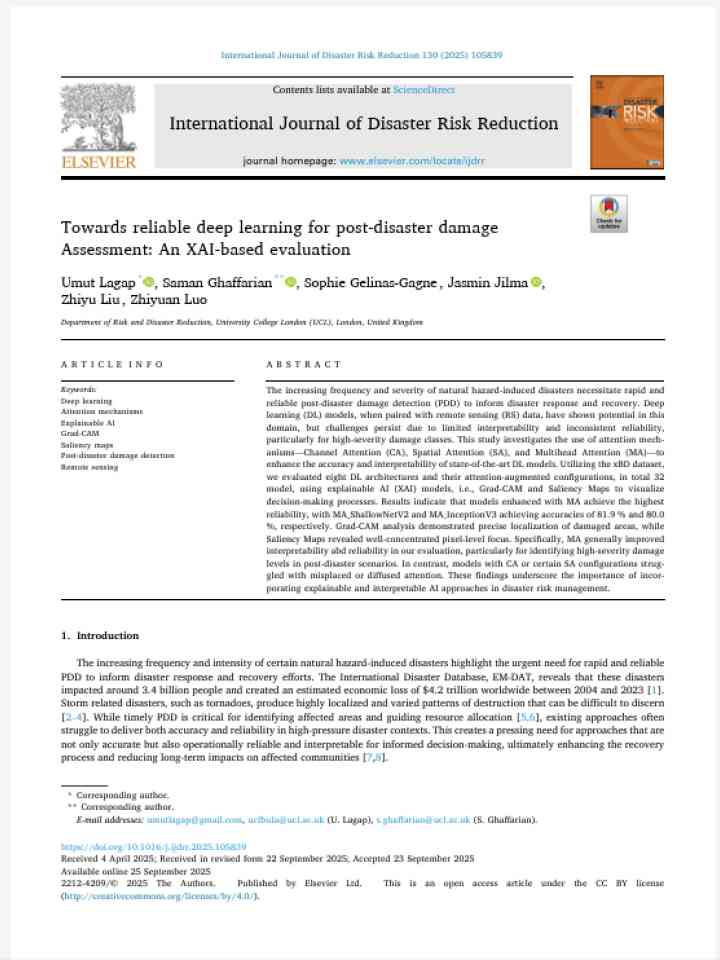
Towards reliable deep learning for post-disaster damage Assessment: An XAI-based evaluation
This study evaluates how attention mechanisms and explainable AI (XAI) techniques can improve the reliability and interpretability of deep learning models for post-disaster building damage assessment using satellite imagery.
Publication
Published on
27 November 2025
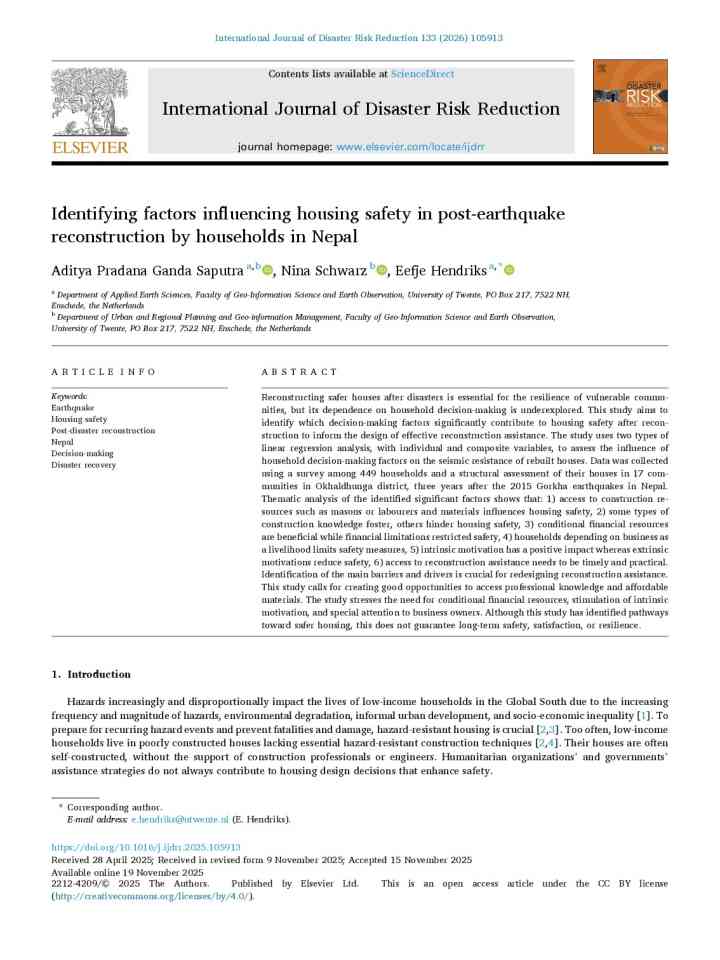
Identifying factors influencing housing safety in post-earthquake reconstruction by households in Nepal
This study aims to identify which decision-making factors significantly contribute to housing safety after reconstruction to inform the design of effective reconstruction assistance.
Publication
Published on
1 October 2025
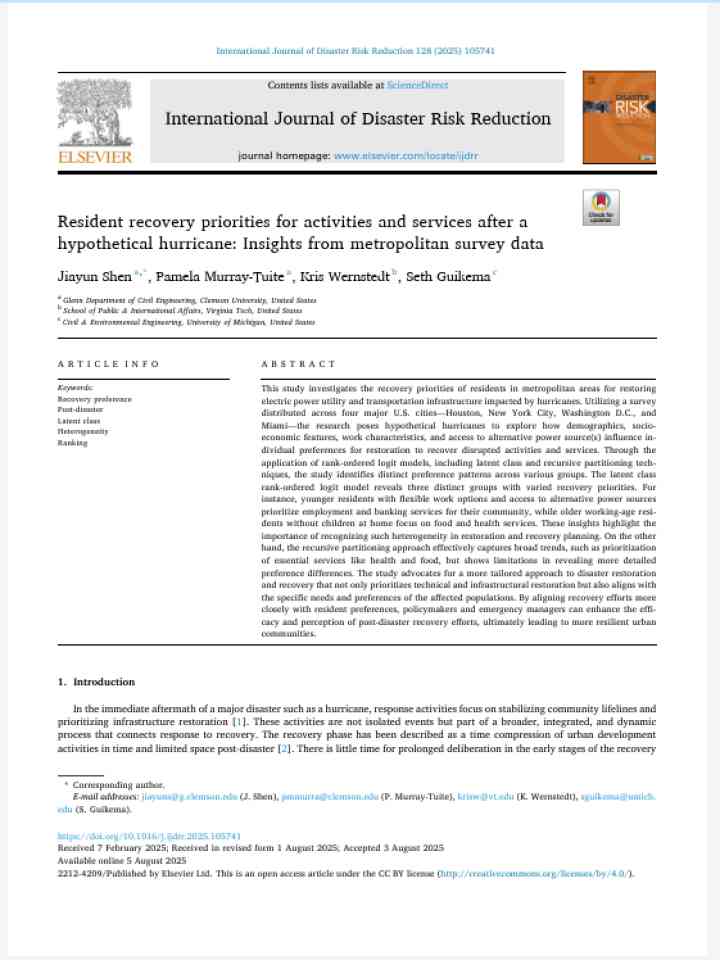
Resident recovery priorities for activities and services after a hypothetical hurricane: Insights from metropolitan survey data
The study advocates for a more tailored approach to disaster restoration and recovery that not only prioritizes technical and infrastructural restoration but also aligns with the specific needs and preferences of the affected populations.
Publication
Published on
30 September 2025
The resilience paradox: Rural self-reliance and the limits of disaster recovery
This academic study explores how rural communities in Western Australia rely on self-reliance to recover from extreme weather, while facing growing limits to long-term resilience under climate change.
Publication
Published on
26 September 2025
Supporting “Build Back Better” in historical towns: a novel methodology to include users’ exposure and vulnerability in strategic function relocation assessment
This work aims to develop a methodological framework to evaluate the multi-scale impact of function relocation in Historical Urban Built Environments (HUBEs) assessing users' vulnerability and exposure.

Pagination

  • Previous page ‹ Previous
  • Current page 1
  • Page 2
  • Page 3
  • Page 4
  • Page 5
  • Page 6
  • Next page Next ›

More content for this organization may be available on PreventionWeb or on the site search.

Voluntary Commitments

The organization has no registered commitments.

The Sendai Framework Voluntary Commitments (SFVC) online platform allows stakeholders to inform the public about their work on DRR. The SFVC online platform is a useful toolto know who is doing what and where for the implementation of the Sendai Framework, which could foster potential collaboration among stakeholders. All stakeholders (private sector, civil society organizations, academia, media, local governments, etc.) working on DRR can submit their commitments and report on their progress and deliverables.

Contact information

https://www.journals.elsevier.com/international-journal-of-disaster-risk-reduct…

Is this page useful?

Yes No
Report an issue on this page

Thank you. If you have 2 minutes, we would benefit from additional feedback (link opens in a new window).

The International Recovery Platform (IRP) is a global partnership working to strengthen knowledge, and share experiences and lessons on building back better in recovery, rehabilitation, and reconstruction.

Latest IRP videos and photos: YouTube Flickr Contact IRP

Loading