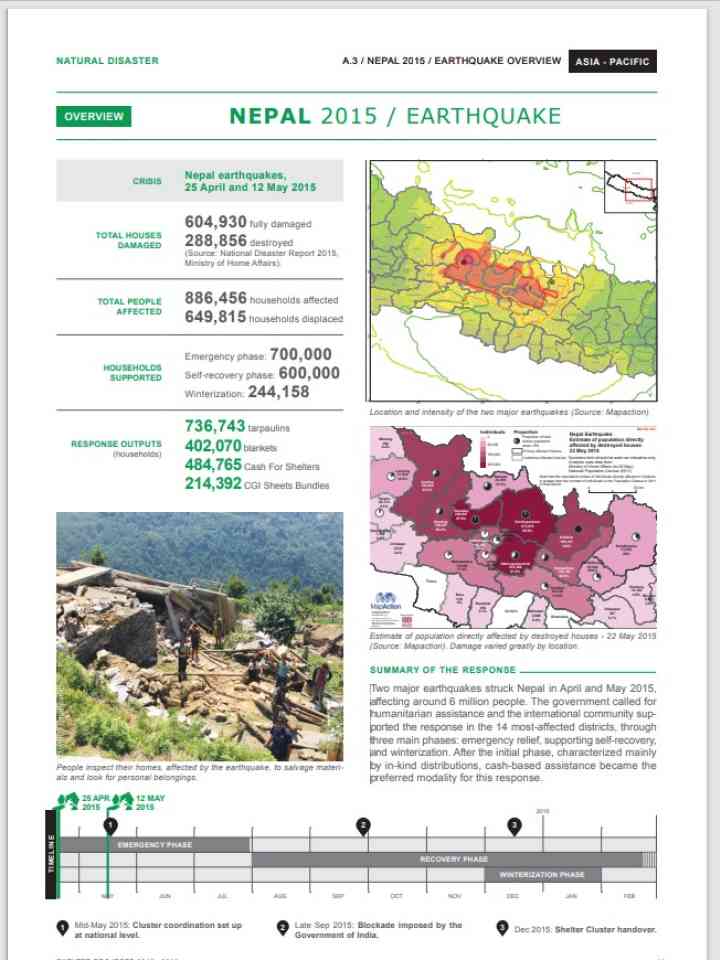
The document provides a comprehensive overview of the response to the devastating earthquakes that struck Nepal in April and May 2015, affecting approximately 6 million people. The earthquakes, with magnitudes of 7.8 and 7.3, resulted in significant loss of life and widespread destruction, leading to a humanitarian crisis. The government of Nepal, recognizing the scale of the disaster, called for international assistance, which was organized into three main phases: emergency relief, support for self-recovery, and winterization. The response involved over 300 organizations and emphasized cash-based assistance, enabling affected families to make choices suited to their needs.
Before the earthquakes, Nepal faced numerous challenges, including high poverty rates and vulnerability to natural disasters. The socio-economic landscape was complicated by migration patterns, with many young men leaving rural areas for work, leaving women and elderly individuals to manage households. The political environment was also unstable, affecting the government's ability to respond effectively to the disaster. Despite prior efforts to improve housing regulations and disaster preparedness, many homes were built without seismic considerations, exacerbating the damage during the earthquakes. Vulnerable groups, including female-headed households and marginalized communities, were disproportionately affected, highlighting the need for targeted assistance in recovery efforts.
The response to the earthquakes faced significant challenges, including political unrest and logistical difficulties in reaching remote areas. A blockade in late 2015 led to shortages of fuel and relief supplies, complicating the humanitarian effort. While the overall response was effective, with high coverage of assistance, disparities in aid distribution raised concerns about equity in recovery. Lessons learned from this disaster emphasize the importance of cash-based assistance, the need for better coordination with the private sector, and the necessity of maintaining strong relationships between humanitarian agencies and the government for future disaster preparedness and response efforts.
Explore further