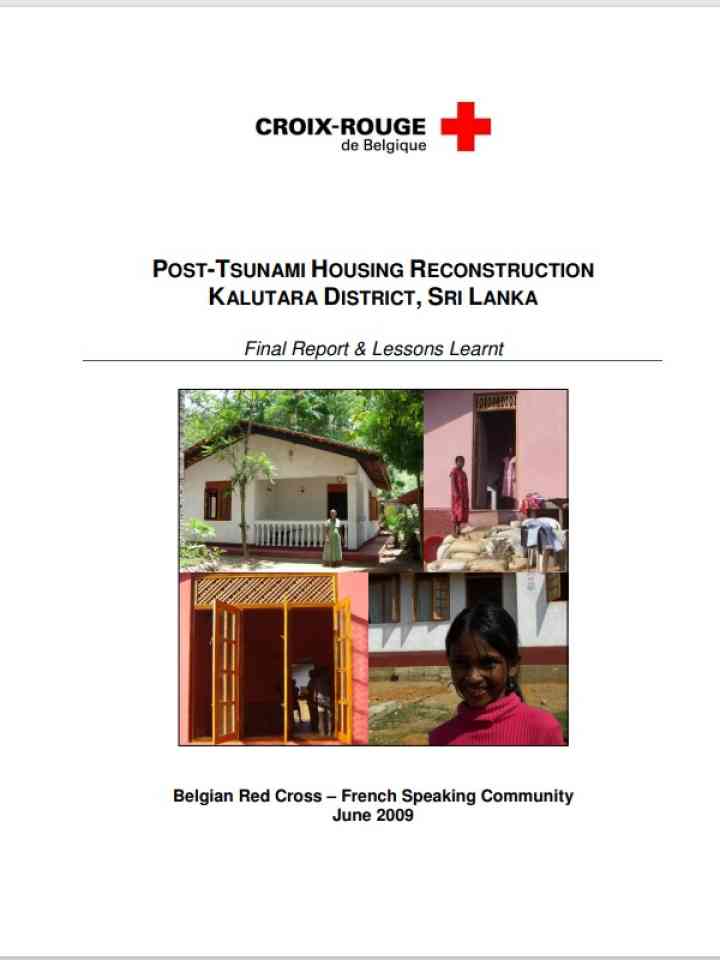
Post-Tsunami Housing Reconstruction, Kalutara District, Sri Lanka - Final Report & Lessons Learnt
The tsunami that struck Sri Lanka on 26th December 2004 caused the loss of over 35,000 lives and the destruction of over 65,000 houses, as well as social upheaval and psychological trauma for the survivors. Between March 2005 and May 2009, Belgian Red Cross -French speaking community (CRB) implemented a housing reconstruction project in the District of Kalutara, on the South-West coast of Sri Lanka. With co-funding from the Luxemburg Red Cross and the Rode Kruis Vlaanderen, CRB funded the construction of four-hundred and ninety-six high quality houses, including ten resettlement sites on land donated by the government. In the resettlement sites, infrastructure such as roads and drains, and community facilities such as community centres and children's play parks were also constructed. Drinking water infrastructure was also provided where necessary.
Alongside the construction programme, CRB ran a community programme in the resettlement sites. The programme supported the new communities in building up the organisations, relationships, and knowledge necessary to act collectively to make the settlement sustainable, both physically and socially. As part of the community programme, CRB also promoted land rights for housing beneficiaries on state land, and advocated within the Red Cross Movement for similar programmes to be run on a wider scale.
CRB constructed almost all housing under an 'owner-driven' approach, in which beneficiaries were given cash grants and managed the reconstruction themselves with CRB's supervision and support. Using this system, CRB was able to start reconstruction before other Partner National Societies (PNSs). The owner-driven approach also made beneficiaries the central actors in their recovery, which helped them to realise their strengths, and focus achievable goals while rebuilding their lives.
CRB recognises that there are many lessons to be learnt going forward. Some aspects of the project were very well executed, such as beneficiary selection and cash-for-housing implementation. Others left room for improvement. Amongst the most significant shortcomings was CRB's initial failure to recognise the great challenges involved in successfully resettling people. Further, weak project management had a negative impact on objectives and approach, as well as efficiency and organisation. A selection of the most important recommendations from the 'Lessons Learnt' section of this report is given below. Some of the recommendations were fully or partially implemented by CRB, while others are to be adopted for future projects.
Explore further