PreventionWeb
Menu
Case Study
Author(s) Watanabe, Hajime; Maruyama, Takuya

Residential preference transitions of disaster victims: A case using three-wave panel data in Mashiki following the 2016 Kumamoto earthquake in Japan

Source
International Journal of Disaster Risk Reduction (Elsevier)

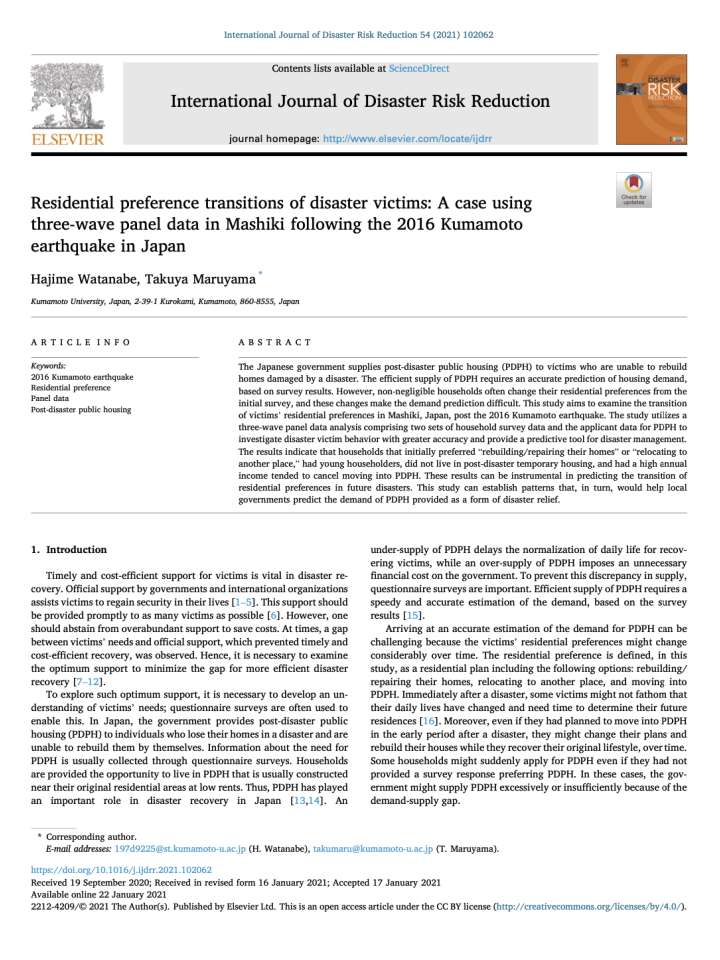
This study aims to examine the transition of victims’ residential preferences in Mashiki, Japan, post the 2016 Kumamoto earthquake. The Japanese government supplies post-disaster public housing (PDPH) to victims who are unable to rebuild homes damaged by a disaster. The efficient supply of PDPH requires an accurate prediction of housing demand, based on survey results. However, non-negligible households often change their residential preferences from the initial survey, and these changes make the demand prediction difficult. The study utilizes a three-wave panel data analysis comprising two sets of household survey data and the applicant data for PDPH to investigate disaster victim behavior with greater accuracy and provide a predictive tool for disaster management.

The results indicate that households that initially preferred “rebuilding/repairing their homes” or “relocating to another place,” had young householders, did not live in post-disaster temporary housing, and had a high annual income tended to cancel moving into PDPH. These results can be instrumental in predicting the transition of residential preferences in future disasters. This study can establish patterns that, in turn, would help local governments predict the demand of PDPH provided as a form of disaster relief.

Download

Access Residential preference transitions of disaster victims: A case using three-wave panel data in Mashiki following the 2016 Kumamoto earthquake in Japan English

Last checked: 16 July 2021

Editors' recommendations

  • Earthquake risk in multifamily residential buildings : Europe and Central Asia region (English)
  • Recovery curves for housing reconstruction from the 2011 Great East Japan Earthquake and comparison with other post-disaster recovery processes
  • Transition of post-disaster housing of rural households: A case study of the 2015 Gorkha earthquake in Nepal
  • Japan: New way to sense earthquakes could help improve early warning systemsv
  • The earthquake disaster risk in Japan and Iran and the necessity of dynamic learning from large earthquake disasters over time

Explore further

Hazards Earthquake
Themes Preparedness Recovery Shelter and housing
Country and region Japan
ISBN/ISSN/DOI
10.1016/j.ijdrr.2021.102062 (DOI)
Number of pages
8 p.
Publication year
2021

Also featured on

PreventionWeb

Is this page useful?

Yes No
Report an issue on this page

Thank you. If you have 2 minutes, we would benefit from additional feedback (link opens in a new window).

The International Recovery Platform (IRP) is a global partnership working to strengthen knowledge, and share experiences and lessons on building back better in recovery, rehabilitation, and reconstruction.

Latest IRP videos and photos: YouTube Flickr Contact IRP

Loading