PreventionWeb
Menu
Case StudyPublications

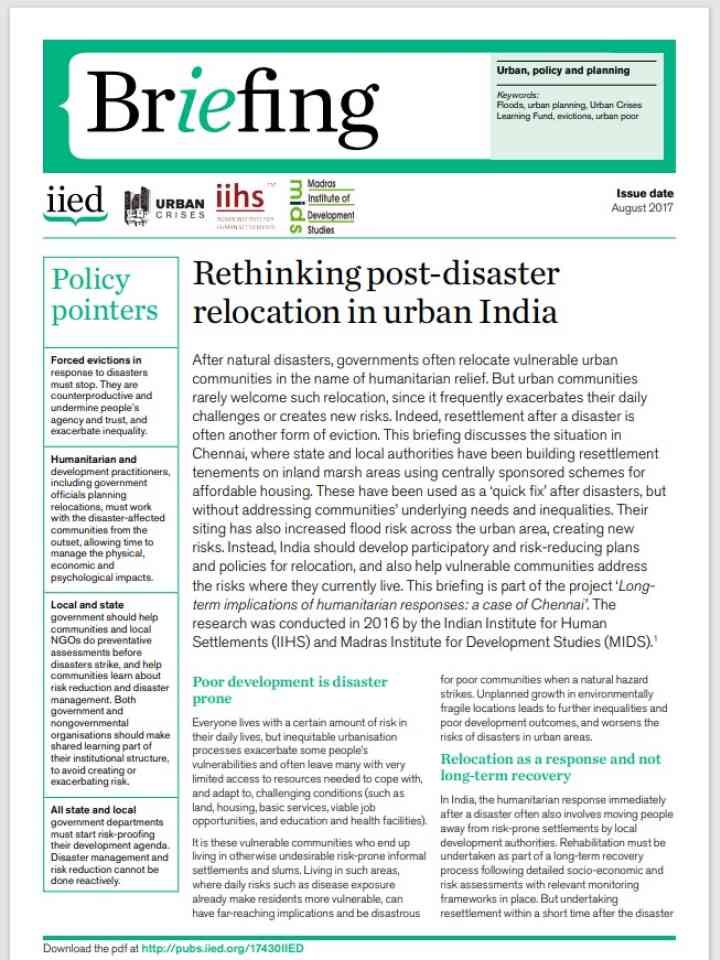
Rethinking post-disaster relocation in urban India

Source
International Institute for Environment and Development (IIED)

After natural disasters, governments often relocate vulnerable urban communities in the name of humanitarian relief. But urban communities rarely welcome such relocation, since it frequently exacerbates their daily challenges or creates new risks. Indeed, resettlement after a disaster is often another form of eviction.

This briefing discusses the situation in Chennai, where state and local authorities have been building resettlement tenements on inland marsh areas using centrally sponsored schemes for affordable housing. These have been used as a 'quick fix' after disasters, but without addressing communities' underlying needs and inequalities. Their siting has also increased flood risk across the urban area, creating new risks. Instead, India should develop participatory and risk-reducing plans and policies for relocation, and also help vulnerable communities address the risks where they currently live.

This briefing is part of the project 'Longterm implications of humanitarian responses: a case of Chennai'. The research was conducted in 2016 by the Indian Institute for Human Settlements (IIHS) and Madras Institute for Development Studies (MIDS).

Download

Rethinking post-disaster relocation in urban India PDF, 0.5 MB English

Last checked: 4 September 2024

Editors' recommendations

  • Forced relocation after the Indian Ocean tsunami 2004: case study of vulnerable populations in three relocation settlements in Galle Sri Lanka
  • Modelling a community resilience index for urban flood-prone areas of Kerala, India (CRIF)
  • An inquiry into success factors for post-disaster housing reconstruction projects: A Case of Kerala, South India

Explore further

Hazards Flood
Themes Recovery Shelter and housing Urban risk and planning
Country and region India
Rethinking post-disaster relocation in urban India
Number of pages
4 p.
Publication year
2017

Is this page useful?

Yes No
Report an issue on this page

Thank you. If you have 2 minutes, we would benefit from additional feedback (link opens in a new window).

The International Recovery Platform (IRP) is a global partnership working to strengthen knowledge, and share experiences and lessons on building back better in recovery, rehabilitation, and reconstruction.

Latest IRP videos and photos: YouTube Flickr Contact IRP

Loading