PreventionWeb
Menu
Author(s) John Gibson Yi Jiang Xiaoxuan Zhang et al.

Are disaster impact estimates distorted by errors in popular night-time lights data?

Source
Economics of Disasters and Climate Change (Springer)

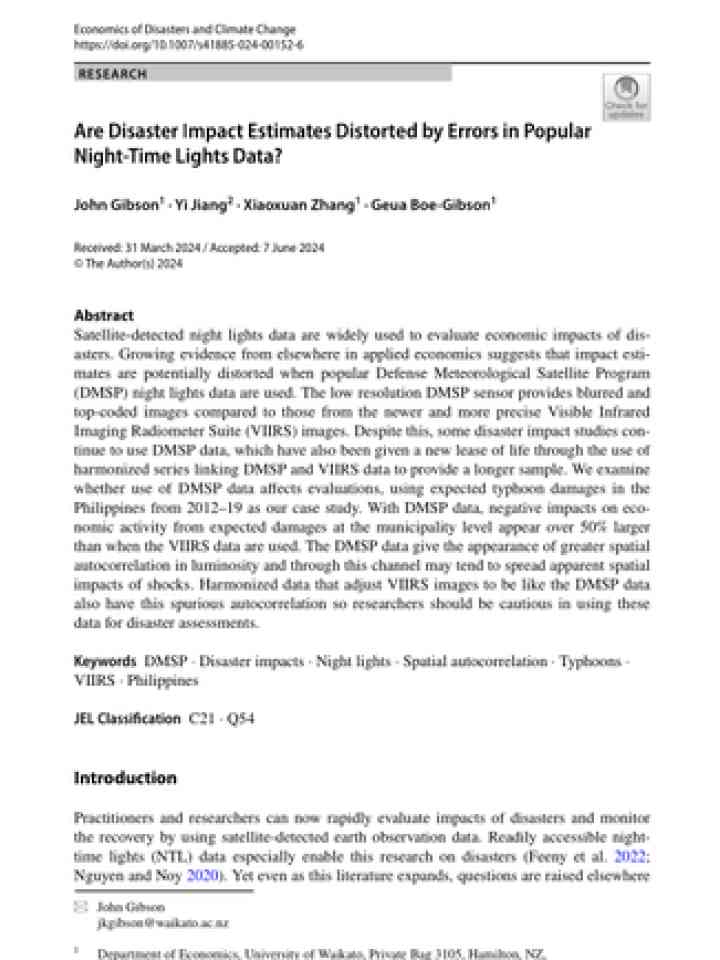
In this study it's examined whether use of Defense Meteorological Satellite Program (DMSP) data affects evaluations, using expected typhoon damages in the Philippines from 2012–19 as our case study. With DMSP data, negative impacts on economic activity from expected damages at the municipality level appear over 50% larger than when the Visible Infrared Imaging Radiometer (VIIRS) data are used. The DMSP data give the appearance of greater spatial autocorrelation in luminosity and through this channel may tend to spread apparent spatial impacts of shocks. Harmonized data that adjust VIIRS images to be like the DMSP data also have this spurious autocorrelation so researchers should be cautious in using these data for disaster assessments.

Satellite-detected night lights data are widely used to evaluate economic impacts of disasters. Growing evidence from elsewhere in applied economics suggests that impact estimates are potentially distorted when popular night lights data are used. The low resolution DMSP sensor provides blurred and top-coded images compared to those from the newer and more precise Visible Infrared Imaging Radiometer Suite (VIIRS) images. Despite this, some disaster impact studies continue to use DMSP data, which have also been given a new lease of life through the use of harmonized series linking DMSP and VIIRS data to provide a longer sample.

Download

Access Are disaster impact estimates distorted by errors in popular night-time lights data?
Download a backup copy hosted by this site PDF, 3 MB English

We keep a copy of many documents to improve long-term access. Use this if the publisher’s site is slow or unavailable. Problems? Contact us.

Last checked: 27 June 2024

Editors' recommendations

  • Türkiye earthquakes one year on: the devastation has exposed deep societal scars and women are bearing the brunt
  • High availability versus disaster recovery: Four elements of high availability infrastructure
  • Ahead of the storm: An innovative disaster recovery planning tool is now available in the Caribbean
  • Navigating challenges of rising climate risks: Countries push to accelerate progress with recovery and building back better

Explore further

Themes Data and information management Recovery
Country and region Philippines
Cover
ISBN/ISSN/DOI
10.1007/s41885-024-00152-6 (DOI)
Number of pages
26 p.
Publication year
2024

Also featured on

PreventionWeb

Is this page useful?

Yes No
Report an issue on this page

Thank you. If you have 2 minutes, we would benefit from additional feedback (link opens in a new window).

The International Recovery Platform (IRP) is a global partnership working to strengthen knowledge, and share experiences and lessons on building back better in recovery, rehabilitation, and reconstruction.

Latest IRP videos and photos: YouTube Flickr Contact IRP

Loading