PreventionWeb
Menu

The role of resilient housing reconstruction in disaster risk management in fragile, conflict, and violence-affected countries

Source
World Bank, the

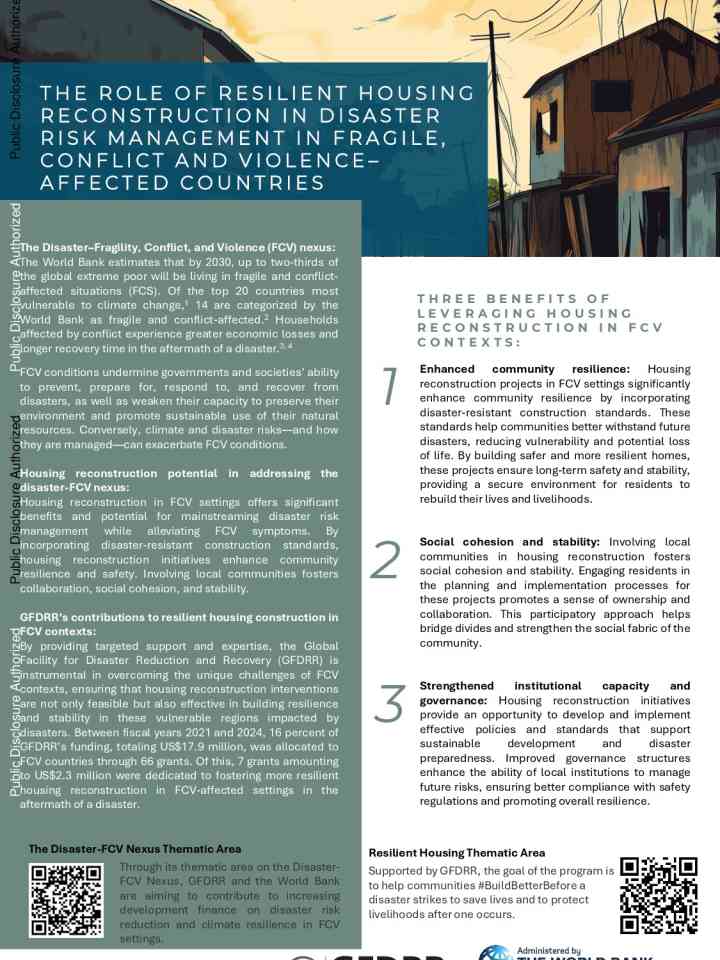
This factsheet outlines the critical role of resilient housing reconstruction in disaster risk management within Fragile, Conflict, and Violence (FCV) contexts. It frames the Disaster–FCV nexus, where climate vulnerability and conflict intersect to exacerbate poverty and impede recovery, and draws on World Bank portfolio data and case studies from Lebanon and Sri Lanka.

The document identifies three core benefits of housing reconstruction: stronger resilience through disaster‑resistant standards, improved social cohesion via inclusive community participation, and enhanced institutional capacity and governance. It also highlights key operational challenges, such as institutional fragility, limited access to skilled labor and materials, and social fragmentation, and recommends leveraging existing programs, conducting localized needs diagnostics, ensuring community engagement, and using preapproved, innovative solutions. From 1984–2023, the World Bank supported 10 housing reconstruction projects in 9 FCV countries, totaling 1.70 billion dollars and reconstructing 0.145 million units. The findings suggest that well‑designed housing reconstruction can accelerate physical recovery while fostering longer‑term stability and development. Limitations include context‑specific constraints and capacity gaps.
Download

Access The role of resilient housing reconstruction in Disaster Risk Management in fragile, conflict, and violence-affected countries
Download a backup copy hosted by this site PDF, 0.6 MB English

We keep a copy of many documents to improve long-term access. Use this if the publisher’s site is slow or unavailable. Problems? Contact us.

Last checked: 18 December 2025

Editors' recommendations

  • On crossroads between the right to shelter and looming chances of displacement: Charting towards a resilient and sustainable framework for rural dwellers in flood-prone areas
  • Entry points for disaster risk reduction mainstreaming in humanitarian shelter and settlements interventions
  • Assessment of physical vulnerability of buildings and socio-economic vulnerability of residents to rainfall induced cut slope failures: A case study in central highlands, Sri Lanka
  • A data-driven approach to rapidly estimate recovery potential to go beyond building damage after disasters

Explore further

Themes Fragility and conflict Recovery
Country and region Lebanon Sri Lanka
The role of resilient housing reconstruction in Disaster Risk Management in fragile, conflict, and violence-affected countries thumbnail
Number of pages
4 p.
Publication year
2025

Also featured on

PreventionWeb

Is this page useful?

Yes No
Report an issue on this page

Thank you. If you have 2 minutes, we would benefit from additional feedback (link opens in a new window).

The International Recovery Platform (IRP) is a global partnership working to strengthen knowledge, and share experiences and lessons on building back better in recovery, rehabilitation, and reconstruction.

Latest IRP videos and photos: YouTube Flickr Contact IRP

Loading