PreventionWeb
Navigation loading…

Navigation failed to load. If you are on the UNDRR office network, your browser may be blocking access to external resources. Learn how to allow access.

Menu
Last updated 11 Aug 2025

Recovery Collection: Typhoon Haiyan (Yolanda) 2013
Image
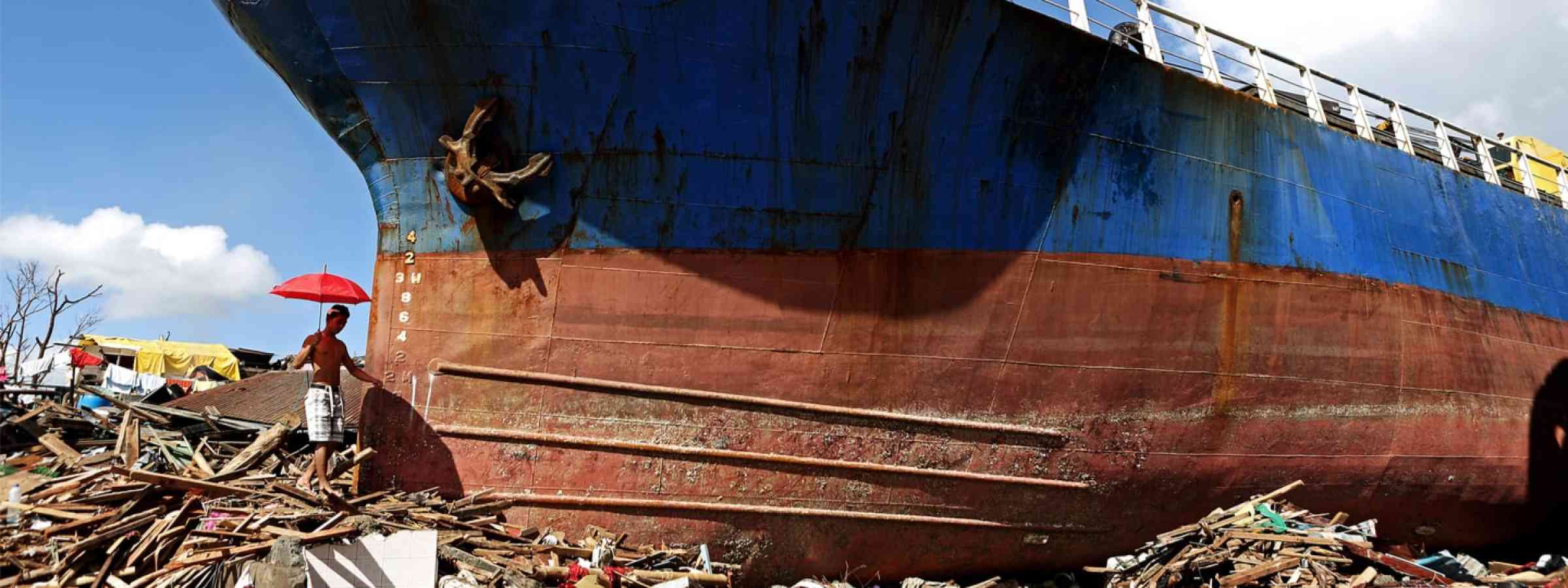
A beached boat and debris.
ymphotos/Shutterstock

Introduction

Typhoon Haiyan, locally known as Super Typhoon Yolanda, was one of the most powerful tropical cyclones on record and made landfall at the Eastern part of the Philippines on 17 November 2013. The most affected islands were Leyte and Samar. The typhoon killed over 6,000 people and affected in around 590 municipalities approximately 16 million people, including 4 million who were displaced. The typhoon also caused widespread damage to housing, livelihoods and infrastructure across nine of the poorest provinces of the country. Almost 1.1 million houses were damaged or destroyed.

The National Disaster Risk Reduction and Management Council (NDRRMC) of the Government of Philippines evacuated over 125,00 people to over 109 evacuation centres before the arrival of typhoon. Initially, the Government developed a document “Reconstruction Assistance on Yolanda”, in which the overall damages and losses from the typhoon were estimated at US$12.9 billion and the needs for recovery and reconstruction were estimated at US$8.2 billion. Subsequently, the Government developed a “Comprehensive Rehabilitation and Recovery Plan”, for the implementation of which the following five clusters were established: Food and water distribution, peace and order, shelter and reconstruction, social services as well as livelihood, employment and commerce.

The World Bank proposed as lessons learned from the typhoon to reform the NDRRMC, to create a disaster rehabilitation and recovery framework as well as effective coordination mechanisms, to develop implementation modalities and strategies for faster rehabilitation and recovery interventions, an effective emergency procurement manual as well as standards for disaster rehabilitation and recovery communications and to explore further channels of funding for disaster rehabilitation and recovery.
Hazards
Cyclone, Hurricane and Typhoon
Country and region
Philippines

Knowledge base

Items: 60
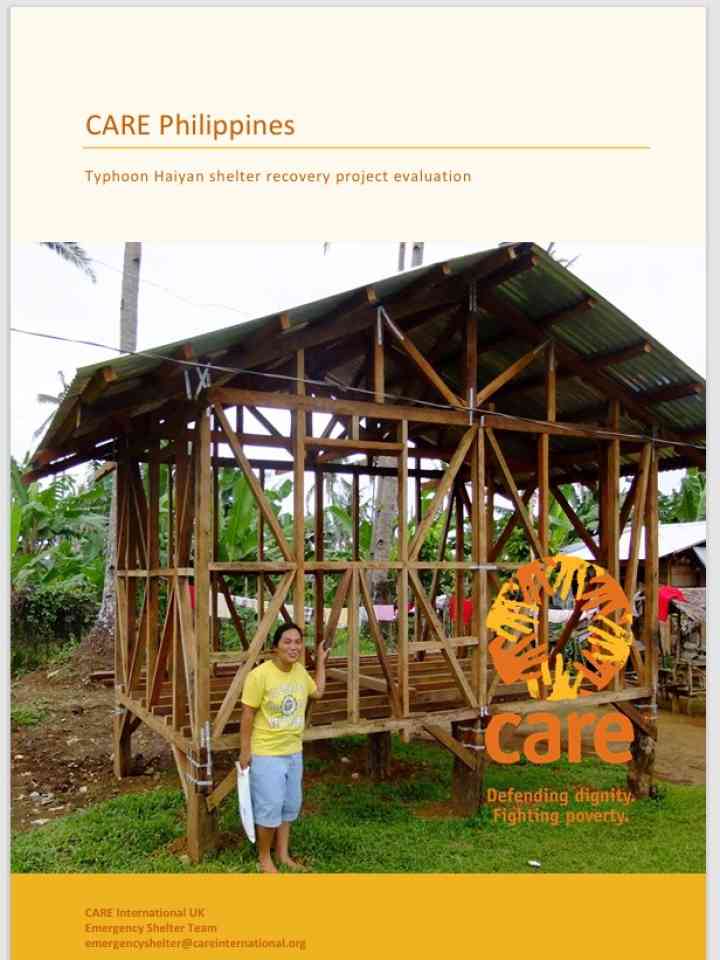
CARE Philippines: Typhoon Haiyan Shelter Recovery Project Evaluation
Documents and publications
Publications
Reports and analysis
10 November 2015
CARE Philippines: Typhoon Haiyan Shelter Recovery Project Evaluation

This report presents the findings from CARE's Emergency Shelter Team's internal evaluation of the early recovery shelter programme undertaken by CARE Philippines and its partners.

CARE International
Update
9 November 2015
Philippines: Haiyan 2 years on - Building back stronger - UNICEF - Blog

On November 8, 2013, Super Typhoon Haiyan, one of the strongest tropical cyclones ever recorded, disrupted the lives of nearly six million children and destroyed the homes of 1.4 million children and their families. Two years on, UNICEF continues to help children, families and communities rebuild their lives...

United Nations Children's Fund (UNICEF)
Photo by Flickr user CAFOD Photo Library CC BY 2.0 https://www.flickr.com/photos/cafodphotolibrary/15765722459/
Update
5 November 2015
Amid Typhoon Haiyan recovery, some feel they are left behind

Leonor Briones, president of Social Watch Philippines, a public spending watchdog, said the slow release of the 167 billion pesos ($3.6 billion) earmarked by President Benigno Aquino had caused a lot of problems for local authorities. Delays in finding rehousing sites, slowness in the release of promised funds, and difficulty finding what the money has been spent on are among the problems, officials say...

Thomson Reuters Foundation, trust.org
Support to the local tool market post-Typhoon Haiyan
Documents and publications
Case Study
Publications
10 September 2015
Support to the local tool market post-Typhoon Haiyan

The document outlines a program initiated by CRS in response to Super Typhoon Haiyan, which provided cash grants to local blacksmiths to restore agricultural tool production, enhancing access to necessary tools and supporting the recovery.

Catholic Relief Services
Update
8 September 2015
Mental health another casualty of changing climate

Extreme loss and survivor guilt after the Typhoon Yolanda (also known as Typhoon Haiyan) disaster have led to depression in at least one in 10 people in Tacloban City, write Jed Alegado and Angeli Guadalupe in an opinion piece on IPS News. But two years after the disaster, some survivors remain unaware of available mental health services...

Inter Press Service International Association
Update
31 July 2015
U.N. raps Philippines for failing to rehouse typhoon homeless

UN Special Rapporteur on the human rights of internally displaced persons urged the Philippines to speed up completion of housing for thousands made homeless by typhoon Haiyan nearly two years ago: "Many families remain housed in collective 'bunkhouses' that do not meet necessary minimum standards for the provision of basic needs and services." ...

Thomson Reuters Foundation, trust.org
Update
2 July 2015
Philippines: Post Haiyan shelter projects wraps with 660 families getting resilient houses and households strengthened against disaster - UN-HABITAT

Targets have been exceeded with 28 communities served, 660 houses built, 54 community improvements done, and over 4,500 households equipped with disaster risk reduction know-how. But the major takeaway from the project is the full demonstration of how recovery and building resilience thrive best as a shared endeavour—with the communities and families themselves driving the process...

United Nations Human Settlements Program, Disaster Mitigation Office
Documents and publications
16 June 2015
Resolving post-disaster displacement: insights from the Philippines after Typhoon Haiyan (Yolanda)

Drawing on the rights-based approach laid out in the Inter-Agency Standing Committee Framework on Durable Solutions for Internally Displaced Persons (IASC Framework) and reflected in many of the Philippines’ own domestic standards, this report analyses efforts to resolve the displacement crisis generated by Typhoon Haiyan.

International Organization for Migration (IOM)
Brookings Institution, the
Update
12 June 2015
Longer-term aid needed to stem spike in baby deaths after disasters - experts

A UN food security expert urges governments to build social safety nets for longer-term sustainability and improved food security, citing research in the Philippines that found a spike in the number of babies who die up to two years after a typhoon because families divert money from paying for healthcare and food, to restoring their homes and livelihoods...

Thomson Reuters Foundation, trust.org
Update
8 June 2015
ACTED: Alternatives to coconut - Improving disaster resilience in the Philippines

During the French presidential visit to Guiuan in February 2015, the French government reiterated its support to those most affected by the consequences of climate change in the Philippines, by supporting ACTED’s activities with the support of the French Development Agency (AFD). Part of this support will go to coconut farmers, hit severely by more and more frequent natural disasters due to global warming...

Agency for Technical Cooperation and Development (ACTED)

Pagination

Showing results 31–40 on this page

  • Previous
  • 1
  • …
  • 3
  • 4
  • 5
  • Next

Is this page useful?

Yes No
Report an issue on this page

Thank you. If you have 2 minutes, we would benefit from additional feedback (link opens in a new window).

The International Recovery Platform (IRP) is a global partnership working to strengthen knowledge, and share experiences and lessons on building back better in recovery, rehabilitation, and reconstruction.

Latest IRP videos and photos: YouTube Flickr Contact IRP

Loading