PDNA guidance

These guides support a consistent and coherent approach to the post-disaster assessment, provide an objective and comprehensive estimate of recovery needs, while facilitating quick decision-making and action

  • Featured PDNAs
  • Featured PDNAs

    PDNA is a government-led exercise, with integrated support from the United Nations, the European Commission, the World Bank and other national and international actors. A PDNA pulls together information into a single, consolidated report, information on the physical impacts of a disaster, the economic value of the damages and losses, the human impacts as experienced by the affected population, and the resulting early and long-term recovery needs and priorities.

    No results found!
  • All PDNAs
  • All PDNAs

    Floods 2008 Bolivia Assessment of the Accumulated and Additional Impact Caused by La Nina
    Documents and publications
    PDNA - Post Disaster Needs Assessments

    This Damage and Loss Assessment estimates total damage and losses caused by heavy rains that caused floods in Bolivia in 2007-2008

    Bolivia - government
    Global Facility for Disaster Reduction and Recovery, the (GFDRR)
    United Nations - Headquarters
    Economic Commission for Latin America and the Caribbean (ECLAC/CEPAL)
    Tropical Storm and Floods 2008 Yemen Damage Losses and Needs Assessment
    Documents and publications
    PDNA - Post Disaster Needs Assessments

    This report presents an estimation of the main effects of the disaster: the value of physical assets totally or partially destroyed; losses in economic flows from the absence of those assets; and the impact on economic development and social conditions.

    Yemen - government
    World Bank, the
    Global Facility for Disaster Reduction and Recovery, the (GFDRR)
    United Nations Office for Disaster Risk Reduction (UNDRR)
    International Federation of Red Cross and Red Crescent Societies (IFRC)
    Cyclone Nargis 2008 Myanmar Post Nargis Joint Assessment
    Documents and publications
    PDNA - Post Disaster Needs Assessments

    This report describes the human loss and assessment of damage to physical assets, the subsequent losses sustained across all economic activities, and the impact of the disaster on both the national economy and household-level activities and well-being.

    Myanmar - government
    Association of South East Asian Nations (ASEAN)
    United Nations - Headquarters
    Global Facility for Disaster Reduction and Recovery, the (GFDRR)
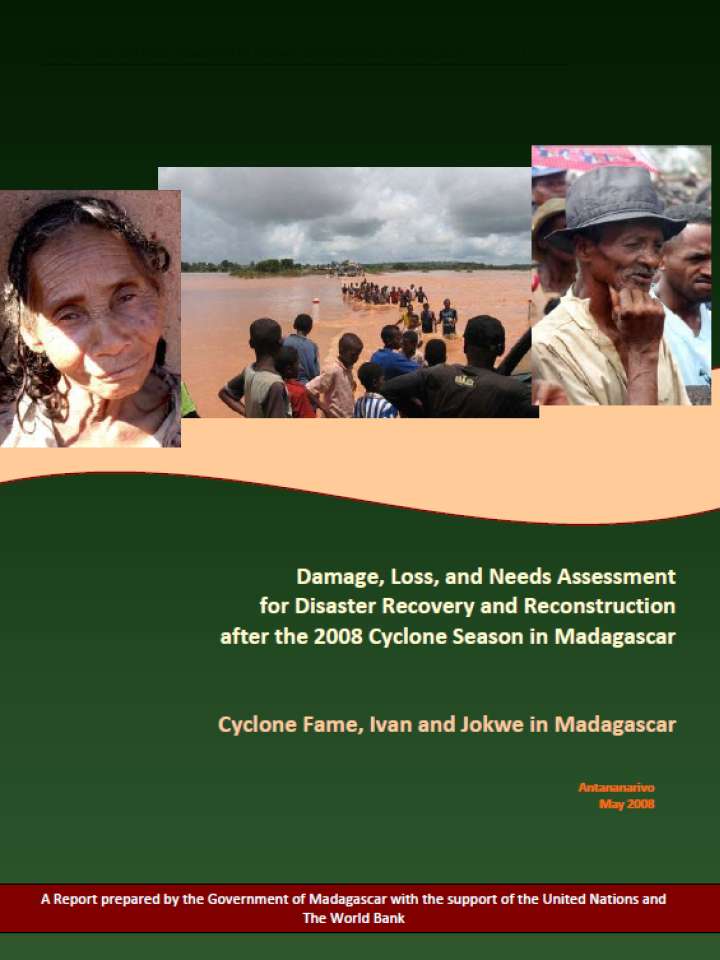
    DLNA Madagascar 2008
    Documents and publications
    PDNA - Post Disaster Needs Assessments

    The Government of Madagascar undertook a comprehensive damage and loss and needs assessment to ascertain the extent of the damages caused by the three consecutive cyclones in 2008, and to define a comprehensive and feasible recovery plan.

    Madagascar - government
    Global Facility for Disaster Reduction and Recovery, the (GFDRR)
    United Nations Development Programme (UNDP)
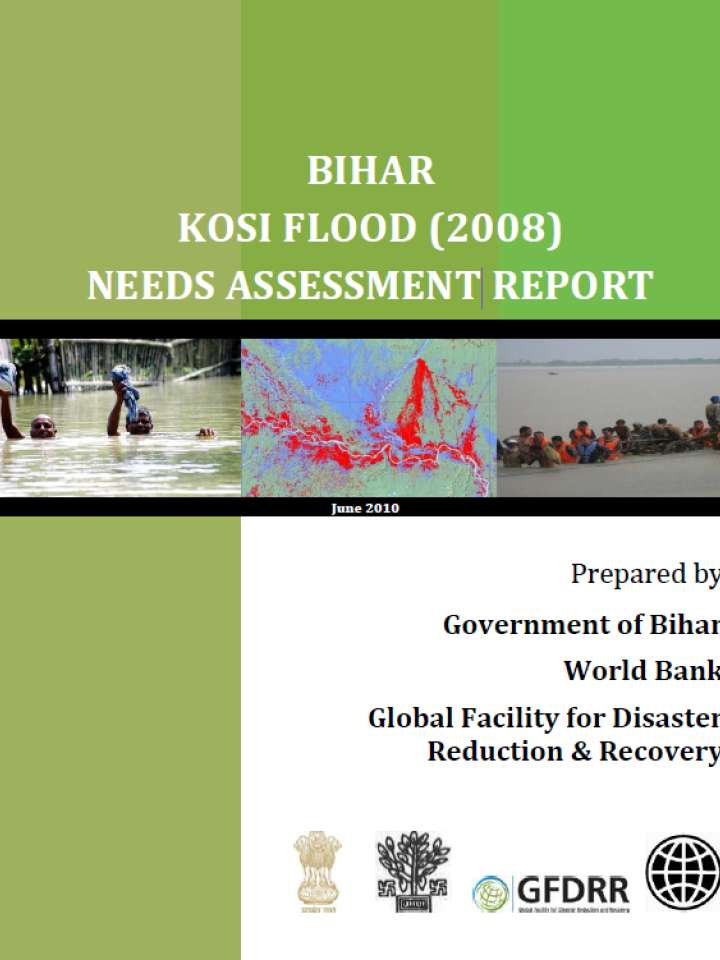
    Bihar Kosi Flood Needs Assessment
    Documents and publications
    PDNA - Post Disaster Needs Assessments

    This Needs Assessment guides the design and investment prioritization of the proposed Kosi Flood Recovery project. It provides a damage overview in key sectors to identify priority interventions and progress made.

    World Bank, the
    Global Facility for Disaster Reduction and Recovery, the (GFDRR)
    Bihar State Disaster Management Authority
    Documents and publications
    PDNA - Post Disaster Needs Assessments

    The aim of the assessment is to identify priority areas to support the Government of Bangladesh in cyclone recovery efforts as well as to design a disaster management strategy.

    Bangladesh - government
    World Bank, the
    European Commission
    International Labour Organization (ILO)
    International Federation of Red Cross and Red Crescent Societies (IFRC)
    Asian Development Bank (ADB)
    United Nations Development Programme (UNDP)
    Japan Bank For International Cooperation
    Japan International Cooperation Agency
    Islamic Development Bank
    Food and Agriculture Organization of the United Nations (FAO)
    World Food Programme (WFP)
    World Health Organization (WHO)
    Department for International Development
    United States Agency for International Development (USAID)
    United Nations Children's Fund (UNICEF)
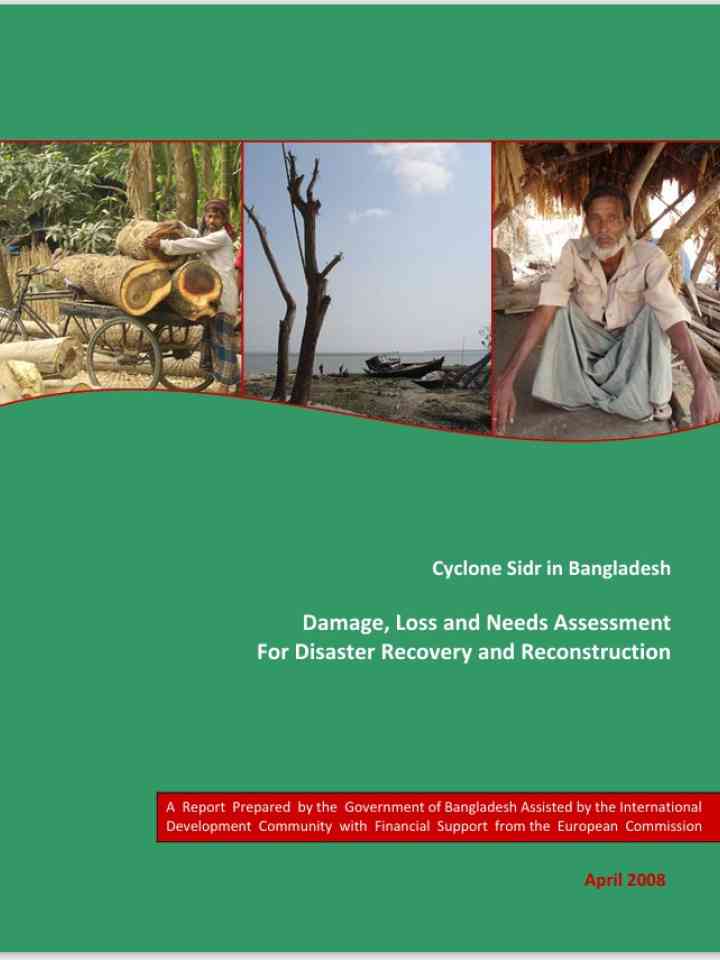
    Cyclone Sidr in Bangladesh: Damage, loss, and needs assessment for disaster recovery and reconstruction
    Documents and publications
    PDNA - Post Disaster Needs Assessments

    This document identifies the needs and quantified financial requirements that will facilitate formulating comprehensive early recovery actions, medium‐term recovery and reconstruction plans, and a long‐term risk management and reduction strategy.

    Bangladesh - government
    World Bank, the
    European Commission
    International Labour Organization (ILO)
    International Federation of Red Cross and Red Crescent Societies (IFRC)
    Asian Development Bank (ADB)
    United Nations Development Programme (UNDP)
    Japan Bank For International Cooperation
    Japan International Cooperation Agency
    Islamic Development Bank
    Food and Agriculture Organization of the United Nations (FAO)
    World Food Programme (WFP)
    World Health Organization (WHO)
    Department for International Development
    United States Agency for International Development (USAID)
    United Nations Children's Fund (UNICEF)
    Documents and publications
    PDNA - Post Disaster Needs Assessments

    This report provides a summary of data collected in the flood assessment.

    World Bank, the
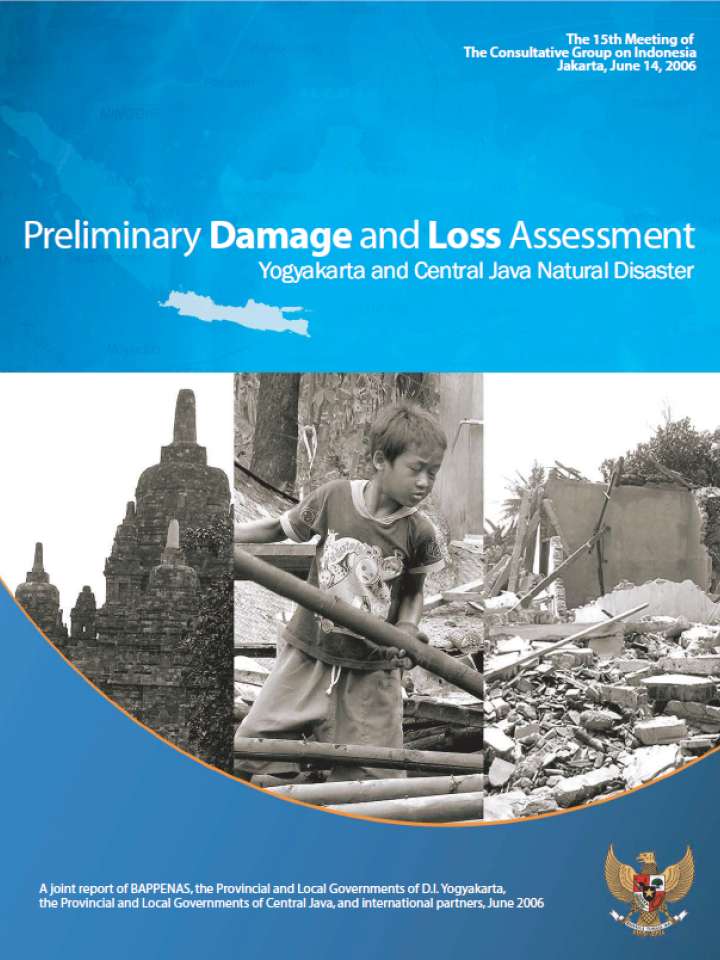
    Earthquake 2006 Indonesia Preliminary Damage and Loss Assessment
    Documents and publications
    PDNA - Post Disaster Needs Assessments

    This report presents a preliminary assessment of the damage and losses caused by the May 2006 earthquake that struck Yogyakarta and Central Java.

    Indonesia - government
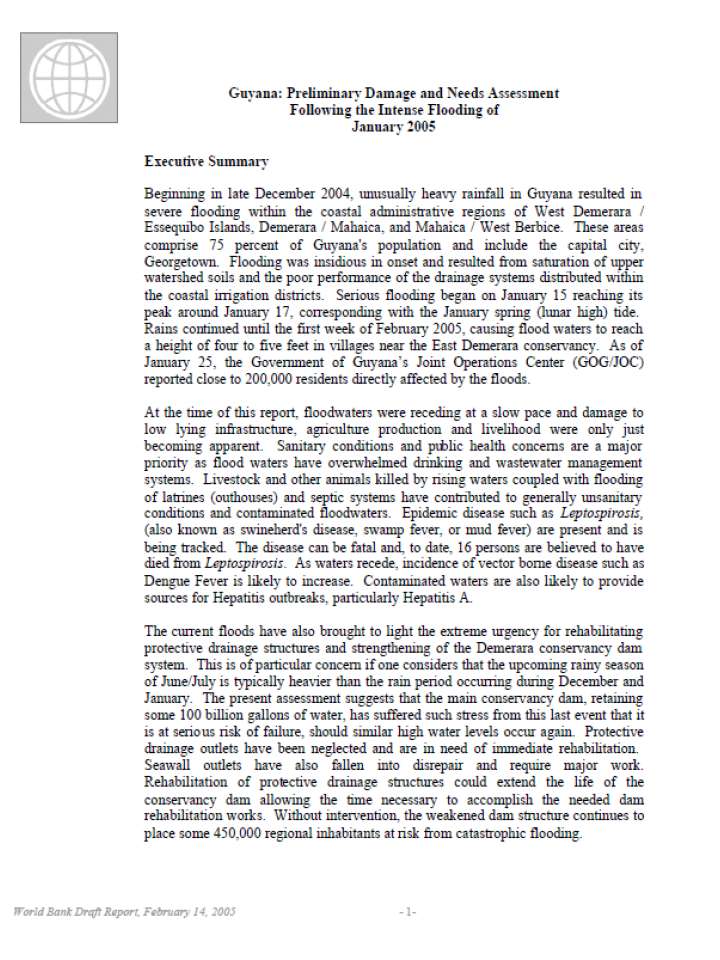
    Floods 2005 Guyana Preliminary Damage and Needs Assessment
    Documents and publications
    PDNA - Post Disaster Needs Assessments

    This report provides a preliminary assessment of damage incurred, with a special focus on reconstruction needs. It provides donors with an initial assessment of possible intervention needs within six months to a year following the floods.

    World Bank, the

PDNA on-demand training

Meetings and conferences
Online
This event focuses on the important role of the public sector, and fiscal policy, that can support a stronger and greener economic recovery, whilst creating a collaborative and enabling environment for the private sector to mobilize resources to Build
Meetings and conferences
Online
In April 2020, at the height of the first wave of COVID-19 across Europe, academics at Alliance Manchester Business School and the Humanitarian and Conflict Response Institute at The University of Manchester launched The Manchester Briefing, a UK funded
Meetings and conferences
Online
This webinar will explore whether community resilience established during COVID-19 can be a new local and national resilience capability. During COVID-19 communities around the globe have proved to be an invaluable resilience capability. We have witnessed
Meetings and conferences
Online
In April 2020, at the height of the first wave of COVID-19 across Europe, academics at Alliance Manchester Business School and the Humanitarian and Conflict Response Institute launched The Manchester Briefing – a fortnightly document that brings together
Meetings and conferences
Online
After Hurricanes Irma and Maria struck Puerto Rico in 2017, RAND helped its government develop a comprehensive recovery plan. With support from the RAND Alumni Impact Fund, researchers partnered with Puerto Rico communities, including local
Meetings and conferences
Online
International Recovery Forum 2021: Building back better from compound disasters - Practical cases and lessons for recovery from natural hazards and COVID-19
Meetings and conferences
Online
The COVID-19 pandemic and the associated economic crisis are posing immense challenges with far reaching impacts across Asia. The period of economic rebuilding after the crisis provides an opportunity to build back better to create more resilient