PreventionWeb
Menu
PDNA - Post Disaster Needs Assessments

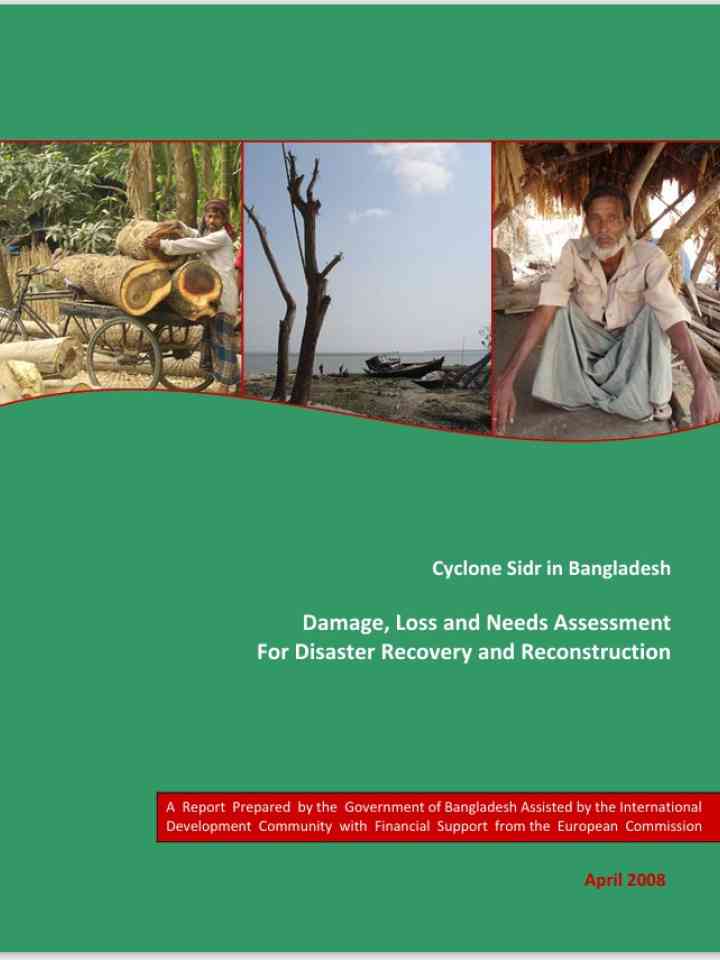
Cyclone Sidr in Bangladesh: Damage, loss, and needs assessment for disaster recovery and reconstruction

Source
Bangladesh - government
World Bank, the
European Commission
International Labour Organization (ILO)
International Federation of Red Cross and Red Crescent Societies (IFRC)
Asian Development Bank (ADB)
United Nations Development Programme (UNDP)
Japan Bank For International Cooperation
Japan International Cooperation Agency
Islamic Development Bank
Food and Agriculture Organization of the United Nations (FAO)
World Food Programme (WFP)
World Health Organization (WHO)
Department for International Development
United States Agency for International Development (USAID)
United Nations Children's Fund (UNICEF)

240 kilometers per hour. The category 4 storm1 was accompanied by tidal waves up to five meters high and surges up to 6 meters in some areas, breaching coastal and river embankments, flooding low‐lying areas and causing extensive physical destruction. High winds and floods also caused damage to housing, roads, bridges, and other infrastructure. Electricity and communication were knocked out, and roads and waterways became impassable. Drinking water was contaminated by debris and many sources were inundated with saline water from tidal surges, and sanitation infrastructure was destroyed.

Destroyed Houses at the Coast of Bangladesh The cyclone was the second natural disaster to affect Bangladesh in twelve months. Monsoon floods had previously caused extensive agricultural production losses and destruction of physical assets, totaling near US$ 1.1 billion2. The occurrence of these events in close succession is a reminder of the country's extreme vulnerability to frequent hydro‐meteorological hazards, which stand to be further exacerbated because of climate change.

The analysis of the damage and loss assessment has identified the needs and quantified financial requirements that will facilitate formulating comprehensive early recovery actions, medium‐term recovery and reconstruction plans, and a long‐term risk management and reduction strategy. These should be formulated, adopted and implemented to reduce the impact of future disasters which are likely to be more intense due to climate change. International support will be essential as domestic resources and capacities are limited.

Download

Cyclone Sidr in Bangladesh: Damage, loss, and needs assessment for disaster recovery and reconstruction PDF, 4.3 MB English

Last checked: 29 May 2024

Editors' recommendations

  • Post-Sidr Family Shelter Reconstruction Bangladesh
  • Cyclone Sidr in Bangladesh: damage, loss and needs assessment for disaster recovery and reconstruction, draft executive summary, March 2008
  • Recovery framework case study: Bangladesh - Planning and implementation of post-Sidr housing recovery, practice, lessons and future implications

Explore further

Hazards Cyclone, Hurricane and Typhoon
Themes Disaster losses Governance Recovery Recovery planning
Country and region Bangladesh
Cyclone Sidr in Bangladesh: Damage, loss, and needs assessment for disaster recovery and reconstruction
Number of pages
159 p.
Publication year
2008

Is this page useful?

Yes No
Report an issue on this page

Thank you. If you have 2 minutes, we would benefit from additional feedback (link opens in a new window).

The International Recovery Platform (IRP) is a global partnership working to strengthen knowledge, and share experiences and lessons on building back better in recovery, rehabilitation, and reconstruction.

Latest IRP videos and photos: YouTube Flickr Contact IRP

Loading