PreventionWeb
Menu

Institute for Social and Environmental Transition - International (ISET)

ISET
United States of America
Academic & Scientific

Mission

ISET-International catalyzes transformative changes toward a more resilient and equitable future. Through research, training and implementation activities, the Institute improves understanding and elevates the level of dialog and practice as society responds to natural resource, environmental and social challenges. It serves as a framework for equal collaboration among individuals and organizations in the North and South.

Disaster Reduction Goal

Natural hazards contribute greatly to endemic poverty around the world. Socially and economically marginalized families often have no option other than to live in areas highly exposed to certain hazards, and find it difficult to reconstruct livelihoods following disasters. Climate change will alter the frequency and intensity of major climate-related hazards such as floods, droughts and heat waves, while causing slow-onset seasonal changes as well as variation in overall temperatures and rainfall. In order to ensure poverty reduction and positive development gains, it is necessary to take a multi-hazard approach which considers both current and likely changes in the nature of certain hazards.

DRR activities

Policies and Programmes in DRR

Current programs in DRR are the Rockefeller Foundation funded Asian Cities Climate Change Resilience Network (ACCCRN) program and the United States Agency for International Development (USAID) funded Building Resilience to Climate Change in Asian Cities project.
Show more
Latest additions
Items: 10
Publication
Published on
30 August 2020
The PERC manual – Learning from disasters to build resilience: A guide to conducting a Post-Event Review 2020
The Post-Event Review Capability (PERC), which was launched in 2013 by the Zurich Flood Resilience Alliance, provides a process and framework for the systematic analysis of a disaster event, focusing on how a specific hazard event became a disaster.
Publication
Published on
27 April 2020
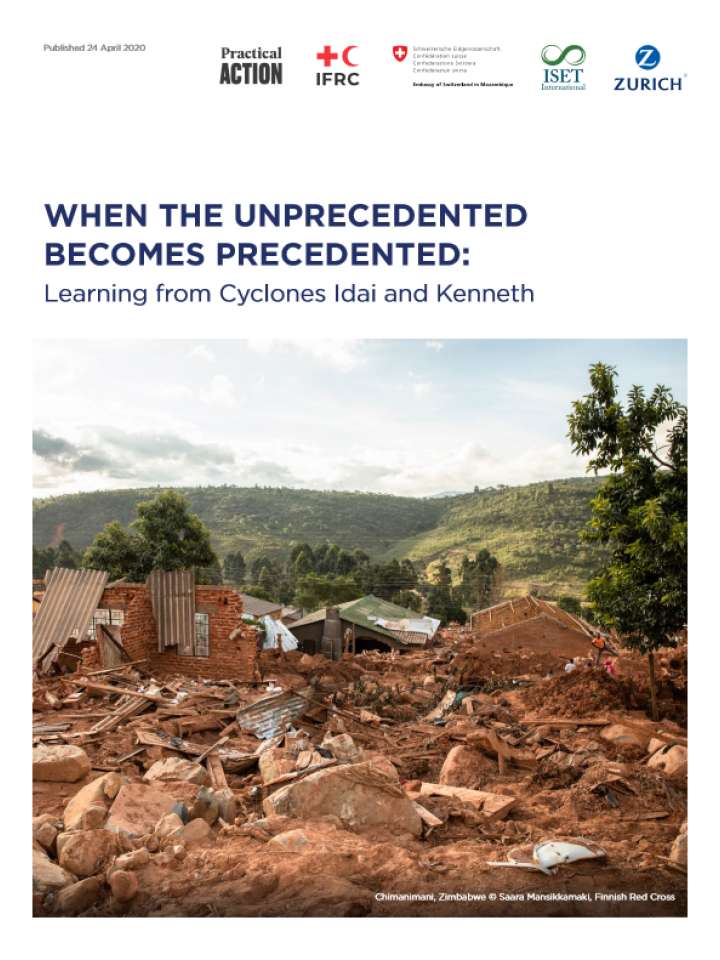
When the unprecedented becomes precedented: Learning from Cyclones Idai and Kenneth
The study focuses on why Cyclones Idai and Kenneth resulted in disasters in Malawi, Mozambique, and Zimbabwe, taking into account the specific country contexts.
Publication
Published on
2 March 2019
Catalyzing transformative changes for resilience: integrated land-use planning for enhanced social capital
Using the 2015 Gorkha Earthquake in Nepal as a case study, this paper explores Nepal’s history of disaster response and the important role that communities have played. In Nepal, community-based organizations (CBOs) are integral actors that support social, economic, and ecological well-being. CBOs enhance social capital (Acharya, 2015), and in Nepal have served as vital institutions in maintaining natural resources, reducing risk and responding to hazards.
Publication
Published on
22 June 2018
Houston and Hurricane Harvey: a call to action
This study looks in detail at the Houston floods that resulted from Hurricane Harvey.
News
Published on
17 May 2018
Flood protection infrastructure: the fine line between disaster generation and disaster prevention
According to several reviews, flood protection infrastructure alone does not mitigate flood risk. Unquestioning faith in it can actually deter risk reduction by causing governments to allocate large sums of recovery funding to construct more protective infrastructure without asking why there was failure in the first place.
Publication
Published on
26 October 2017
Prioritizing recovery spending: Lessons from the 2017 Peru floods
This brief provides an overview of challenges in disaster reconstruction and recommendations as they relate to recovery spending for the 2017 floods in Peru.
Publication
Published on
26 Octubre 2017
Estableciendo prioridades para las inversiones de reconstrucción: Documento breve de política
Este documento breve de política está basado en un Análisis de Capacidades PostDesastre (PERC), financiado por el Programa de Resiliencia frente a las Inundaciones de Zúrich.
Publication
Published on
13 December 2016
A post-event review of the October 2015 floods in South Carolina: a deep dive into the Columbia and Charleston event
This study looks in detail at two very different floods: Columbia and Charleston floods, which occurred due to the October 2015 torrential rainfall and flooding in South Carolina.

Pagination

  • Previous page ‹ Previous
  • Current page 1
  • Page 2
  • Next page Next ›

More content for this organization may be available on PreventionWeb or on the site search.

Voluntary Commitments

The organization has no registered commitments.

The Sendai Framework Voluntary Commitments (SFVC) online platform allows stakeholders to inform the public about their work on DRR. The SFVC online platform is a useful toolto know who is doing what and where for the implementation of the Sendai Framework, which could foster potential collaboration among stakeholders. All stakeholders (private sector, civil society organizations, academia, media, local governments, etc.) working on DRR can submit their commitments and report on their progress and deliverables.

Contact information

http://www.i-s-e-t.org/
[email protected]
+62-380-829-851
Fax:
+62-380-823-984
Facebook
LinkedIn
Twitter

Is this page useful?

Yes No
Report an issue on this page

Thank you. If you have 2 minutes, we would benefit from additional feedback (link opens in a new window).

The International Recovery Platform (IRP) is a global partnership working to strengthen knowledge, and share experiences and lessons on building back better in recovery, rehabilitation, and reconstruction.

Latest IRP videos and photos: YouTube Flickr Contact IRP

Loading