PreventionWeb
Menu

International Institute for Environment and Development (IIED)

IIED
United Kingdom of Great Britain and Northern Ireland
Non Governmental Organizations

Mission

IIED is an independent, non-profit organization promoting sustainable patterns of world development through collaborative research, policy studies, networking and knowledge dissemination.


DRR activities

IIED's mission is to build a fairer, more sustainable world, using evidence, action and influence in partnership with others. IIED focus on four globally important challenges: demonstrating climate chance policies that work for development, tackling the resource squeeze, helping build cities that work for people and planet, and shaping responsible markets.
Show more
Latest additions
Items: 14
Publication
Published on
30 December 2017
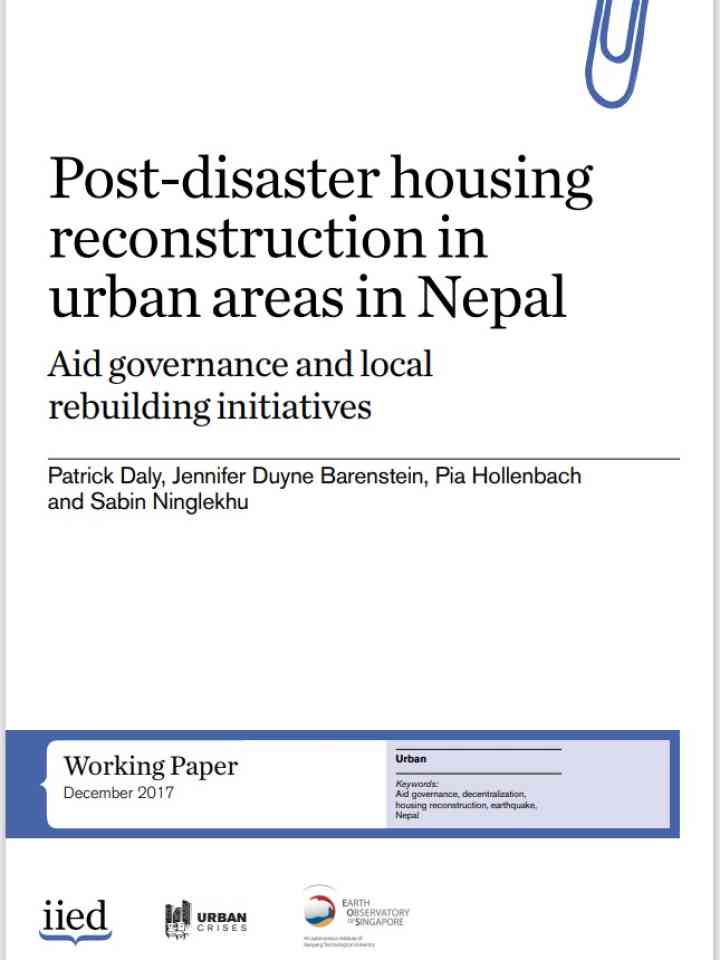
Post-disaster housing reconstruction in urban areas in Nepal: Aid governance and local rebuilding initiatives
This research was motivated by the lack of reconstruction progress in urban settlements one year after the earthquakes and conducted ethnographic fieldwork in five urban settlements over a period of 18 months.
Publication
Published on
1 November 2017
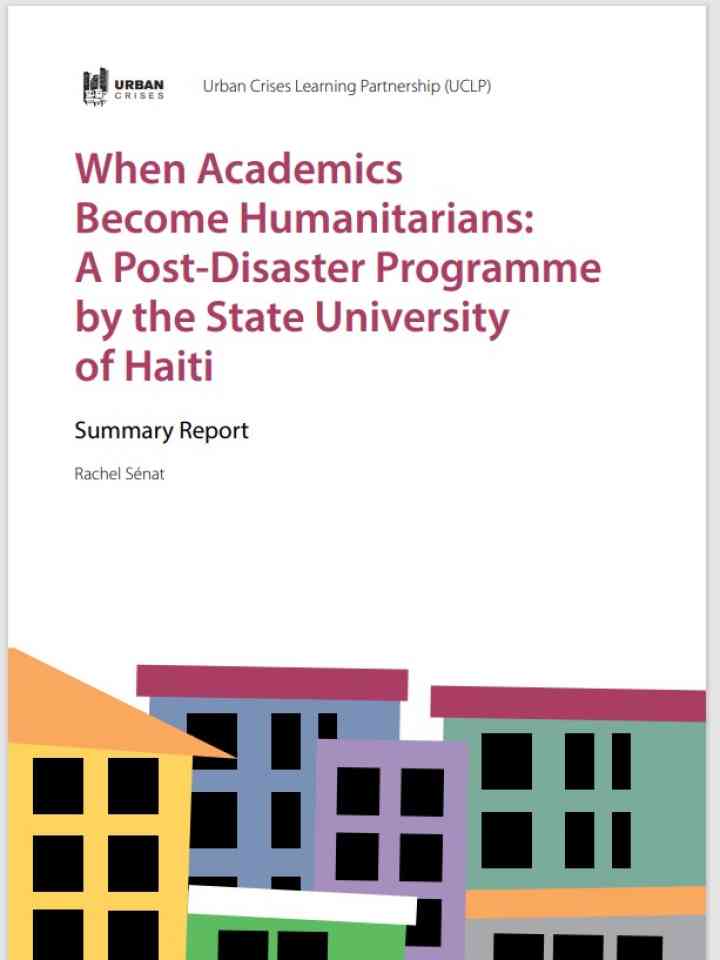
When Academics Become Humanitarians: A Post-Disaster Programme by the State University of Haiti: Summary Report
This case study asks to what extent an academic institution can make a useful and valued contribution to post-disaster response.
Publication
Published on
30 August 2017
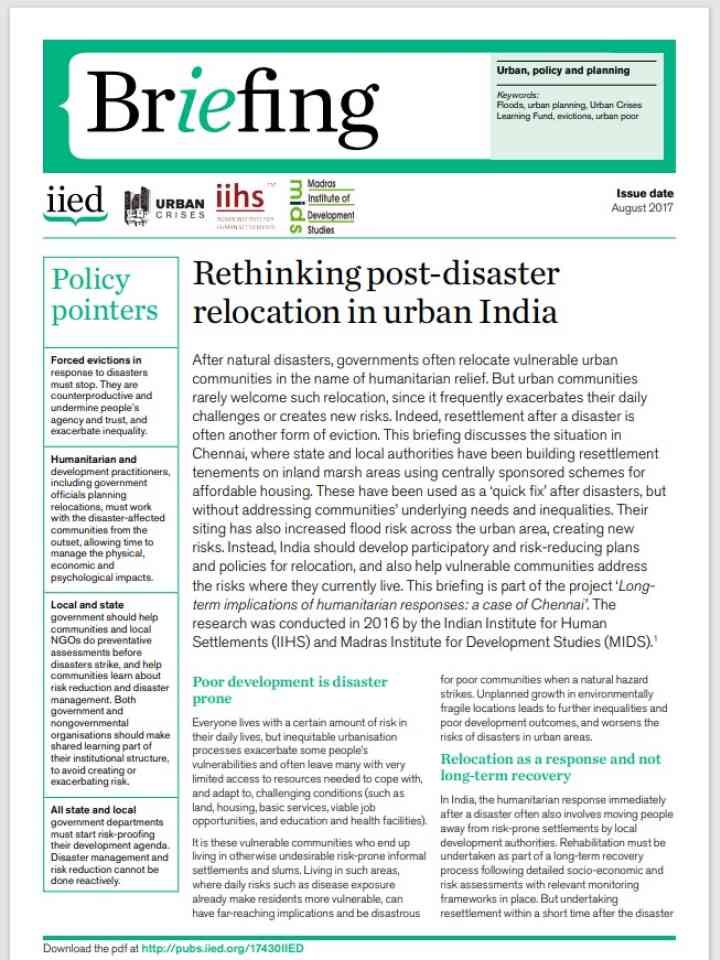
Rethinking post-disaster relocation in urban India
This briefing is part of the project 'Longterm implications of humanitarian responses: a case of Chennai'. The research was conducted in 2016 by the Indian Institute for Human Settlements (IIHS) and Madras Institute for Development Studies (MIDS).
Publication
Published on
24 October 2016
Typhoon Haiyan: Lessons for urban disaster response and recovery
This briefing examines the challenges the city government faced, first in the immediate humanitarian response and later during the recovery and rehabilitation phases. Drawing on these experiences, it makes recommendations for local and national government and humanitarian agencies to improve their capacity for a more coordinated, efficient and sustainable response to future disasters.
Publication
Published on
1 September 2016
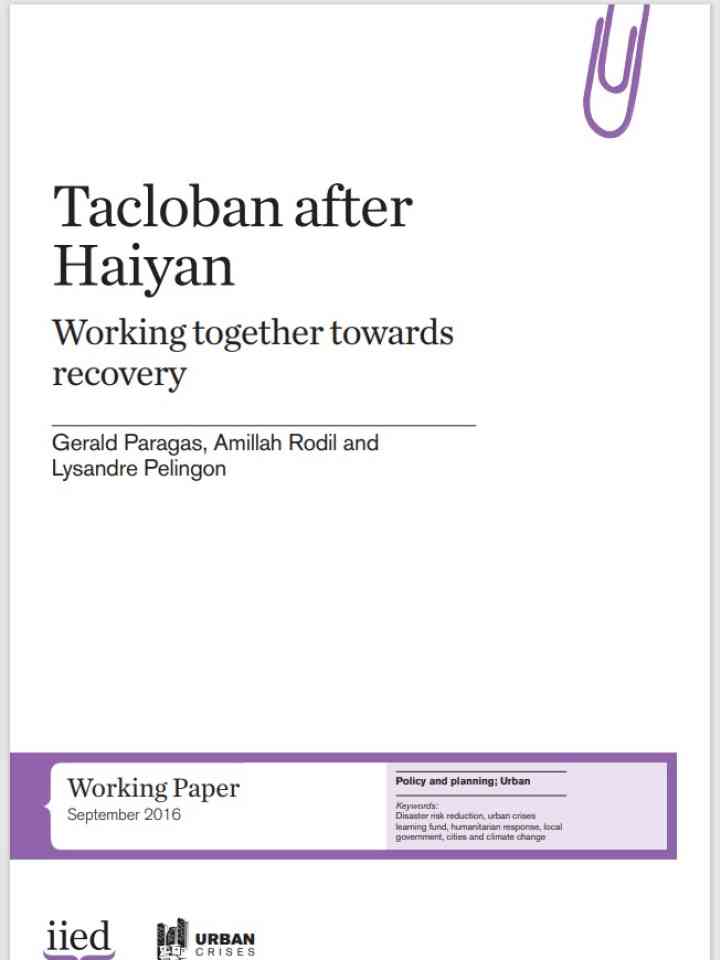
Tacloban after Haiyan: Working Together Towards Recovery
This paper describes the experience, challenges, successes and lessons of the Tacloban city government as the city transitioned from the humanitarian response to the recovery and development phases following the disaster.
Publication
Published on
12 December 2010
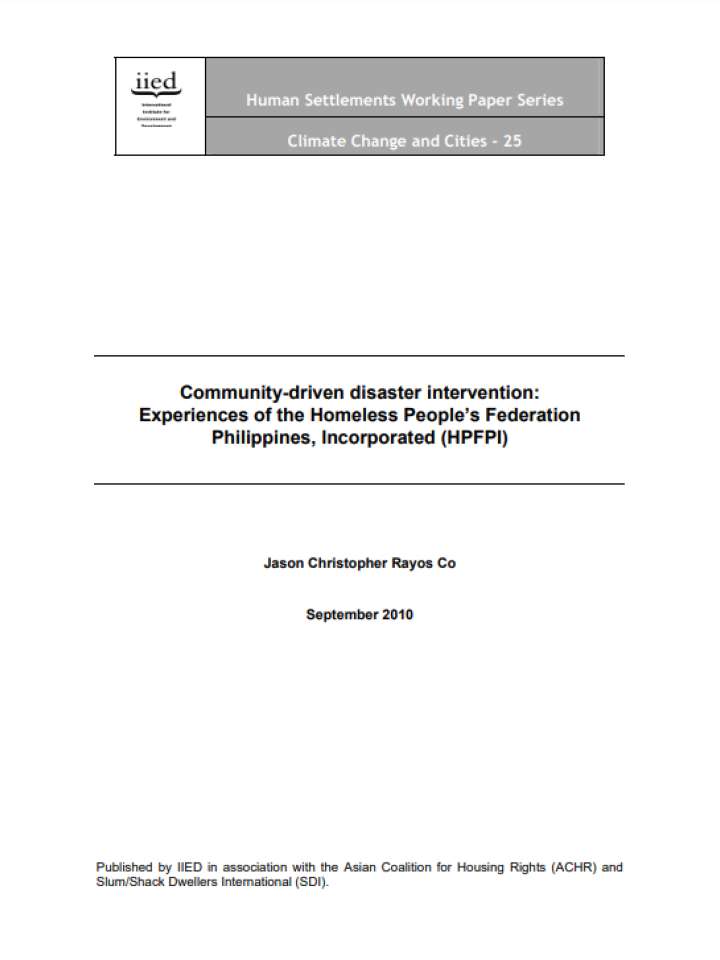
Community-driven disaster intervention: Experiences of the Homeless People’s Federation Philippines, Incorporated (HPFPI)
This paper describes the experiences of the Philippines Homeless People’s Federation in community-driven measures to avoid disasters, in disaster preparedness and in disaster response.

Pagination

  • Previous page ‹ Previous
  • Page 1
  • Current page 2
  • Next page Next ›

More content for this organization may be available on PreventionWeb or on the site search.

Voluntary Commitments

The organization has no registered commitments.

The Sendai Framework Voluntary Commitments (SFVC) online platform allows stakeholders to inform the public about their work on DRR. The SFVC online platform is a useful toolto know who is doing what and where for the implementation of the Sendai Framework, which could foster potential collaboration among stakeholders. All stakeholders (private sector, civil society organizations, academia, media, local governments, etc.) working on DRR can submit their commitments and report on their progress and deliverables.

Contact information

http://www.iied.org
[email protected]
+44 2034637399
Fax:
+44 20735149055

Is this page useful?

Yes No
Report an issue on this page

Thank you. If you have 2 minutes, we would benefit from additional feedback (link opens in a new window).

The International Recovery Platform (IRP) is a global partnership working to strengthen knowledge, and share experiences and lessons on building back better in recovery, rehabilitation, and reconstruction.

Latest IRP videos and photos: YouTube Flickr Contact IRP

Loading