PreventionWeb
Navigation loading…

World Bank, the

WB
UN & International Organizations

Mission

Since its inception in 1944, the World Bank has expanded from a single institution to a closely associated group of five development institutions. The mission has evolved from the International Bank for Reconstruction and Development (IBRD) as facilitator of post-war reconstruction and development to the present day mandate of reducing poverty and promoting shared prosperity worldwide. The five institutions composing the World Bank Group are IBRD, International Development Association (IDA), International Finance Corporation (IFC), Multilateral Guarantee Agency (MIGA), and International Centre for the Settlement of Investment Disputes (ICSID). IBRD and IDA together are commonly referred to as “The World Bank,” with IBRD aiming to reduce poverty in middle-income and creditworthy poorer countries and IDA focusing exclusively on low-income countries.

The World Bank’s projects and operations are designed to support low-income and middle-income countries’ poverty reduction strategies. It does so within each country’s specific socio-economic context, adapting programmes to country capacity and needs. The World Bank provides low-interest loans, interest-free credits and grants to developing countries for a wide array of purposes that include investments in disaster recovery and risk mitigation, education, health, public administration, infrastructure, financial and private sector development, agriculture, and environmental and natural resource management. The World Bank also provides technical assistance, capacity development, policy advice, research and analysis.

While the World Bank traditionally plays a key role in post-disaster recovery and reconstruction, it has and will continue to increase its involvement in longer term disaster risk reduction. While the World Bank traditionally plays a key role in post-disaster recovery and reconstruction, it has and will continue to increase its involvement in longer term disaster risk reduction.

The Global Facility for Disaster Reduction and Recovery (GFDRR), a partnership financing mechanism that includes 43 country governments from developed, emerging and developing countries, as well as eight international organizations, serves as the World Bank’s focal point for disaster risk reduction and recovery. Together with major donors and the UN, the World Bank in 2006 launched GFDRR to support the implementation of the Hyogo Framework for Action 2005-2015 and thereby address the needs of vulnerable countries and provide coherent approaches globally and regionally to risk reduction and recovery by using the ISDR system. The GFDRR is managed by the World Bank on behalf of the participating donor partners and other partnering stakeholders. It offers a unique business model for advancing disaster risk reduction based on ex ante support to high risk countries and ex post assistance for accelerated recovery and risk reduction after a disaster. This partnership has been successful in raising the profile of disaster risk reduction for sustainable development. Five pillars of action provide the operational framework for GFDRR’s strategic approach: risk identification, risk reduction, preparedness, financial protection and resilient reconstruction. The World Bank’s Global Expert Team (GET) for Disaster Risk Management provides high quality rapid advisory support to Governments. support of these strategic priorities. GET consists of World Bank staff and experts from its partner organizations with global expertise in disaster risk management.

 
Disaster Reduction Goal

The World Bank envisions a world in which resilient societies manage and adapt to emerging disaster risks and where the human and economic impacts of disasters are reduced. The World Bank therefore aims to incorporate risk reduction into development assistance in disaster-prone countries, leveraging investments that build resilience.

The overarching objective is to mainstream disaster risk reduction and climate change adaptation in country development strategies, such as Poverty Reduction Strategies (PRSP), Country Assistance Strategies (CAS), and National Adaptation Plans (NAPs) to reduce vulnerabilities to natural hazards. This is done through providing analytical, technical and operational support to countries for disaster risk reduction and climate change adaptation.

DRR activities
Policies and Programmes in DRR

View 2011 World Bank DRR profile

The World Bank has made significant progress toward mainstreaming disaster risk reduction in its programs. On average, 7 out of every 10 Country Assistance Strategies (CAS) now at a minimum recognize natural disasters as a challenge or a risk to sustainable development, compared with 4 out of 10 in 2006. Similarly, in line with a commitment made in the context of the IDA 16 Replenishment, vulnerability to climate change was discussed in all 2012 (fiscal year) CAS products, compared to 32% in 2007 (fiscal year).

World Bank financing for disaster risk reduction has also become more strategic. Between 1984 and 2006 the World Bank financed more than $26 billion disaster-related projects, or just less than $1.2 billion a year. Since then, financing directly linked to disaster risk management has increased to more than $2.3 billion a year (totaling $11.7 billion). The World Bank has developed a series of instruments and approaches, spanning financial, knowledge, and convening services to support disaster risk management in countries. A new operational policy on rapid response to crisis and emergencies was adopted in 2007, and new instruments were introduced to accelerate resource mobilization in case of disaster, including the Catastrophe Deferred Drawdown Option (CAT DDO), the IDA Crisis Response Window (CRW), and the IDA Immediate Response Mechanism (IRM).

Between 2006 and 2011 the World Bank financed 113 disaster prevention and preparedness operations ($7.9 billion) and 68 disaster reconstruction operations ($3.8 billion).

In all support for disaster risk reduction, the World Bank promotes a comprehensive, multi-sector approach to managing disaster risk in countries.
Strengthening its support to vulnerable countries, GFDRR approved 31 projects worth over $22 million in fiscal year 2012. The highest share of funding – over 60% – was allocated for risk reduction activities. This was followed by 13% each for risk identification and financial protection, 9% for resilient reconstruction and 4% for preparedness.

Membership in Key Networks

• Inter-Agency Group (IAG)
• Inter Agency Standing Committee (IASC)
• International Recovery Platform (IRP)
• OECD Experts Group on Risk and Resilience
• Political Champions Group for Disaster Resilience

National Counterpart

Government

Disaster Reduction Focal Point(s)

Mr. Francis Ghesquiere, Manager, World Bank Disaster Risk, Management Practice Group and Head, GFDRR Secretariat, Global Facility for Disaster Reduction and Recovery (GFDRR) ([email protected])

Websites

http://www.worldbank.org
http://www.gfdrr.org
Show more
Latest additions
Items: 304
Documents and publications
13 February 2009
International forum on tsunami and earthquake: experts meeting - summary report

This is a summary report of the Experts Meeting which was organized on January 16 to verify the progress made in recovery efforts implemented in tsunami- and earthquake-hit regions and to come up with concrete measures to achieve better recovery. The Experts Meeting comprised three thematic group discussions, on “Housing” “Livelihood” and “Organizational and Institutional Arrangements,” for a recovery with a view to build back better as well as a plenary session.

World Bank, the
International Federation of Red Cross and Red Crescent Societies (IFRC)
United Nations Human Settlements Programme (UN-HABITAT)
兵庫県 Hyogo Prefectural Government
International Labour Organization (ILO)
International Recovery Platform
Ministry of Foreign Affairs of Japan
United Nations Office for the Coordination of Humanitarian Affairs
United Nations Office for Disaster Risk Reduction - Kobe Office
This is a summary report of the Experts Meeting which was organized on January 16 to verify the progress made in recovery efforts implemented in tsunami- and earthquake-hit regions and to come up with concrete measures to achieve better recovery. The Experts Meeting comprised three thematic group discussions, on “Housing” “Livelihood” and “Organizational and Institutional Arrangements,” for a recovery with a view to build back better as well as a plenary session.
Documents and publications
5 February 2009
Data against natural disasters: establishing effective systems for relief, recovery and reconstruction

This book seeks to provide the analytical tools needed to enhance national capacity for disaster response. The editors and authors begin with an overview that summarizes key lessons learned form the six country case studies in the volume. Next, they

World Bank, the
This book seeks to provide the analytical tools needed to enhance national capacity for disaster response. The editors and authors begin with an overview that summarizes key lessons learned form the six country case studies in the volume.
Training event
12 January 2009 - 6 February 2009
In person
Damage and reconstruction needs assessment (online course)
The Damage and Reconstruction Needs Assessment course is a joint offering of National Institute of Disaster Management, New Delhi and World Bank Institute, Washington. It is part of the Comprehensive Natural Disaster Risk Management Program developed by
The Damage and Reconstruction Needs Assessment course is a joint offering of National Institute of Disaster Management, New Delhi and World Bank Institute, Washington.
Tropical Storm and Floods 2008 Yemen Damage Losses and Needs Assessment
Documents and publications
PDNA - Post Disaster Needs Assessments
15 November 2008
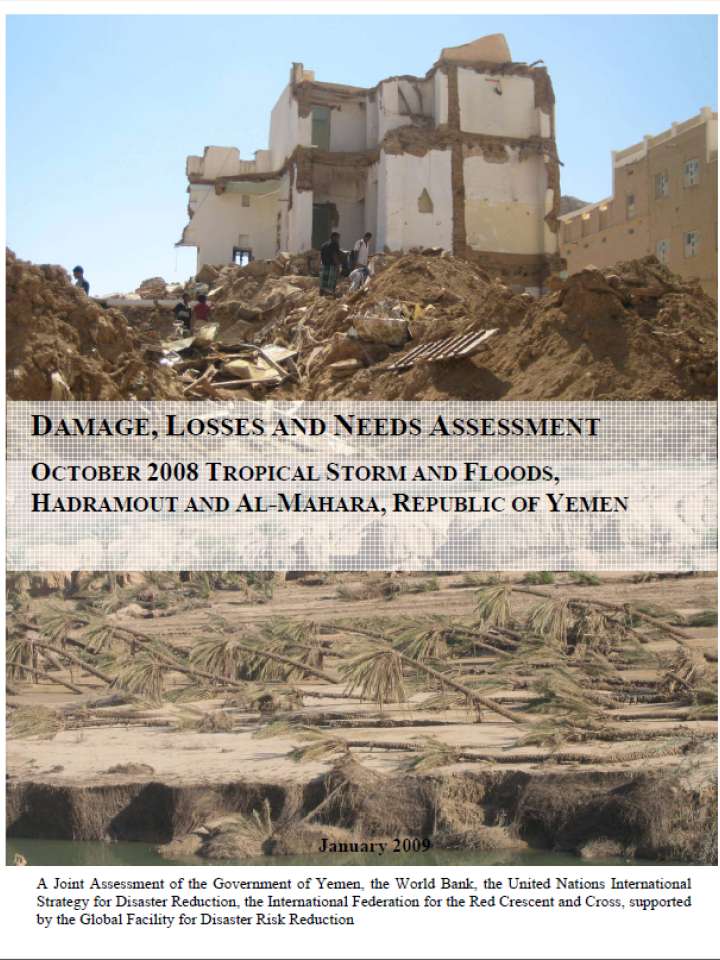
Damage, Losses and Needs Assessment October 2008 Tropical Storm and Floods, Hadramout and Al-Mahara, Republic of Yemen

This report presents an estimation of the main effects of the disaster: the value of physical assets totally or partially destroyed; losses in economic flows from the absence of those assets; and the impact on economic development and social conditions.

Yemen - government
World Bank, the
Global Facility for Disaster Reduction and Recovery, the (GFDRR)
United Nations Office for Disaster Risk Reduction (UNDRR)
International Federation of Red Cross and Red Crescent Societies (IFRC)
This report presents an estimation of the main effects of the disaster: the value of physical assets totally or partially destroyed; losses in economic flows from the absence of those assets; and the impact on economic development and social conditions.
Bihar Kosi Flood Needs Assessment
Documents and publications
PDNA - Post Disaster Needs Assessments
22 October 2008
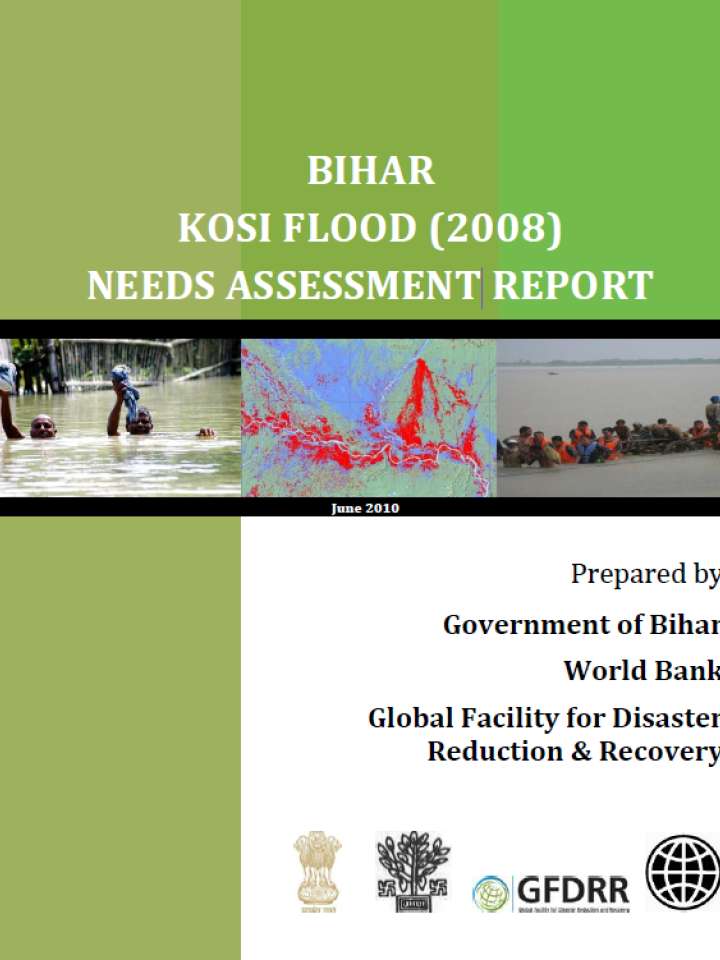
Bihar Kosi Flood Needs Assessment Report

This Needs Assessment guides the design and investment prioritization of the proposed Kosi Flood Recovery project. It provides a damage overview in key sectors to identify priority interventions and progress made.

World Bank, the
Global Facility for Disaster Reduction and Recovery, the (GFDRR)
Bihar State Disaster Management Authority
This Needs Assessment guides the design and investment prioritization of the proposed Kosi Flood Recovery project. It provides a damage overview in key sectors to identify priority interventions and progress made.
Documents and publications
14 August 2008
Surviving disasters and supporting recovery: a guidebook for microfinance institutions

This guide was published as a collaborative effort of ProVention, the World Bank's Hazard Management Unit, and the UN Capital Development Fund. It provides practical guidance on how to reduce the vulnerability of Microfinance Institutions (MFIs) to disaster impacts as well as to more effectively support the recovery of their clients in the aftermath of a natural disaster.

World Bank, the
United Nations Capital Development Fund
World Bank, the
This guide was published as a collaborative effort of ProVention, the World Bank's Hazard Management Unit, and the UN Capital Development Fund. It provides practical guidance on how to reduce the vulnerability of Microfinance Institutions (MFIs) to disaster impacts as well as to more effectively support the recovery of their clients in the aftermath of a natural disaster.
Documents and publications
10 August 2008
Tsunami, India: two years after

This report reflects on progress in the past two years and the contributions made to support the Government’s efforts by the World Bank, the Asian Development bank and the United Nations Team for Tsunami Recovery Support. It ends with an outline of what

World Bank, the
Asian Development Bank (ADB)
United Nations - Headquarters
This report reflects on progress in the past two years and the contributions made to support the Government’s efforts by the World Bank, the Asian Development bank and the United Nations Team for Tsunami Recovery Support.
Documents and publications
7 August 2008
The impact of the conflict, the tsunami and reconstruction on poverty in Aceh: Aceh poverty assessment 2008

Three years into the reconstruction effort, with vast amounts of aid having been spent, this reports aims to shed some light on questions regarding the ability of the early relief and reconstruction effort to alleviate poverty in Aceh. This report aims to offer the provincial government in Aceh and the reconstruction agency (BRR) a clearer picture of poverty in the post-conflict and tsunami environment in order to allow them to better design policies and programs to alleviate poverty in the province.

World Bank, the
Three years into the reconstruction effort, with vast amounts of aid having been spent, this reports aims to shed some light on questions regarding the ability of the early relief and reconstruction effort to alleviate poverty in Aceh. This report aims to offer the provincial government in Aceh and the reconstruction agency (BRR) a clearer picture of poverty in the post-conflict and tsunami environment in order to allow them to better design policies and programs to alleviate poverty in the province.

Pagination

  • Previous page ‹ Previous
  • «
  • Page 30
  • Page 31
  • Page 32
  • Page 33
  • Current page 34
  • Page 35
  • Page 36
  • Page 37
  • Page 38
  • Next page Next ›

More content for this organization may be available on PreventionWeb or on the site search.

Voluntary Commitments

The organization has no registered commitments.

The Sendai Framework Voluntary Commitments (SFVC) online platform allows stakeholders to inform the public about their work on DRR. The SFVC online platform is a useful toolto know who is doing what and where for the implementation of the Sendai Framework, which could foster potential collaboration among stakeholders. All stakeholders (private sector, civil society organizations, academia, media, local governments, etc.) working on DRR can submit their commitments and report on their progress and deliverables.

Contact information

[email protected]
+1 202 473 1000
Fax:
+1 202 477 6391

Is this page useful?

Yes No
Report an issue on this page

Thank you. If you have 2 minutes, we would benefit from additional feedback (link opens in a new window).

The International Recovery Platform (IRP) is a global partnership working to strengthen knowledge, and share experiences and lessons on building back better in recovery, rehabilitation, and reconstruction.

Latest IRP videos and photos: YouTube Flickr Contact IRP

Loading