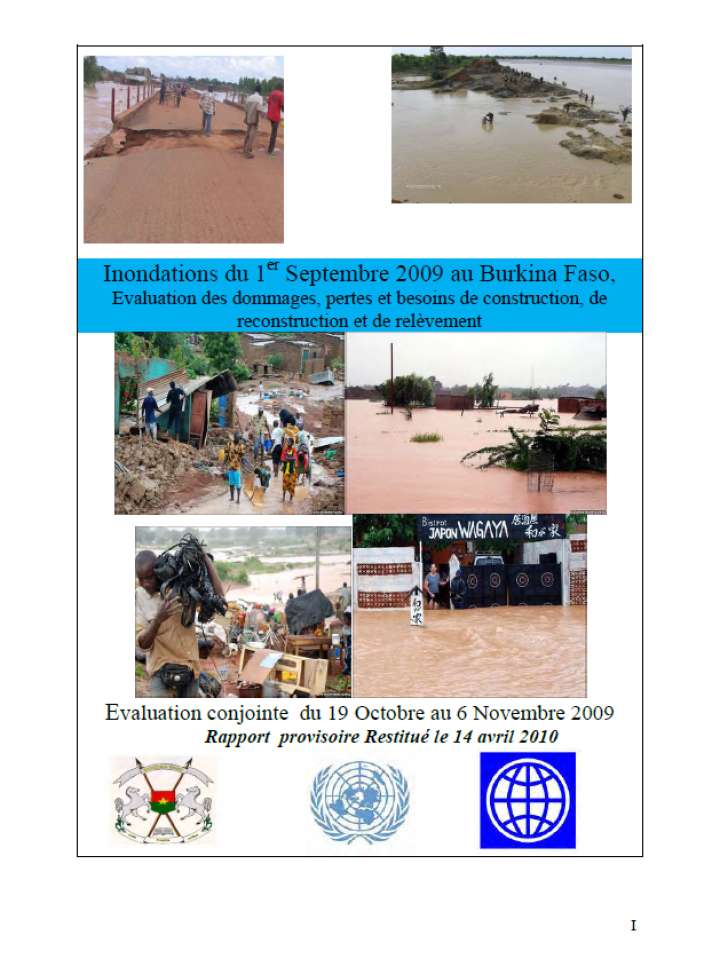
2009 Floods in Burkina Faso - Assessment of damage, losses, reconstruction and recovery needs
This post-disaster needs assessment provides estimates of the damages and losses, and the costs for reconstruction and recovery following the 2009 floods in Burkina Faso.
The assessment concluded that the floods caused the following negative impacts on the areas affected: the human toll was 119,356 victims, 46 deaths, 63 injured, and 1 person not found were registered; the floods hit 11 regions out of the 13 regions of the country. The assessment made a classification of the Regions from the most affected to the least affected as follows: the Central Region, the Mouhoun Region, the Eastern Region, the Central-Eastern Region, the Southwest Region, the Central-Northern Region, the Central-Southern Region, the Sahel Region, the Central Plateau Region and finally the Cascades Region. One important characteristic of the damages and losses concerns the type of sectors affected. The damages occurred on the public infrastructure (roads, dams, health facilities) while the losses occurred mostly in the private sector (87%). However, since these people are mostly poor and have lost nearly everything, therefore unable to start any restoration activity, they needed support from the government.
As far as the economy is concerned, the floods would have had an impact on the poverty level. The assessment revealed that the worst impact will be on the production sector, followed by infrastructure and social services. A decline of 46% of the added value in production is expected, 29% in infrastructure and 25% in social services (as compared with the expectations of the Ministry of Economy and Finance before the disaster). In 2010, the fiscal value of the reconstruction activities will probably reach 1.5% of the GDP estimated after the floods. If there is no new source of income or additional support, the budget deficit will extend over the next years; and in 2013, it will come down to the initial level determined by the Ministry of Economy and Finance before the floods.
The mission concluded that the floods brought about damages amounting to about 45,859,000,000 CFA, i.e., 102 million US dollars, and losses amounting to 15,032,000,000 CFA, i.e., 33 million US dollars, and needs for construction, reconstruction and restoration amounting to 119,670,000,000 CFA, i.e. 266 millions US dollars.
The mission noticed that the September 2009 floods once again drew people’s attention to the hazards and the disaster prevention and management issue in Burkina Faso. Both national and international stakeholders agreed to address the situation. The mission discussed the hazards and disaster prevention and management issue and suggested recommendations for improvement. Concerning recovery, actions should be undertaken in the sectors of agriculture, cattle breeding, fishing, trade, industry, housing, urbanization and potable water and sanitation. Concerning reconstruction, actions should be focused on transport, housing, urbanization, hydro-agricultural dams, drainage and health.