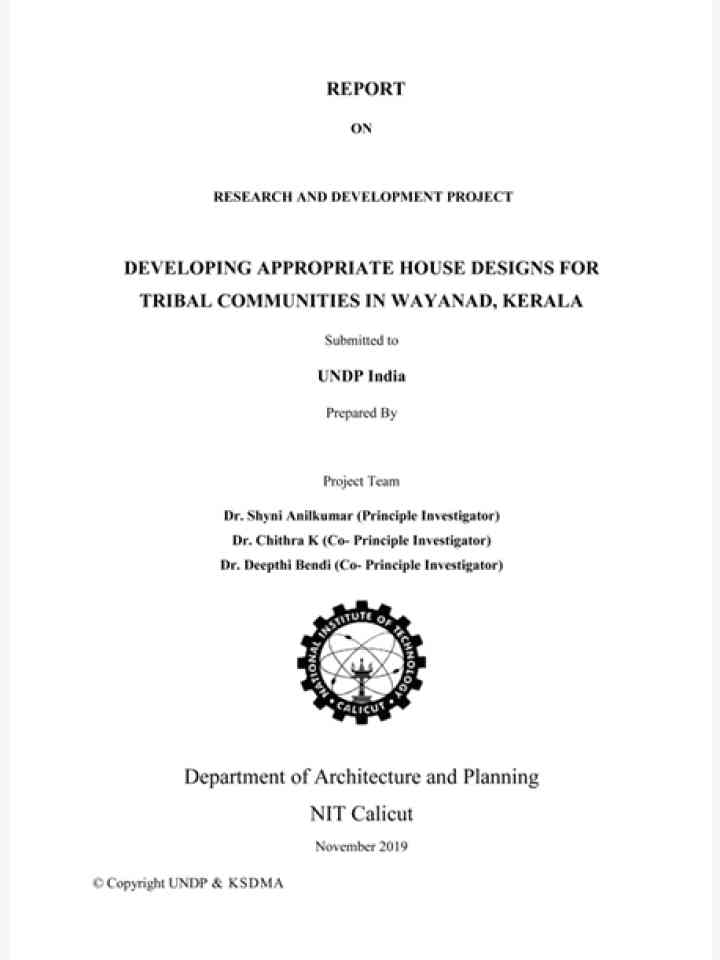
Developing appropriate house designs for tribal communities in Wayanad, Kerala
The report examines the severe housing vulnerability of tribal communities in Wayanad district, Kerala, following repeated floods and landslides, particularly the 2018 disaster. It highlights how indigenous communities such as the Paniya, Adiya, and Kattunaika—who are socio-economically marginalized and highly dependent on local ecosystems—are disproportionately affected due to unsafe settlement locations, fragile housing, and limited access to technical support.
The study documents traditional tribal housing typologies, materials, and construction techniques, emphasizing their cultural value, sustainability, and climate responsiveness. While these indigenous houses use locally available materials and reflect deep environmental knowledge, the report identifies critical weaknesses, especially poor flood resistance, structural deterioration, and high maintenance demands. It also assesses existing government housing schemes and finds that standardized designs often fail to align with tribal lifestyles, cultural practices, and hazard exposure.
To address these gaps, the report proposes a participatory design approach that actively involves tribal communities in settlement appraisal, housing design, and decision-making. It develops disaster-resilient and eco-friendly housing prototypes, including flood-resilient units, and provides technical guidelines for materials, construction methods, and cluster planning in hazard-prone areas. Overall, the report underscores the importance of inclusive, culturally appropriate, and resilience-focused housing solutions to support safer recovery and long-term well-being of tribal communities.
Explore further