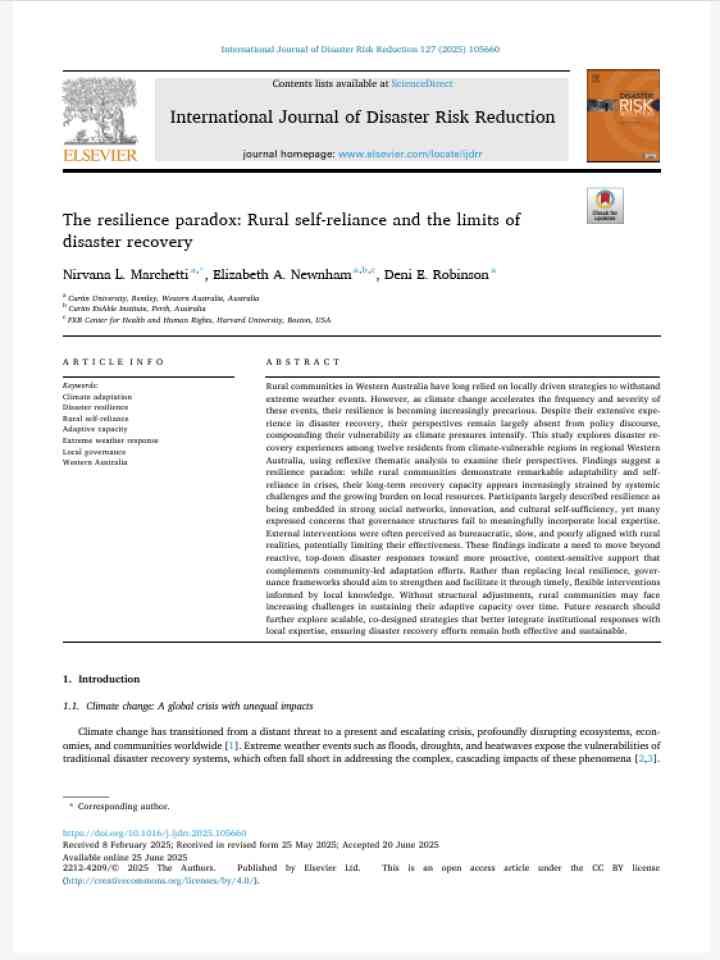
The resilience paradox: Rural self-reliance and the limits of disaster recovery
This peer-reviewed article examines disaster recovery experiences in rural Western Australia, a region increasingly affected by climate-driven extreme weather such as droughts, bushfires, floods, and heatwaves. The study focuses on how rural and agricultural communities perceive resilience and recovery in contexts where climate change is intensifying both the frequency and severity of hazards. It responds to a gap in disaster research that often overlooks rural perspectives in favour of urban-focused resilience frameworks.
Using qualitative methods, the authors conducted in-depth interviews with twelve residents from climate-vulnerable rural regions, including the Wheatbelt, Great Southern, South-West, Mid-West, and Goldfields. Through reflexive thematic analysis, the study identifies a “resilience paradox”: while strong social networks, cultural identity, and local knowledge enable effective short-term response, these same factors can strain communities over time when external institutional support is misaligned, delayed, or insufficient. Participants reported frustration with top-down governance systems that fail to integrate local expertise into recovery planning.
The article argues that resilience should be understood as a continuous, adaptive process rather than a return to pre-disaster conditions. It highlights the risks of over-reliance on self-reliance without adequate systemic reinforcement and calls for governance frameworks that complement, rather than replace, community-led adaptation. By centring lived experience, the study contributes to more context-sensitive approaches to disaster recovery, climate adaptation, and rural resilience in an era of escalating climate risk.
Explore further