PreventionWeb
Menu
Author(s) Yuta Kurihara Mamoru Miyamoto Ryota Sunakawa

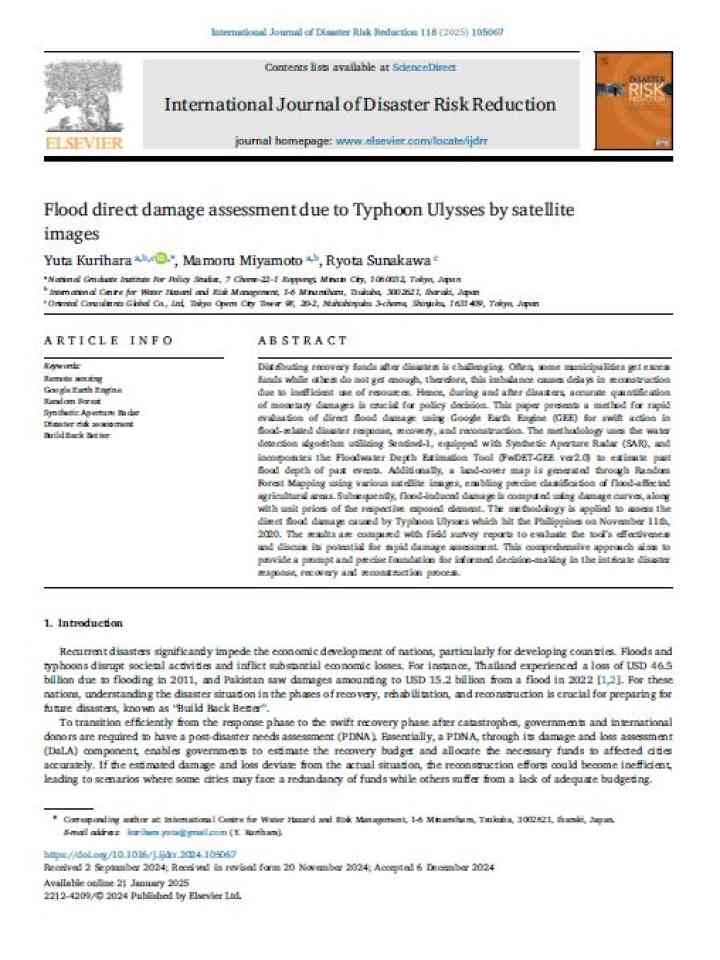
Flood direct damage assessment due to Typhoon Ulysses by satellite images

Source
International Journal of Disaster Risk Reduction (Elsevier)

This paper presents a method for rapid evaluation of direct flood damage using Google Earth Engine (GEE) for swift action in flood-related disaster response, recovery, and reconstruction. The methodology uses the water detection algorithm utilizing Sentinel-1, equipped with Synthetic Aperture Radar (SAR), and incorporates the Floodwater Depth Estimation Tool (FwDET-GEE ver2.0) to estimate past flood depth of past events.

Additionally, a land-cover map is generated through Random Forest Mapping using various satellite images, enabling precise classification of flood-affected agricultural areas. Subsequently, flood-induced damage is computed using damage curves, along with unit prices of the respective exposed element. The methodology is applied to assess the direct flood damage caused by Typhoon Ulysses which hit the Philippines on November 11th, 2020. The results are compared with field survey reports to evaluate the tool’s effectiveness and discuss its potential for rapid damage assessment. This comprehensive approach aims to provide a prompt and precise foundation for informed decision-making in the intricate disaster response, recovery and reconstruction process.

Download

Access Flood direct damage assessment due to Typhoon Ulysses by satellite images
Download a backup copy hosted by this site PDF, 5.1 MB English

We keep a copy of many documents to improve long-term access. Use this if the publisher’s site is slow or unavailable. Problems? Contact us.

Last checked: 12 February 2025

Editors' recommendations

  • Mapping local communities to inform response and recovery in Nepal
  • Testing the utility of mapping drones for early recovery in the Philippines
  • Handbook on recovery institutions: a guidebook for recovery practitioners
  • Mapping flood risk uncertainty zones in support of urban resilience planning

Explore further

Hazards Cyclone, Hurricane and Typhoon Flood
Themes GIS and mapping Recovery
Country and region Philippines
Cover
ISBN/ISSN/DOI
10.1016/j.ijdrr.2024.105067 (DOI)
Number of pages
15 p.
Publication year
2025

Also featured on

PreventionWeb

Is this page useful?

Yes No
Report an issue on this page

Thank you. If you have 2 minutes, we would benefit from additional feedback (link opens in a new window).

The International Recovery Platform (IRP) is a global partnership working to strengthen knowledge, and share experiences and lessons on building back better in recovery, rehabilitation, and reconstruction.

Latest IRP videos and photos: YouTube Flickr Contact IRP

Loading