PreventionWeb
Navigation loading…

Navigation failed to load. If you are on the UNDRR office network, your browser may be blocking access to external resources. Learn how to allow access.

Menu
Author(s) Lightfoot, Estilla S.; Lesen, Amy E.; Ferreira, Regardt J.

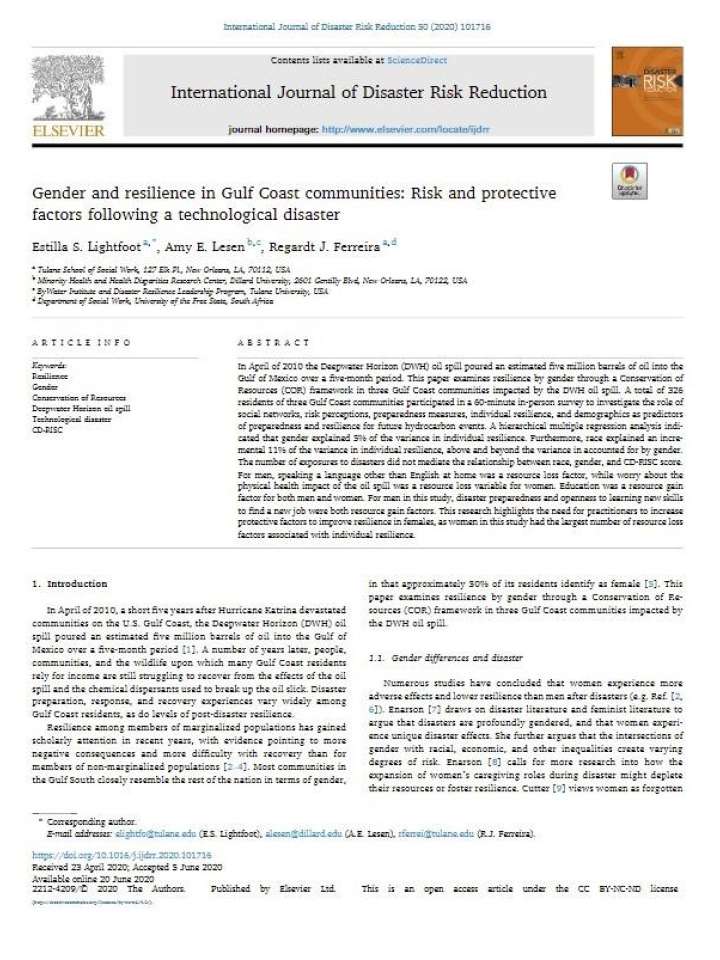
Gender and resilience in Gulf Coast communities: Risk and protective factors following a technological disaster

Source
International Journal of Disaster Risk Reduction (Elsevier)

In April of 2010 the Deepwater Horizon (DWH) oil spill poured an estimated five million barrels of oil into the Gulf of Mexico over a five-month period. This paper examines resilience by gender to investigate the role of social networks, risk perceptions, preparedness measures, individual resilience, and demographics as predictors of preparedness and resilience for future hydrocarbon events.

For men, speaking a language other than English at home was a resource loss factor, while worry about the physical health impact of the oil spill was a resource loss variable for women. Education was a resource gain factor for both men and women. For men in this study, disaster preparedness and openness to learning new skills to find a new job were both resource gain factors. This research highlights the need for practitioners to increase protective factors to improve resilience in females, as women in this study had the largest number of resource loss factors associated with individual resilience.

Download

Access Gender and resilience in Gulf Coast communities: Risk and protective factors following a technological disaster English

Last checked: 16 July 2021

Editors' recommendations

  • Gender lens essential to addressing linked climate change and security crises, urges joint UN report
  • Gender and age inequality in the face of disaster risk
  • OPINION: Environmental disasters widen the gender gap

Explore further

Hazards Technological hazard
Themes Gender Recovery Social impacts and social resilience
Country and region United States of America
ISBN/ISSN/DOI
10.1016/j.ijdrr.2020.101716 (DOI)
Number of pages
9 p.
Publication year
2020

Also featured on

PreventionWeb

Is this page useful?

Yes No
Report an issue on this page

Thank you. If you have 2 minutes, we would benefit from additional feedback (link opens in a new window).

The International Recovery Platform (IRP) is a global partnership working to strengthen knowledge, and share experiences and lessons on building back better in recovery, rehabilitation, and reconstruction.

Latest IRP videos and photos: YouTube Flickr Contact IRP

Loading