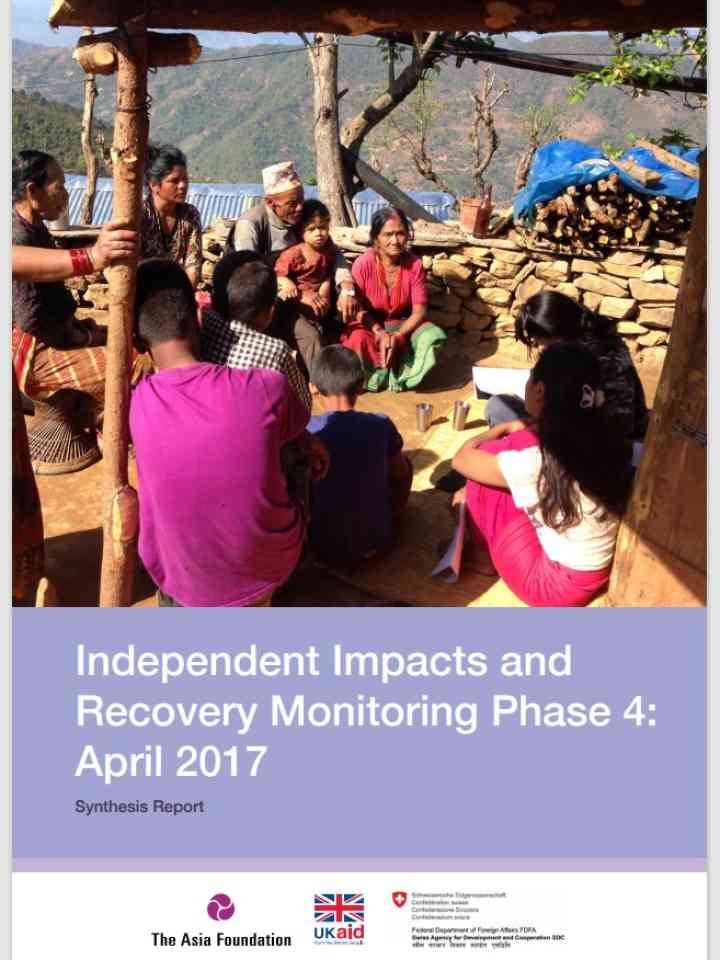
Independent Impacts and Recovery Monitoring Phase 4: April 2017 Synthesis Report
Two years after two powerful earthquakes hit Nepal in April and May 2015, the Independent Impacts and Recovery Monitoring project (IRM) completed its fourth round of research to track how people are recovering, what aid has been provided and how effective it has been, which groups are being left behind, and what coping strategies people have used.
By shedding light on the evolving situation on the ground, the IRM project aims to contribute to effective and sustainable recovery plans. The IRM research is longitudinal, conducted at six-month intervals over the course of nearly two years to track changes over time. IRM utilizes mixed methods research, involving both in-depth qualitative field monitoring and large-scale quantitative surveys. The same locations are revisited for each research round. The first research round was conducted in June 2015, the second in February and March 2016, the third in August and September 2016 and the fourth in April 2017.
This report summarizes findings from the fourth round of the survey as well as the qualitative research conducted in April 2017. For this round, nearly 4,854 respondents were interviewed in 11 earthquake-affected districts, and qualitative research was conducted in 12 VDCs across four districts (Gorkha, Sindhupalchowk, Okhaldhunga and Solukhumbu). The analyses examine changes that have occurred over time, comparing data and findings with those from previous rounds of research. The information in the synthesis report focuses on the reconstruction of houses and infrastructure and the recovery of livelihoods, shelter conditions, the effectiveness of aid and the housing reconstruction cash grant, coping strategies and their effectiveness, and the impacts of the disaster on politics, social cohesion and conflict.
Explore further