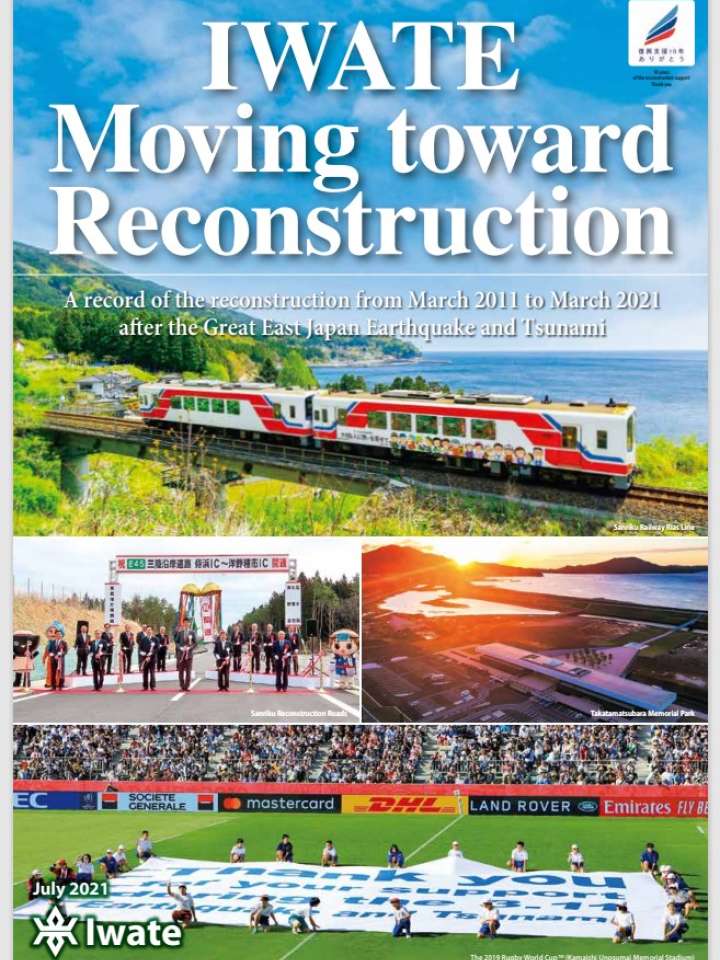
Iwate moving toward reconstruction (Ver.4)
The Great East Japan Earthquake and Tsunami occurred ten years ago on March 11, 2011. As a result, including aftershocks and other disaster-related fatalities mainly in the coastal regions, 5,145 precious lives were lost in Iwate Prefecture. Even to this day, 1,111 people are still missing.
The goal of Iwate Prefecture is “to protect lives while living in harmony with the sea and land, and to create a homeland Iwate and Sanriku.” Under the philosophy of “no one left behind”, which is also shared in the sustainable development goals adopted by the United Nations, they have been making progress in an effort to “Build Back Better.”
Over the past ten years, they have disposed disaster waste and restored damaged prefectural hospitals and public schools; for reconstruction urban development, they have completed surface area maintenance and the construction of disaster public housing. e new reconstruction expressway and coastal protection facilities were built and the reopening of commercial facilities and seafood processing facilities is currently in progress. At the ports and harbors, a gantry crane began operations and the opening of regular container routes has brought economic benefits.
However, there are some remaining challenges to work on, such as the need to develop still-incomplete areas of the social capital as soon as possible, provide mental care for the survivors, support the formation of new communities, tackle the reduced catch rate in the fishing industry, restore sales channels in the commerce industry, and secure human resources.
In February of 2021, Iwate Prefecture enacted an ordinance making March 11 a “Day for Passing on Stories of the Great East Japan Earthquake and Tsunami”. Mainly through the Iwate Tsunami Memorial Museum, Japan's leading hub for learning about the earthquake and tsunami, they strive to share the realities and lessons of the disaster, provide updates on the status of the reconstruction, prevent memories of the disaster from fading, and contribute to the improvement of disaster prevention measures across the world.
In addition, in line with the Iwate Prefecture Citizens’ Plan (2019-2028), in which the basic objective is to create a “Land of Hope, Iwate, where they mutually secure and enhance happiness while tackling the ongoing recovery work based on the experiences of the Great East Japan Earthquake and Tsunami”, they move forward to the next stages of the reconstruction.
Explore further